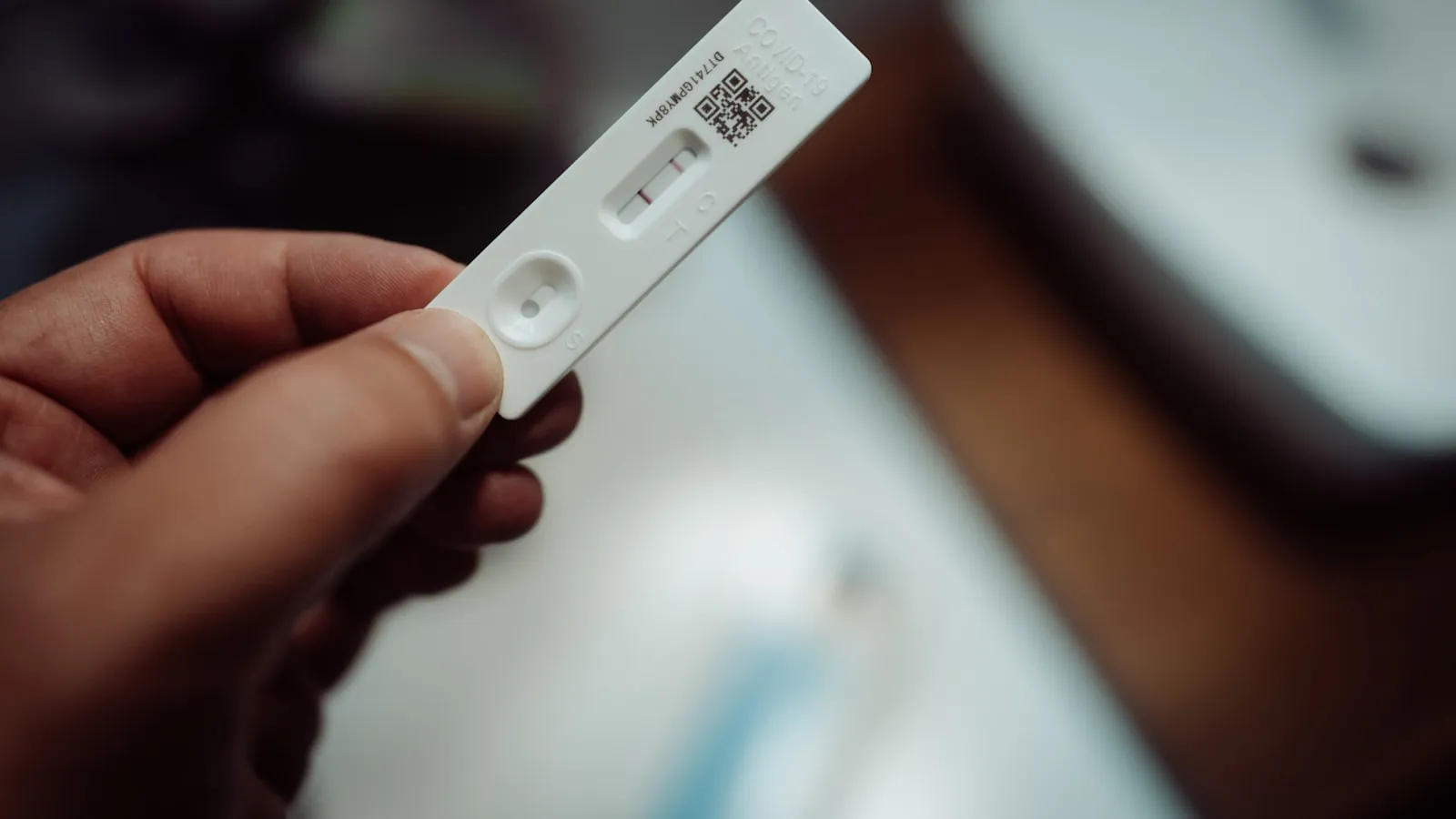
Pregnancy Blood Test
Quantitative HCG blood test for early and accurate pregnancy detection.
The hCG in your blood comes from the pregnancy as it implants, and serum b-hCG becomes measurable roughly eight to eleven days after conception, a few days before most home urine tests turn positive. The blood test also returns a number rather than a line, which means the direction of travel can be followed. At Lunara we rarely read a single result on its own: two measurements taken forty-eight hours apart in the same laboratory say far more than one isolated value. This page explains how quickly hCG rises in the first weeks, what weekly ranges can and cannot tell you, and when your symptoms matter more than the number.
Doctor's Assessment Included
Human chorionic gonadotropin (hCG) is produced by the syncytiotrophoblast, the outer cell layer of the embryo that embeds itself in the lining of the womb. The hormone is built from two protein chains: an alpha subunit that is identical to the one found in LH, FSH and TSH, and a beta subunit that belongs to hCG alone. The laboratory therefore targets that beta chain, so that a high level of another pituitary hormone cannot be counted by mistake. Your result appears as b-hCG, expressed in units per litre.
In serum, b-hCG is usually detectable from about eight to eleven days after conception, a few days earlier than most home urine tests. That is the genuine advantage of a blood measurement, and the only one that really matters: it is earlier, and it is quantitative. A urine test answers yes or no; the blood test answers how much. It is that number which allows two moments in time to be compared.
What the measurement cannot do matters just as much. An hCG value does not reveal where the pregnancy is sitting, and it does not date a pregnancy precisely either, because the ranges quoted per week overlap enormously. Laboratories also calibrate their assays differently, so two results can only be compared fairly when they come from the same laboratory. That is why we include b-hCG in the pregnancy blood test, where a repeat measurement fits naturally.
The question women actually bring us is almost never "what is my number", but "is this going well". One hCG value cannot answer that. Around implantation the level roughly doubles every two days, yet that is a simplification. Below about 1,500 U/L a rise of at least fifty percent over forty-eight hours already counts as a normal increase, and pregnancies that progress perfectly well can fall short of the classic doubling. As the number climbs, the rise flattens: the peak arrives later in the first trimester, after which the level declines again. The shape of the curve therefore says more than any single point on it. Two measurements from one laboratory, forty-eight hours apart, beat the prettiest chart on a forum.
Equally important is what the hormone fundamentally cannot do. hCG says nothing about where the pregnancy is located. In an ectopic pregnancy the value may rise, fall or plateau, and no number rules that possibility out. Location is answered by transvaginal ultrasound. Above the so-called discriminatory zone, roughly 1,500 to 3,500 U/L depending on the centre, a normal intrauterine pregnancy should be visible. If you develop sudden abdominal pain, pain radiating to your shoulder tip, dizziness or fainting, go to emergency care or call your doctor straight away, whatever your last result said. Waiting for another blood draw is the wrong plan in that moment.
Around loss, the trend again helps more than a snapshot. After a miscarriage hCG falls over days to weeks, and a repeat measurement is used to confirm that fall, often before you and your doctor discuss what comes next. During IVF something else applies: an hCG injection given as part of the cycle can still colour a test taken soon afterwards, so the timing of the draw matters. In women in or after the menopause, a low level can originate from the pituitary rather than from a pregnancy, which is harmless but confusing while nobody explains it. Rarely, hCG acts as a tumour marker, in molar pregnancy, choriocarcinoma and germ cell tumours. That is exactly why an unexpected or unexplained result belongs with a doctor rather than with a calculator.
When you draw blood decides how much the answer is worth. Serum b-hCG is usually detectable from eight to eleven days after conception, which in practice lands around the day your period is due. Test earlier and a negative result may simply be too early to mean anything. With an irregular cycle that moment follows your ovulation, not the calendar.
| Situation | When to test | Why that moment |
|---|---|---|
| Trying to conceive, natural cycle | From the day your period is missed | Serum b-hCG becomes detectable about eight to eleven days after conception |
| After IVF or embryo transfer | On the day your clinic specifies, usually nine to fourteen days later | An hCG injection given earlier in the cycle can still affect the result |
| Early pregnancy, uncertainty about progress | Repeat after forty-eight hours | The difference between two values says more than the first number |
| After a miscarriage | As advised by your doctor, often after one to two weeks | The repeat measurement confirms that the level is falling |
| Menopause or an unexpected positive | Always alongside a doctor | A low level can come from the pituitary and then does not indicate pregnancy |
Three habits make the result usable. Book a repeat draw at roughly the same time of day and in the same laboratory, so you are comparing like with like. Record the cycle day or the day of transfer next to the result, because without it no number can be placed. And do not expect weekly figures to date a pregnancy, since the ranges overlap so heavily that ultrasound answers that question rather than the laboratory. If you want to map the cycle itself rather than a pregnancy, other hormones suit that purpose better, such as progesterone or estradiol.
There is nothing you can train or eat your way toward with an hCG result; what you do control is the quality of the comparison. Have any repeat measurement done in the same laboratory, leave roughly forty-eight hours between the two draws, and aim for a similar time of day. Laboratories calibrate differently, and a jump caused by that difference is easily misread as a problem that does not exist.
Always mention what you are taking. An hCG injection given during IVF can still influence an early test, and high-dose biotin supplements can interfere with immunoassays; your doctor or the laboratory can say whether a pause is needed. Beyond that, resist comparing your number with a friend's or with a chart from a forum, however tempting it is: the spread between entirely normal pregnancies is vast, and the comparison almost always buys unnecessary worry.
Finally, allow yourself room during the wait between two results. Those forty-eight hours are heavier for many women than the blood draw itself, and support from a partner, a friend or your midwife is part of the picture rather than a luxury. If you want a broader hormonal view, discuss with your doctor whether further testing is sensible, for instance through the pregnancy blood test. And if pain or bleeding appears, do not sit and wait for the next number.
This marker is included in the following test panels.
Quantitative HCG blood test for early and accurate pregnancy detection.
Prenatal screening commonly included during pregnancy.
b-hCG (Human Chorionic Gonadotropin)
€38,-