
hCG blood test, no referral: your value measured exactly
An hCG blood test measures the pregnancy hormone in your blood. The result is an exact value in IU/L, measurable from 8 to 10 days after conception.
Add to your order
No referral needed
Added to your order
Click the button to view your cart
Included Markers
1 markersb-hCG (Human Chorionic Gonadotropin)
An hCG blood test measures how much pregnancy hormone is in your blood. That hormone, hCG (human chorionic gonadotropin) or beta hCG, is only produced after implantation. In blood it is measurable from about 8 to 10 days after conception, earlier than in urine.
You get a number in IU/L rather than a line, reviewed by a BIG-registered doctor. The blood is drawn at a certified location near you. You order online and no GP referral is needed.
Why an hCG blood test rather than a urine test?
A urine test shows whether the hormone is present. This test measures how much of it is in your blood. That difference is the reason to choose blood.
Blood usually confirms a pregnancy earlier than urine. Fluids you drink dilute urine but not your blood, so the value stays reliable. Did a home test give you a faint line? A number then tells you more than a second home test.
Who is this test for?
This hCG test on blood can be useful in several situations:
You think you may be pregnant and want reliable confirmation.
A urine test was unclear or negative, but you have pregnancy symptoms.
You want to test earlier than a urine test allows.
You want to follow how your values develop in early pregnancy.
You have had a miscarriage or an ectopic pregnancy before and want your values checked.
This is not the standard blood screen your midwife orders early in pregnancy. That screen looks at your blood group, rhesus factor and infections, not at hCG.
What is measured?
This test measures one marker:
b-hCG, in full beta human chorionic gonadotropin: the hormone the placenta produces after implantation.
The result is given in IU/L, international units per litre. If you see mIU/mL somewhere, that is the same number. After implantation the value rises quickly. Later in pregnancy that rise gradually levels off.
Blood test, home test or urine test: the difference
| Self-test (urine or finger prick) | hCG blood test via the laboratory | |
|---|---|---|
| Result | Yes or no | A number in IU/L |
| Who takes the sample | You | A staff member at a draw location |
| Assessment | None | A BIG-registered doctor |
| Following the trend | Not possible | Yes, with a repeat test after 48 to 72 hours |
Pharmacies sell self-tests that read the hormone from urine or a drop of blood. As a first step such a test is fine. Want to know how high the value is, for example to follow its course? Then the laboratory is the route to take.
You do not draw the sample yourself, and here you cannot. A staff member draws your blood at a certified location. The laboratory then determines the value with equipment a home test does not have.
What can the result tell you?
The result gives the amount of hCG in your blood. In a healthy pregnancy that value rises quickly in the first weeks.
What a single hCG value means depends on how far along you are. To see which values are usual per week of pregnancy, use our hCG calculator. More on the hormone itself is on the page about b-hCG.
Buying an hCG blood test: how it works
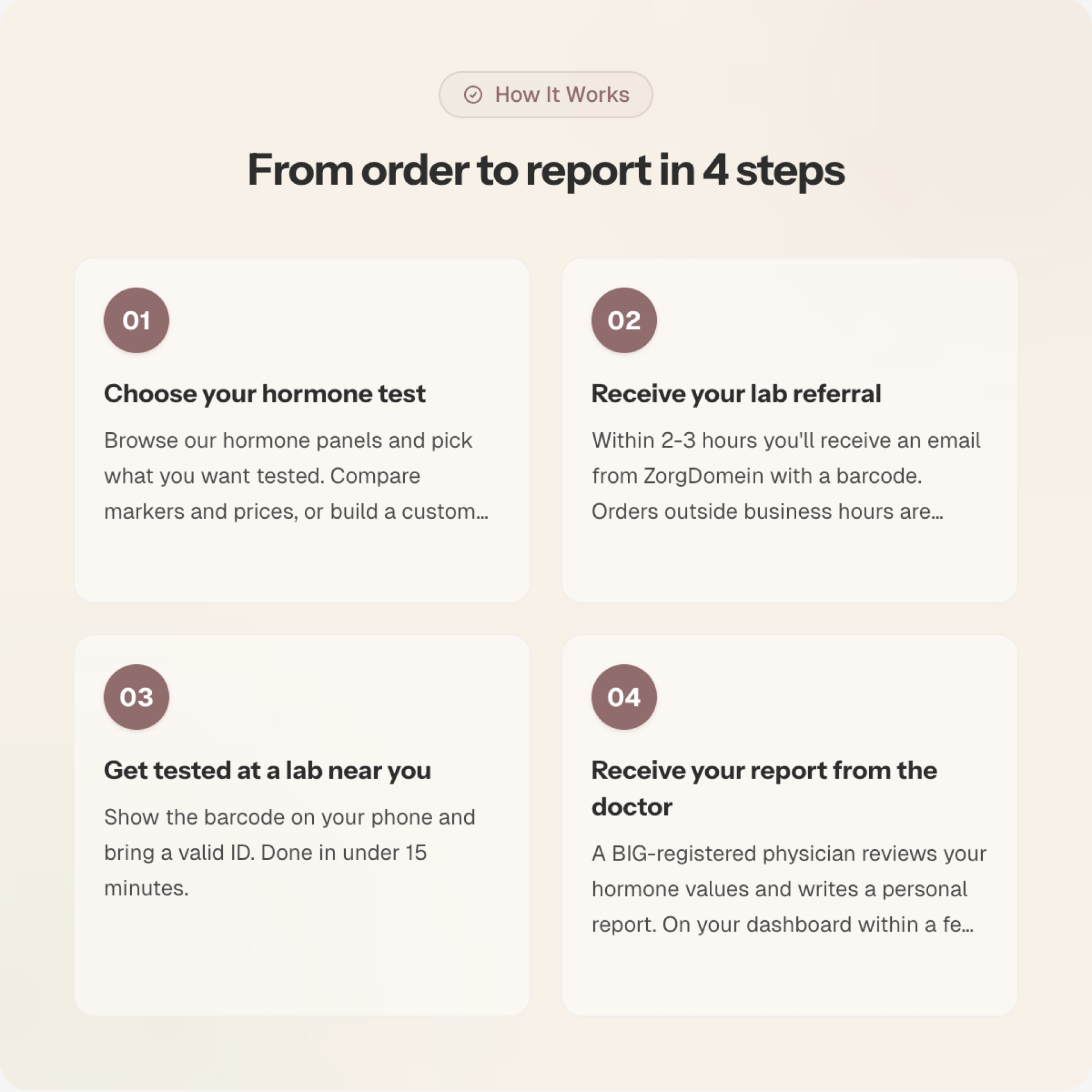
You order the test online, without a referral from your GP.
After your order we arrange your referral through ZorgDomein, usually within one business day. You receive an email with a barcode.
With that barcode you go to a certified draw location near you. Without a BSN there is no barcode: you then print your referral form through the link in the email and bring it to the draw location. You choose the moment; locations without walk-in hours take an appointment.
The draw itself takes a few minutes. You do not need to fast, so you can carry on with your day afterwards.
The laboratory determination takes about 24 hours. Your result is usually in your account within 2 working days of the blood draw; a doctor reviews it and the report follows after that.
How early can you test?
hCG is detectable in blood from 8 to 10 days after conception. That is early enough to establish a pregnancy before a urine test can. If you test very early, the value may still be low. A repeat after a few days then tells you more than a single result.
What does your value mean?
Your result shows the measured value. What fits depends on the number of weeks and varies a great deal between people.
In the first weeks the value doubles every 48 to 72 hours on average. That is an average, not a rule: a slower rise can also belong to a healthy pregnancy. In a healthy pregnancy the value usually rises by at least half in two days. One measurement therefore says little, the course over two days says more.
High results sometimes occur with a multiple pregnancy. Is the result very high? Then dilution of hCG in the laboratory is needed to determine it accurately. A BIG-registered doctor assesses your result before you receive it.
Preparation
No special preparation is needed and you do not have to fast. The sample can be taken at any time of day.
Do you use medication containing hCG, for example during fertility treatment? Mention it, because it can affect your result. A recent miscarriage can also keep the value raised for a while.
What happens after the result?
If the result is positive, contact your GP or midwife. They will discuss the next steps with you, such as a first ultrasound.
Is the value lower than expected or unclear? Then a repeat test after 48 to 72 hours is often the next step. The doctor who reviews your result says so in your report.
The information on this page is general information and does not replace professional medical advice. Always discuss your results with your GP or midwife.
Frequently Asked Questions
From about 8 to 10 days after conception. That is earlier than most urine tests. Those only become reliable around the day your period would start. If you test very early, repeating after a few days can give more clarity.
A blood test measures the exact amount of the hormone. A urine test only shows whether it is present. That means blood can confirm a pregnancy earlier. It also gives more to go on when a result is unclear.
That depends on how far along you are; the ranges per week are very wide. Under 5 IU/L most laboratories read as not pregnant, from 25 IU/L as pregnant. In between it is often simply too early, and a repeat test after two days says more. Laboratories set those limits themselves; the doctor therefore weighs your value against your week of pregnancy.
Not for this test. A staff member draws your blood at a certified location, and a laboratory then determines the value. You can measure yourself with a self-test from the pharmacy. That only gives a yes or no, not a number.
The laboratory determination takes about 24 hours. Your result is usually in your account within 2 working days of the blood draw; a doctor reviews it and the report follows after that. The exact turnaround can vary per laboratory.
Yes. You order the test online and we arrange your referral through ZorgDomein, usually within one business day. With the barcode from that email you go to a certified location near you. Locations without walk-in hours take an appointment. A referral from your GP is not needed.
Yes. A GP or midwife can have hCG measured in blood when there is a medical reason. Want to know your value yourself? Then you order this test online without a referral. You choose the location yourself.
Yes. After a miscarriage or a birth the hormone stays measurable for a while. Medication containing hCG, such as in fertility treatment, also raises the value. Rarely, a raised value has another cause. That is why a doctor assesses an unexpected result and advises follow-up where needed.
A test from the shop tells you whether you are pregnant. This test also tells you how high your value is. That helps if you want to follow its course, or if an earlier test was unclear.
It depends on the markers; each test shows whether fasting is needed. If it is, eat nothing after 22:00 the evening before and drink only water, for at least 8 hours. Skip coffee and tea that morning and have blood taken before 10:00.
You pay €74,-. The blood draw is already included, so nothing is added.
No, a test you request yourself is not part of the basic Dutch insurance. You pay it yourself, and your deductible (eigen risico) stays untouched.
Count on one business day, a day longer for an order after 17:00 or at the weekend: by then the referral email has arrived, and you cannot go before it does. Some draw sites then take walk-ins and the rest work by appointment. Each location says which.
Your barcode from the ZorgDomein email and a valid ID. Showing the barcode on your phone is fine. Without a BSN you get no barcode; print the referral form from the link in the email instead.
Yes, unless your own doctor said otherwise. Some markers ask for extra preparation, such as no alcohol for 24 hours or no heavy training for 48 hours. You see this on the test and in the instructions after you order.
You show your barcode and your ID at the draw site, and then your blood is taken. Allow about a quarter of an hour.
Yes, a BIG-registered doctor assesses every result and explains your values in your account. If you want treatment, discuss the result with your GP.
In one of the independent, certified laboratories across the Netherlands that Lunarahealth works with. They also run the draw sites, which Lunarahealth does not own. Reference values can differ a little between labs.
No, your test bypasses your GP and does not end up in your medical record. Data goes to a healthcare provider only with your written consent, and it is never sold. Anonymous is not possible: a valid result needs your name, date of birth and ID.
What We Test
| No. | Biomarker | Unit |
|---|---|---|
| 01 | b-hCG (Human Chorionic Gonadotropin) | U/L |
| Your results are usually in your Lunarahealth account within 2 working days of the blood draw. | ||
Preparation
-
Better pause biotin
RecommendedBiotin from supplements can interfere with this measurement. Skip the supplement 72 hours before the draw if you can.
- Water is always fine. Drink as usual beforehand, it makes the draw easier.
- Take your usual medication, unless your own doctor told you otherwise.
You Might Also Like
Fertility Assessment
Ovarian reserve panel with AMH, FSH, LH, and Estradiol.
IVF Blood Test Complete (Women)
Everything in the IVF panel plus full thyroid, preconception nutrients, progesterone and CMV immunity.
IVF Blood Test (Women)
Complete female IVF intake panel: ovarian reserve, thyroid, infectious screening, immunity serology, blood group and CBC.