Early menopause test: FSH, estradiol and your thyroid
FSH and estradiol when early menopause is suspected, plus TSH and free T4 for your thyroid.
Add to your order
No referral needed
Added to your order
Click the button to view your cart
Included Markers
4 markersTSH (Thyroid Stimulating Hormone), Free T4 (Thyroxine), FSH (Follicle Stimulating Hormone), Estradiol (E2)
An early menopause test measures FSH and estradiol, the two hormones that are measured when early menopause before the age of 40 is suspected. The test also measures TSH and free T4, because a thyroid that works too slowly or too fast can cause complaints that look like the menopause.
If you are 40 or older, your GP recognises the menopause from your complaints and your cycle. FSH and estradiol are usually not measured for this, because in those years they swing so much that one result says little. For you, the thyroid measurement is the useful part.
What is early menopause?
In early menopause your ovaries work less or stop working before you are 40. Your periods become irregular or stop, and you can get the complaints that come with the menopause, such as hot flushes and night sweats. Doctors also call this premature ovarian insufficiency, or POI.
Early menopause is uncommon: about 1 in 100 women has her last period before 40. On average, women in the Netherlands reach the menopause at 50 or 51. A menopause between 40 and 45 is called relatively early, but it does not count as early menopause.
Which complaints can come with it is in our article on the symptoms of early menopause.
Can you test whether you are in the menopause?
The answer depends on your age. From 40, the menopause is recognised from your complaints and your cycle, once other causes have been ruled out. A blood test cannot settle it. Your FSH swings so much in the years before your last period that a normal result does not rule the menopause out.
If you are under 40 and your periods stop or become irregular, a blood test is part of the investigation. A raised FSH with a low estradiol then fits early menopause. One measurement is not enough for that diagnosis: a doctor repeats it after 4 to 6 weeks.
If you first want to list the complaints you have, take the free menopause check. It is a set of questions about your complaints, with no blood draw.
What does this test measure?
The test measures four values in your blood.
- FSH (follicle-stimulating hormone) comes from your pituitary, a gland under your brain. It tells your ovaries to ripen eggs and make oestrogen. When your ovaries respond less well, your pituitary makes more FSH. A high FSH therefore means your body has to work harder to get your ovaries going.
- Estradiol is the main form of oestrogen, the female sex hormone your ovaries make. It changes over your cycle and falls as your ovaries start to work less.
- TSH (thyroid-stimulating hormone) is the signal your pituitary uses to drive your thyroid. If your thyroid works too slowly, your TSH rises. If it works too fast, your TSH falls.
- Free T4 is the thyroid hormone that circulates freely in your blood and that your body can use straight away. Together with TSH it shows whether your thyroid works too slowly or too fast.
Thyroid or menopause?
A thyroid that does not work properly causes complaints that are hard to recognise and can look like the menopause. If your thyroid works too fast, you can lose weight while eating normally, and get palpitations, shaky hands, restlessness, heavy sweating and trouble with heat. If it works too slowly, you can gain weight, feel cold easily, feel tired and slow, and become constipated.
That is why a GP measures your TSH when needed if you have menopausal complaints. If you only want your thyroid measured, the thyroid function test fits. If you also want your iron, vitamin B12 and vitamin D measured, look at the tiredness panel.
Who is this test for?
- You are under 40, and your periods have stopped or come irregularly.
- You have complaints that look like the menopause and you want to know whether your thyroid plays a part.
If your periods have stopped, the first question is whether you are pregnant. If you are unsure, a pregnancy blood test or a pregnancy test from the pharmacy answers that first.
Do you use the pill, a hormonal IUD or other hormones? They can mask your cycle and your menopausal complaints, and they can change your FSH and estradiol. Keep that in mind when you read your result.
What does your result mean?
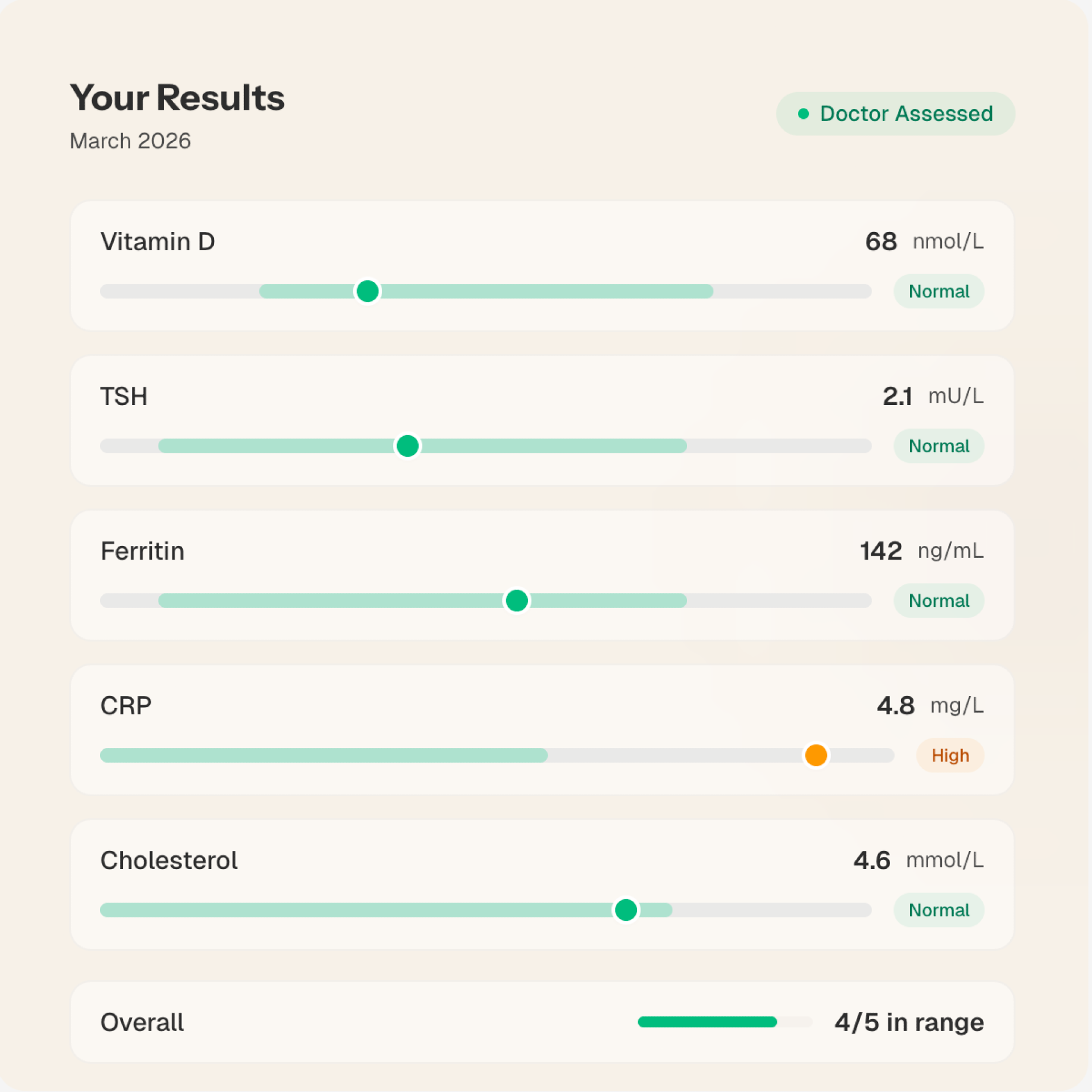
You see each value with its unit and the laboratory's reference range. Those ranges differ between laboratories, and FSH and estradiol also change over your cycle. A BIG-registered doctor assesses your result.
A raised FSH with a low estradiol fits ovaries that are working less. If you are under 40, discuss the result with your GP. Your GP repeats the measurement and refers you if needed so the cause can be investigated. If you are 40 or older, a normal FSH does not rule out the menopause.
An abnormal TSH or free T4 can point to a thyroid that works too slowly or too fast. You discuss that result with your GP as well.
How does the blood draw work?
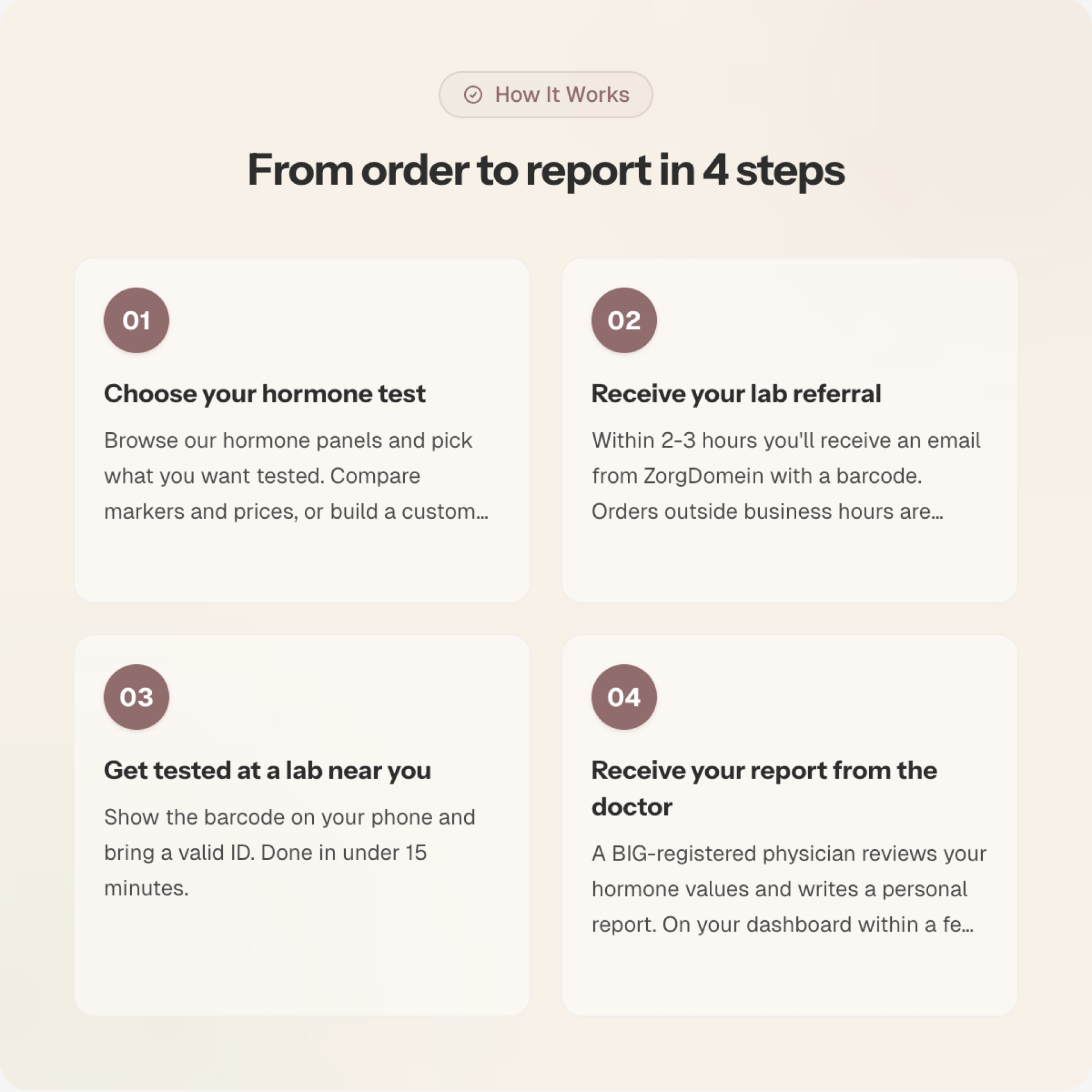
After your order we arrange your referral through ZorgDomein, which takes one business day. Orders placed in the evening or at the weekend start on the next business day. The ZorgDomein email carries a barcode, which you show on your phone at the draw location. Without a BSN there is no barcode: you then print your referral form through the link in the email and bring it to the draw location.
You choose a draw location near you. Many have walk-in hours, others take an appointment. You do not need to fast for this test.
When is your result ready?
Our indicative planning, counted from the draw, is about 48 hours for FSH, estradiol and TSH, and about 96 hours for free T4. A doctor then assesses your result and you can see it online.
Frequently Asked Questions
From 40, the menopause is recognised from your complaints and your cycle, without a blood test. Under 40, measuring FSH and estradiol is part of the investigation into early menopause, and the measurement is repeated after 4 to 6 weeks.
Your periods become irregular or stop before 40, often with complaints such as hot flushes or night sweats. Your GP then has your FSH and estradiol measured. A raised FSH with a low estradiol, measured twice with 4 to 6 weeks in between, fits early menopause.
A self-test from the pharmacy measures FSH in your urine and only shows whether it is raised at that moment. Because FSH swings a lot in the years before your last period, a negative result does not rule out the menopause, and a positive result does not prove it. The same holds for an FSH measurement in your blood.
It is uncommon: about 1 in 100 women has her last period before 40. If your periods stop at 35, discuss it with your GP, even if you think it is the menopause.
A thyroid that works too slowly or too fast can cause complaints that look like the menopause, such as tiredness, heavy sweating, palpitations and restlessness. TSH and free T4 show whether your thyroid plays a part.
No. You do not need to fast for FSH, estradiol, TSH or free T4.
No. After your order we arrange the referral through ZorgDomein, which takes one business day. You take the barcode from that email to the draw location. Without a BSN you bring the printed referral form instead.
You pay €109,-. The blood draw is already included, so nothing is added.
No, a test you request yourself is not part of the basic Dutch insurance. You pay it yourself, and your deductible (eigen risico) stays untouched.
Count on one business day, a day longer for an order after 17:00 or at the weekend: by then the referral email has arrived, and you cannot go before it does. Some draw sites then take walk-ins and the rest work by appointment. Each location says which.
Your barcode from the ZorgDomein email and a valid ID. Showing the barcode on your phone is fine. Without a BSN you get no barcode; print the referral form from the link in the email instead.
Yes, unless your own doctor said otherwise. Some markers ask for extra preparation, such as no alcohol for 24 hours or no heavy training for 48 hours. You see this on the test and in the instructions after you order.
You show your barcode and your ID at the draw site, and then your blood is taken. Allow about a quarter of an hour.
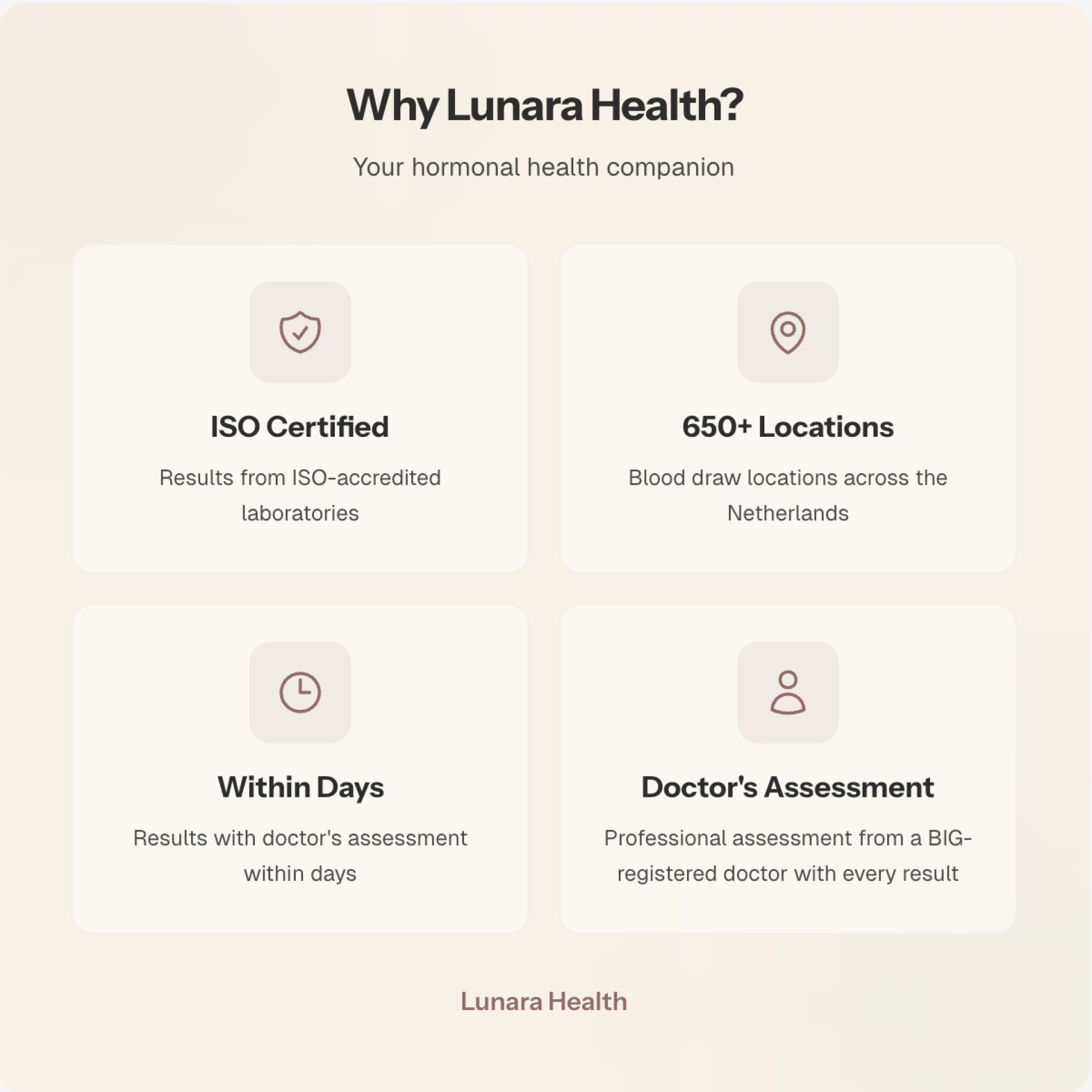
Yes, a BIG-registered doctor assesses every result and explains your values in your account. If you want treatment, discuss the result with your GP.
In one of the independent, certified laboratories across the Netherlands that Lunarahealth works with. They also run the draw sites, which Lunarahealth does not own. Reference values can differ a little between labs.
No, your test bypasses your GP and does not end up in your medical record. Data goes to a healthcare provider only with your written consent, and it is never sold. Anonymous is not possible: a valid result needs your name, date of birth and ID.
What We Test
| No. | Biomarker | Unit |
|---|---|---|
| 01 | TSH (Thyroid Stimulating Hormone) | mu/l |
| 02 | Free T4 (Thyroxine) | pmol/l |
| 03 | FSH (Follicle Stimulating Hormone) | U/L |
| 04 | Estradiol (E2) | pmol/l |
| Your results are usually in your Lunarahealth account within 2 working days of the blood draw. The laboratory states a longer turnaround for Free T4 (Thyroxine). | ||
Preparation
-
Pause biotin
RequiredDo you take a supplement with biotin (vitamin B8, common in hair, skin and nail supplements)? Stop it 72 hours before the draw. Biotin interferes with the measurement of these values.
-
Timing worth knowing
Good to knowIf you repeat this test, pick the same time of day each time so the results compare.
-
On levothyroxine? Worth knowing
Good to knowTell the staff at the draw when you took your tablet; for most values the timing makes no difference.
-
Do you have a cycle? Pick the right day
RequiredIf you have a menstrual cycle, count the first day of your period as day 1 and have the draw on day 2 to 5. On hormonal contraception, or without a cycle, any day works.
- Water is always fine. Drink as usual beforehand, it makes the draw easier.
- Take your usual medication, unless your own doctor told you otherwise.
Extend this panel
Same draw, no second appointment.
You Might Also Like
Estradiol Test
An estrogen test with one blood value: estradiol (E2), the main form of estrogen. No referral needed.
PCOS Screening
Screening covering key markers associated with PCOS.
Hormones Women
A hormone test for women measures FSH, LH, estradiol, progesterone and prolactin. Together these five values make a hormonal imbalance visible.