Get your AMH tested and check your ovarian reserve
Measure your AMH for insight into your ovarian reserve. No referral needed, results within a few working days.
Add to your order
No referral needed
Added to your order
Click the button to view your cart
Included Markers
1 markersFertility often raises questions: how much time do I have, and what does my ovarian reserve look like? These questions are completely understandable, and you do not have to sit with them on your own.
AMH (Anti-Müllerian Hormone) is a hormone that can say something about your ovarian reserve. Measuring it gives you a factual starting point to build on.
Why this test?
Around fertility and family planning, it helps to have something tangible in hand. An AMH blood test can give you a first reference point about your egg supply.
AMH is produced by the small, growing follicles in your ovaries. Its level can therefore give an impression of your ovarian reserve, that is, the number of egg cells you have left.
Who is this test for?
This test can be useful if you are thinking about your fertility, now or in the future. Think of women with a wish to conceive, those exploring their options, or simply those curious about their ovarian reserve.
AMH is also often measured around IVF or before freezing eggs. If you want your AMH tested, that can be done on any day of your cycle.
What is tested?
This test measures one hormone in your blood:
- AMH (Anti-Müllerian Hormone): produced by the small growing follicles in your ovaries and seen as an indication of your ovarian reserve (the number of remaining egg cells).
Because AMH stays relatively stable throughout your cycle, you do not need to account for a specific cycle day.
What can this test tell you?
Your AMH value can give an impression of the size of your egg supply. A higher value may point to a larger reserve, while a lower value can fit with a reduced ovarian reserve.
Good to know: AMH says something about the quantity of egg cells, not about their quality. On its own, it also cannot predict a natural pregnancy.
How is the sample collected?
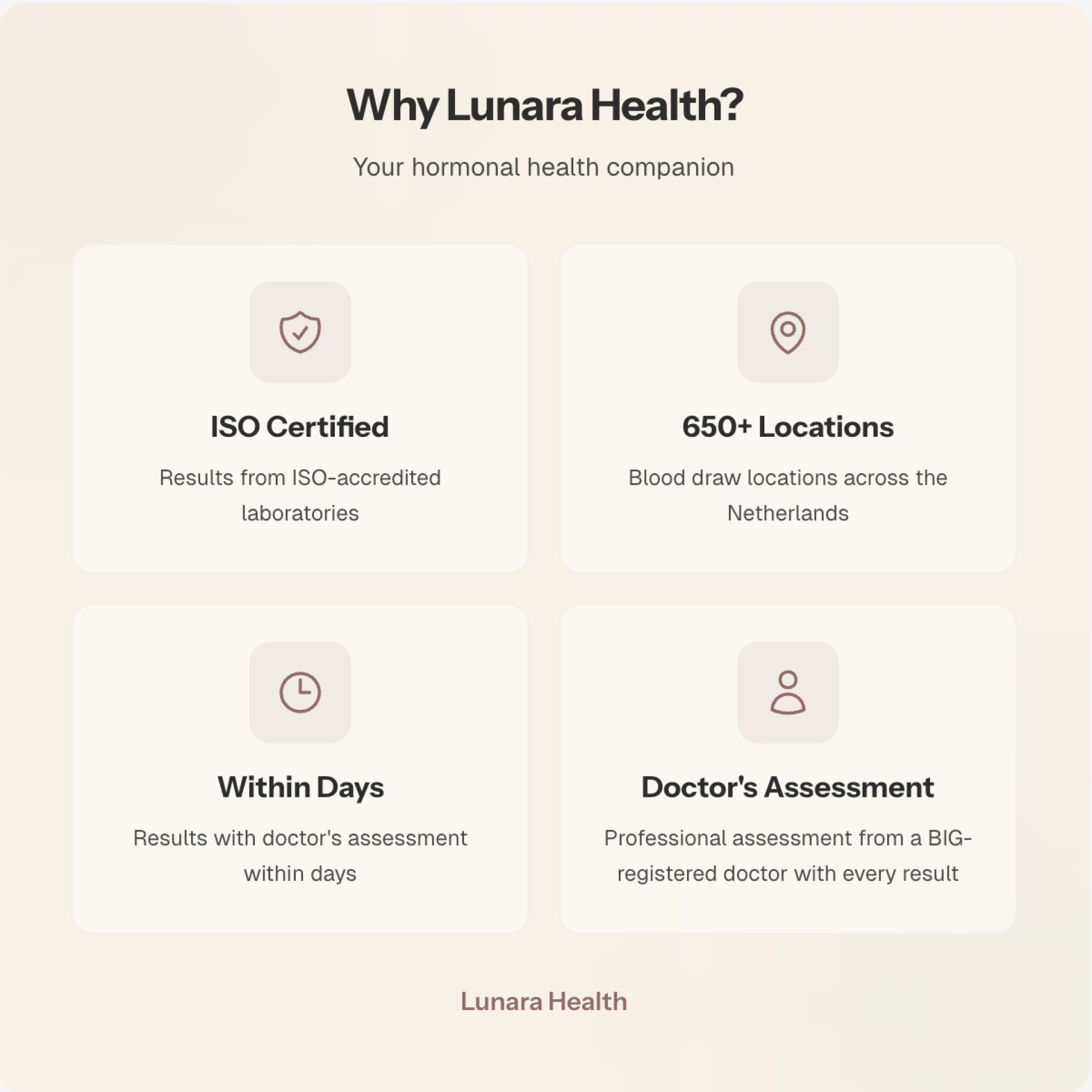
This test requires a small blood draw at a certified sample point. In the Netherlands you can choose from more than 750 locations.
After ordering, you pick a location near you and schedule a moment that suits you. You do not need a referral from your GP.
When is this test useful?
Testing AMH can be valuable at different moments, for example:
- when you are planning a wish to conceive or want to know how much time you may still have
- around an IVF pathway, where your AMH value can help doctors fine-tune the dosage
- when considering freezing your eggs
- when there are questions about PCOS, where AMH can sometimes be higher than average
Because AMH gradually declines with age, an AMH value is assessed in relation to your age.
What do the results mean?
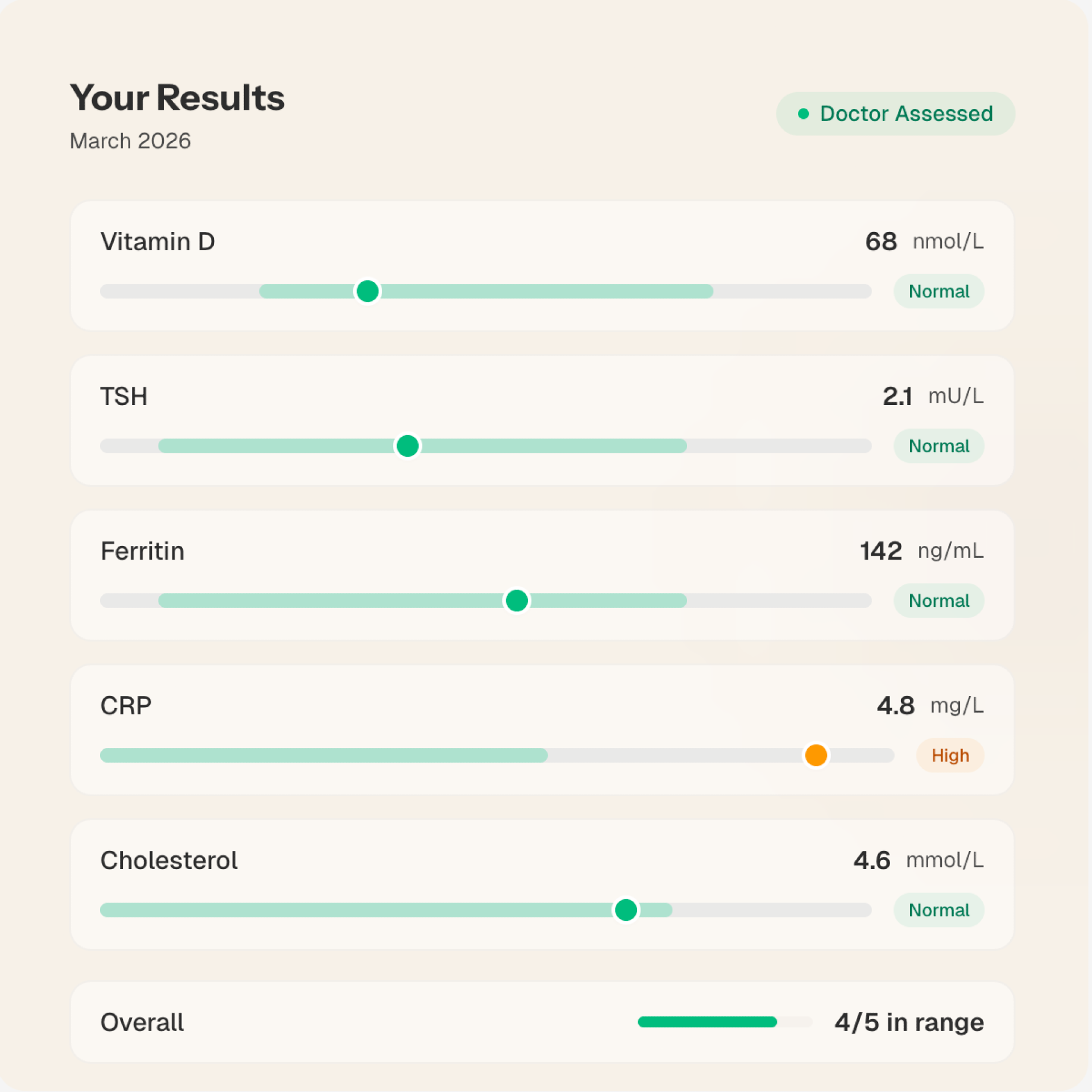
Your result shows your AMH value together with a reference range and a short explanation. What counts as usual varies by laboratory and depends, among other things, on your age.
A value below or above the range can mean different things. A lower value sometimes fits with a reduced egg supply, while a higher value can occur with PCOS, for instance. The doctor helps you place this value in the right context.
Preparation
For an AMH test you do not need to fast, and no special preparation is required. You can have blood drawn on any day of your cycle, which makes planning a lot easier.
What happens after the results?
Your result is usually available online within a few working days. Each value is shown clearly with a reference range and an explanation, so you understand what you see.
Every blood test result includes a professional assessment from a BIG-registered doctor. For treatment decisions, discuss your results with your GP.
Frequently Asked Questions
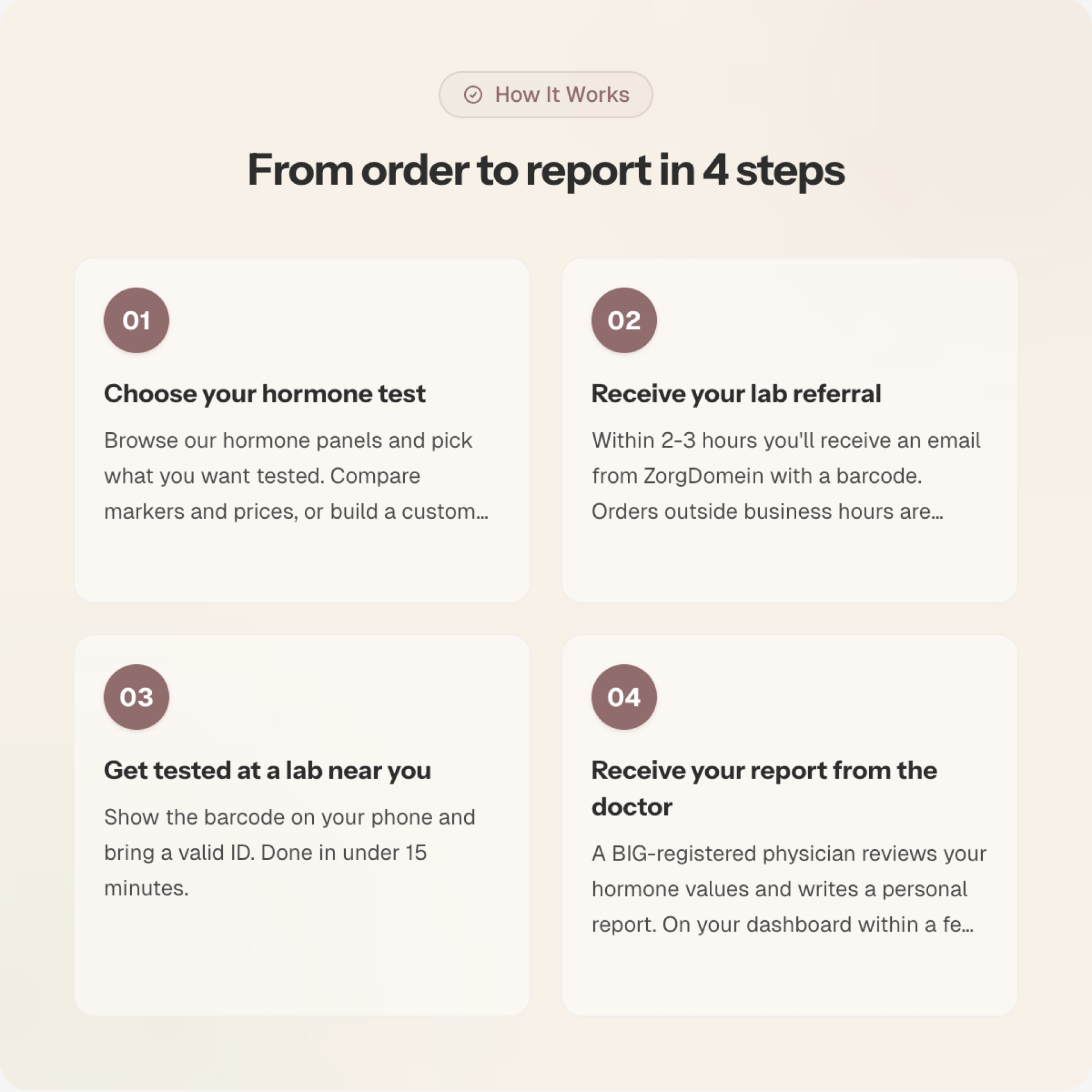
From order to report in 4 steps
A hormone test without referral: test when you want, not only when symptoms are severe. No waiting list, just order and go.
Choose your hormone test
Browse our hormone panels and pick what you want tested. Compare markers and prices, or build a custom test.
Receive your lab referral
On the same business day you'll receive an email from ZorgDomein with a barcode. Orders outside business hours are processed the next business day.
Get tested at a lab near you
Show the barcode on your phone and bring a valid ID. Done in under 15 minutes.
Receive your report from the doctor
A BIG-registered physician reviews your hormone values and writes a personal report. On your dashboard within a few business days.
Choose your hormone test
Browse our hormone panels and pick what you want tested. Compare markers and prices, or build a custom test.
Receive your lab referral
On the same business day you'll receive an email from ZorgDomein with a barcode. Orders outside business hours are processed the next business day.
Get tested at a lab near you
Show the barcode on your phone and bring a valid ID. Done in under 15 minutes.
Receive your report from the doctor
A BIG-registered physician reviews your hormone values and writes a personal report. On your dashboard within a few business days.
Always a location near you
With more than 700+ certified phlebotomy points across the Netherlands.
What We Test
This test includes 1 biomarkers to give you a comprehensive health picture.
AMH (Anti-Müllerian Hormone) is made by the granulosa cells around the small, growing follicles in the ovary. The more of those follicles still waiting in the queue, the higher the value. That is why AMH is used as a measure of ovarian reserve: the size of the remaining egg supply. Unlike FSH and LH, AMH is not driven by the pituitary. The value therefore barely fluctuates within a cycle and can be drawn on any cycle day, without you having to fast. AMH estimates a number, not a quality. It predicts well how the ovaries respond to hormonal stimulation, but says little about the chance of conceiving naturally. It is not a fertility score.
Learn moreAMH (Anti-Müllerian Hormone)
HormonesAMH (Anti-Müllerian Hormone) is made by the granulosa cells around the small, growing follicles in the ovary. The more of those follicles still waiting in the queue, the higher the value. That is why AMH is used as a measure of ovarian reserve: the size of the remaining egg supply. Unlike FSH and LH, AMH is not driven by the pituitary. The value therefore barely fluctuates within a cycle and can be drawn on any cycle day, without you having to fast. AMH estimates a number, not a quality. It predicts well how the ovaries respond to hormonal stimulation, but says little about the chance of conceiving naturally. It is not a fertility score.
AMH is currently the most widely used blood value for estimating ovarian reserve, but it is frequently over-interpreted. It matters to know what AMH does and does not predict. What AMH is good at: predicting how the ovaries respond to hormonal stimulation. In an IVF pathway the doctor uses the AMH value to estimate how many eggs will mature under stimulation and to choose the hormone dose. A low value makes a modest yield more likely; a high value raises the chance of an over-response and of ovarian hyperstimulation syndrome. In that domain AMH is genuinely clinically useful. What AMH is not good at: predicting a spontaneous pregnancy. In women without a fertility problem, a low AMH is not reliably associated with a lower chance of conceiving within a year. Research among women who had only just started trying showed that a low AMH barely reduced the chance of conception within six to twelve cycles. AMH is therefore not a fertility score and not a countdown clock. A low value fits a diminished ovarian reserve and can be a reason to think earlier, together with a doctor, about family planning or about freezing eggs. A strongly raised value fits a large number of small follicles and is common in polycystic ovary syndrome. Finally, take the assay into account. AMH tests are not internationally standardised, so different laboratories can report different absolute numbers for the same blood. A change over time within one laboratory therefore says more than a comparison between two laboratories.
Related biomarkers
Biomarkers often explored alongside this test for a fuller picture.
17-OH Progesterone
17-OH Progesterone is a steroid hormone that plays an important role in your hormonal balance. It serves as a building block for cortisol and androgens, and its levels may fluctuate throughout your menstrual cycle.
ACTH (Adrenocorticotropic Hormone)
ACTH is a hormone from the pituitary gland that tells your adrenal glands to produce cortisol. Understanding your ACTH levels may offer insights into how your body manages stress and supports your hormonal well-being.
Androstenedione
Androstenedione is a hormone your body uses to produce both estrogen and testosterone. Understanding your levels may help provide insight into hormonal balance, cycle health, and conditions that could affect your well-being.
Calcitonin
Calcitonin is a thyroid hormone involved in calcium regulation and bone health. For women, understanding calcitonin levels may offer insights into thyroid function and mineral balance, which are important throughout different life stages.
Cortisol
Cortisol plays an important role in women's hormonal balance. Chronic stress may disrupt menstrual cycles, affect fertility, and influence mood. Monitoring supports a comprehensive hormonal health picture.
DHEA-S
DHEA-S serves as a precursor to oestrogen and testosterone in women. Monitoring supports understanding of adrenal health, hormonal balance, and age-related changes.
You Might Also Like
Explore more tests for your hormonal health journey.
FSH Test
Measure your FSH for insight into ovarian reserve and (peri)menopause. No referral needed, results within a few working days.
IVF Blood Test Complete (Women)
Everything in the IVF panel plus full thyroid, preconception nutrients, progesterone and CMV immunity.
Fertility Assessment
Ovarian reserve panel with AMH, FSH, LH, and Estradiol.
This test not quite right?
Build your own blood test from 185+ individual biomarkers — choose exactly what you need.
Have a question?
Our team is happy to help. Ask your question and we'll respond as soon as possible.