Extended cortisol: the adrenal panel we do not sell
An extended adrenal panel with ACTH and DHEA-S. We deliberately do not sell this. Read why.
We do not sell this test
We deliberately do not sell this panel. The combination of cortisol, ACTH and DHEA-S is the panel sold to demonstrate "adrenal fatigue", a condition that does not exist. Measuring more values also makes things worse: in Dutch research on unexplained fatigue, the share of false-positive results rose from 22% to 55.5% when the panel was expanded. We would rather earn nothing from you than sell you a false alarm.
You cannot order this test here
We do not sell this test, because we do not believe it answers your question. If you recognise the symptoms below, discuss them with your GP.
Included Markers
3 markersAn "extended cortisol panel" or "adrenal panel" usually consists of cortisol, ACTH and DHEA-S. We could easily measure all three; our lab runs them. Even so, you cannot get this panel from us, and that is a deliberate choice.
For the single cortisol test we make an exception, because a doctor sometimes asks for it. For this panel, that exception does not exist. There is no situation in which it makes sense for you to request it yourself. And there is one reason that weighs especially heavily for women: if you use the pill, are pregnant, or sleep badly through perimenopause, there is a good chance these results simply cannot be interpreted.
Why this panel in particular
The combination of cortisol + ACTH + DHEA-S is not a coincidence. It is very nearly the exact panel sold under names like "adrenal stress index" to demonstrate "adrenal fatigue".
That condition does not exist. The term was coined in 1998 by a chiropractor. A 2016 systematic review searched 3,470 publications, kept 58, and found no substantiation at all. In most fatigued participants, the cortisol measurements were simply normal. The Endocrine Society: no scientific proof exists, and there is no test that can detect it.
The international guideline is also explicit about ACTH. The same sentence that advises against a random cortisol measurement also advises against a random ACTH measurement. ACTH belongs in the story only after a doctor has established, by the proper route, that something is genuinely wrong with your cortisol. As a standalone value, without that history, it cannot be interpreted.
And what about the DUTCH test? It comes up almost the moment you start reading about this, because the DUTCH test (Dried Urine Test for Comprehensive Hormones) is marketed squarely at women, usually with cortisol and "hormone balance" as the hook. Honestly, here is what we know: every published validation study of the DUTCH test was authored and funded by Precision Analytical Inc., the company that sells the test. The competing-interests declaration on those papers lists Mark Newman as founder, president and owner of that company. On top of that, those studies examine one thing only: analytical agreement, that is, whether dried urine gives roughly the same number as liquid urine. Nowhere do they examine whether the result diagnoses anything. No independent clinical validation exists. So nobody has shown you can base a decision on it, which is precisely what you would want to know about a test.
In women, this panel often cannot be read at all
Start with the basics, because they settle everything. Cortisol fluctuates enormously, even in healthy people doing nothing unusual. The reference change value tells you how much a value must change before you can say with 95% confidence that something genuinely changed. For cortisol in blood, that is around 47%; for salivary cortisol it runs from 96% to 245%. So your cortisol has to roughly double before anyone can establish that anything changed at all. Everything below that is noise.
And in your case, something else comes on top. Cortisol does not float around freely in your blood: most of it is stuck to a carrier protein, cortisol-binding globulin (CBG). Only the small, free fraction actually does anything. A blood test measures total cortisol, bound plus free together.
Oestrogen you swallow, as in the combined pill and in some tablet forms of hormone therapy, prompts your liver to make more CBG. More carrier protein means more bound cortisol and therefore a higher total, while the free, active cortisol barely changes. The number goes up, the hormone that does the work does not. Nothing is wrong with you; something is wrong with what the test measures.
That effect is large. The Endocrine Society guideline states that "false-positive rates for the overnight DST are seen in 50% of women taking the oral contraceptive pill". In a small Dutch study (Vastbinder, 2016), cortisol failed to suppress on that test in eight of thirteen healthy volunteers on the pill, just over 61%. Healthy women. A test that said "abnormal".
The guideline therefore advises withdrawing oestrogen roughly six weeks before testing. Read that carefully: that is a decision for you and your doctor together. We will never advise you to stop your contraception in order to get a tidier number; that is not a webshop's call. We tell you so you understand why we are not pushing this panel on you.
Pregnancy is a different matter: there, cortisol genuinely does rise. Urinary free cortisol excretion can run up to three times higher towards term, overlapping the values seen in genuine Cushing's syndrome. Outside specialist care, such a result cannot be judged. DHEA-S is also influenced by hormonal contraception. So in a woman on the pill, two of the three values in this panel are distorted, and the third (ACTH) is meaningless without the rest anyway.
Measuring more makes it worse, and then there is the arithmetic
It sounds logical: if one value is uncertain, measure three. But that is not how it works, and the numbers are unambiguous.
Reference ranges are usually set so that the middle 95% of healthy people fall inside them. That means every single test has roughly a 5% chance of an "abnormal" result in a healthy person that means nothing. With five tests, that chance rises to about 23%. The Dutch primary-care guideline does this arithmetic itself, and concludes that for vague complaints you should order as little as possible.
This is not theory. A Dutch randomised trial in people with unexplained fatigue compared a short blood panel with an expanded one:
- short panel: 6.4% genuine findings, 22.0% false positives
- expanded panel: 7.5% genuine findings, 55.5% false positives
You buy 1.1 percentage points more truth at the price of 33.5 percentage points more false alarms. The panel is not neutral: it actively makes your situation less clear.
Then the arithmetic that settles it. The diseases this panel would be looking for are extraordinarily rare. Cushing's syndrome occurs in European population studies in around 2 to 3 people per million per year. Addison's disease in around 100 to 140 per million. Work that through for someone without the specific signs a doctor looks for, and the outcome is merciless: of all "abnormal" results in such a group, the overwhelming majority are false alarms. Not a few. Almost all of them. And in women on the pill, that chance of a false alarm is larger still, for exactly the reason above.
A false alarm is not free. An abnormal cortisol result often leads to imaging of the adrenal glands. In roughly 3% of people over 50, rising to 10% over 80, that incidentally reveals a benign nodule on the adrenal gland that has nothing to do with anything. Which then has to be investigated. That is how a cascade of tests, worry and cost begins, starting from a test you never needed to take.
One more thing worth knowing: research shows that testing when the chance of disease is low does not reassure you either. The worry and the symptoms persist; the test changes little. "Let us just measure it to be sure" does not, in practice, deliver that certainty.
What we recommend instead
If you came here because of fatigue, poor sleep, weight gain or feeling burned out, this is the honest answer.
For persistent fatigue, the Dutch primary-care guideline starts with a short list, and the shortness is precisely the point:
- Haemoglobin, and if abnormal your iron stores via ferritin. In menstruating women, an iron store drained by heavy bleeding is one of the most frequently missed explanations for fatigue
- CRP, an inflammatory marker
- Fasting glucose
- TSH, your thyroid. Thyroid disorders are far more common in women than in men, and this genuinely is a common and treatable cause of fatigue
Among people presenting to a GP with fatigue, roughly 4% turn out to have a serious physical illness. The largest categories are musculoskeletal complaints, infections and psychological or social causes. In more than half, no physical explanation is found even after a year.
If you feel burned out, there is no blood value that demonstrates it. Burnout is a clinical diagnosis your GP makes from your story, and the Dutch guideline says of additional investigation, literally: "not indicated". What does work is day structure, paced recovery and addressing the cause, together with your GP or occupational physician. That costs you nothing here, and it is the only thing that genuinely moves you forward.
When your adrenal glands should be investigated
To avoid any misunderstanding: adrenal diseases exist, they are serious, and they are sometimes recognised too late. We are not saying your symptoms are not real. They are real. This panel is simply not the answer to them.
The route there runs through your GP, not through a panel you pick out yourself. A doctor looks for specific signs and then chooses the right test: two late-night saliva samples, two 24-hour urine collections, a dexamethasone suppression test, or an ACTH stimulation test. A diagnosis also requires two abnormal measurements, and referral to an endocrinologist. Always tell your doctor whether you use oestrogen-containing contraception, take hormone therapy, or are pregnant: it changes how your result must be read.
If your doctor specifically asked for cortisol, you can have the single cortisol test done with us. If they ask for ACTH or DHEA-S, that measurement belongs in your doctor's request, not in a panel you assemble yourself.
Sources
We think you should be able to check what we base this on.
- Nieman LK et al. The Diagnosis of Cushing's Syndrome: An Endocrine Society Clinical Practice Guideline. J Clin Endocrinol Metab. 2008;93(5):1526-40. PMID 18334580. (Explicitly recommends against random serum cortisol and random plasma ACTH. Also the source of "false-positive rates for the overnight DST are seen in 50% of women taking the oral contraceptive pill", the advice to withdraw oestrogen roughly six weeks before testing, and the up to threefold rise in urinary free cortisol in pregnancy.)
- Vastbinder M et al. The influence of oral contraceptives on overnight 1 mg dexamethasone suppression test. Neth J Med. 2016;74(4):158-61. PMID 27185774. (In eight of thirteen healthy volunteers using the oral contraceptive pill, just over 61%, cortisol failed to suppress.)
- Bornstein SR et al. Diagnosis and Treatment of Primary Adrenal Insufficiency: An Endocrine Society Clinical Practice Guideline. J Clin Endocrinol Metab. 2016;101(2):364-89. PMID 26760044.
- Cadegiani FA, Kater CE. Adrenal fatigue does not exist: a systematic review. BMC Endocr Disord. 2016;16(1):48. PMID 27557747.
- Koch H et al. Ordering blood tests for patients with unexplained fatigue in general practice: what does it yield? Br J Gen Pract. 2009;59(561):e93-100. PMID 19341544. (Short panel 6.4% genuine findings at 22.0% false positives; expanded panel 7.5% at 55.5%.)
- Rolfe A, Burton C. Reassurance after diagnostic testing with a low pretest probability of serious disease. JAMA Intern Med. 2013;173(6):407-16. PMID 23440131.
- Fassnacht M et al. European Society of Endocrinology clinical practice guidelines on the management of adrenal incidentalomas. Eur J Endocrinol. 2023;189(1):G1-G42. PMID 37318239.
- DUTCH test: the published validation studies were authored and funded by Precision Analytical Inc., the manufacturer. The competing-interests declaration lists Mark Newman as founder, president and owner. Those studies demonstrate analytical agreement between dried and liquid urine, not clinical usefulness. Independent clinical validation is absent.
- NHG/NVKC LESA Laboratoriumdiagnostiek, chapter on general blood work. NHG-Standaard Overspanning en burn-out (M110).
Frequently asked questions
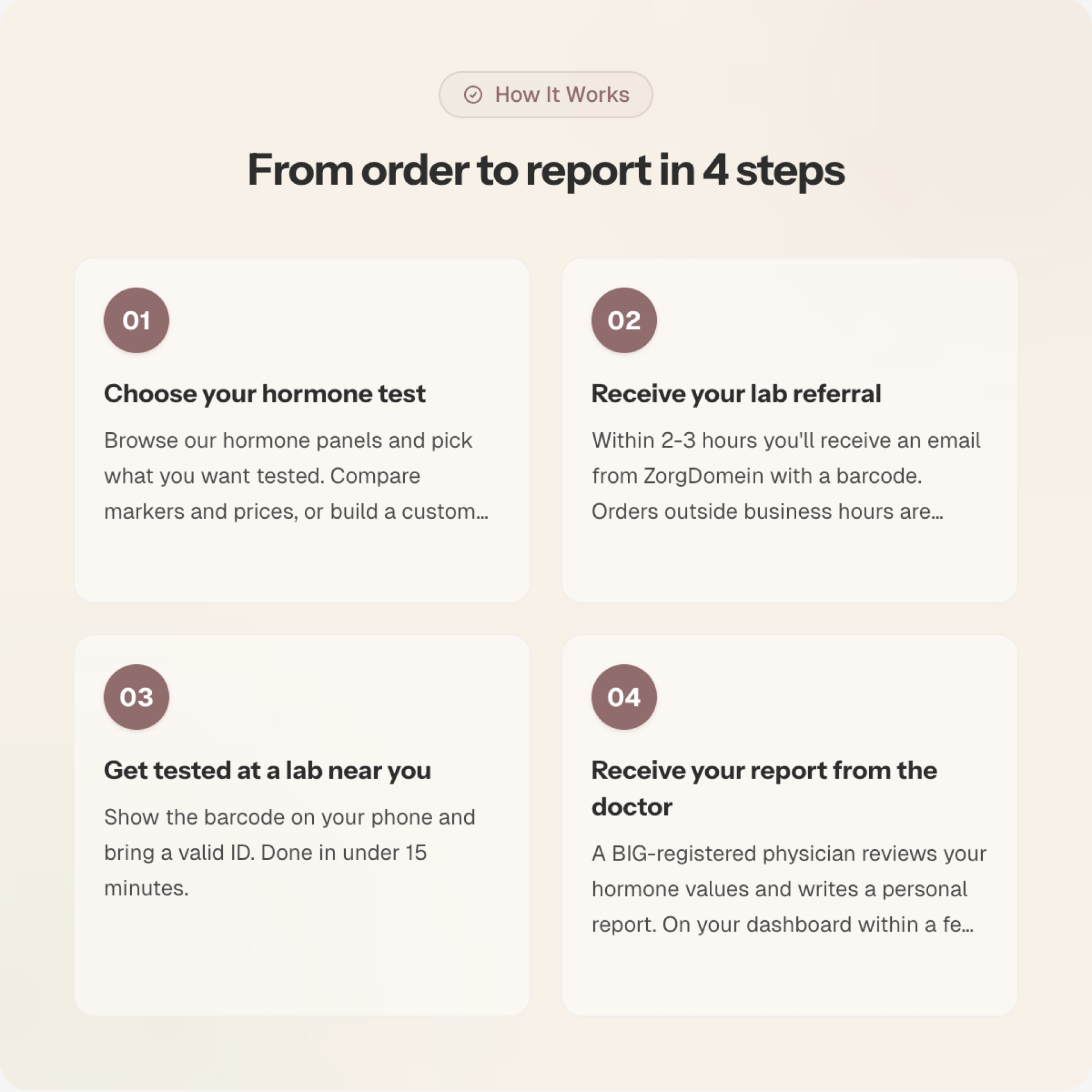
From order to report in 4 steps
A hormone test without referral: test when you want, not only when symptoms are severe. No waiting list, just order and go.
Choose your hormone test
Browse our hormone panels and pick what you want tested. Compare markers and prices, or build a custom test.
Receive your lab referral
On the same business day you'll receive an email from ZorgDomein with a barcode. Orders outside business hours are processed the next business day.
Get tested at a lab near you
Show the barcode on your phone and bring a valid ID. Done in under 15 minutes.
Receive your report from the doctor
A BIG-registered physician reviews your hormone values and writes a personal report. On your dashboard within a few business days.
Choose your hormone test
Browse our hormone panels and pick what you want tested. Compare markers and prices, or build a custom test.
Receive your lab referral
On the same business day you'll receive an email from ZorgDomein with a barcode. Orders outside business hours are processed the next business day.
Get tested at a lab near you
Show the barcode on your phone and bring a valid ID. Done in under 15 minutes.
Receive your report from the doctor
A BIG-registered physician reviews your hormone values and writes a personal report. On your dashboard within a few business days.
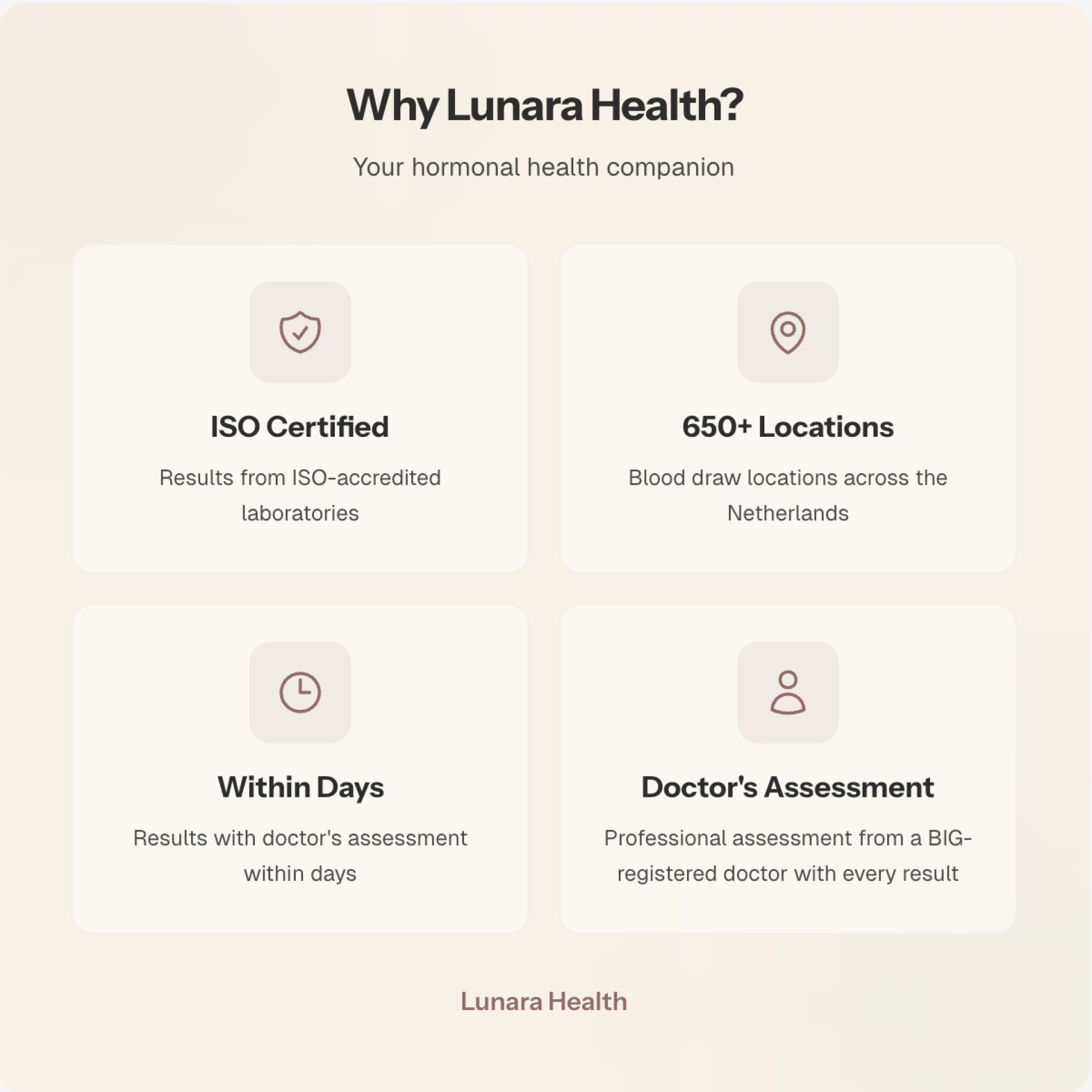
Always a location near you
With more than 700+ certified phlebotomy points across the Netherlands.
What We Test
This test includes 3 biomarkers to give you a comprehensive health picture.
Cortisol is the body's primary stress hormone, produced by the adrenal glands. It regulates metabolism, immune responses, and the sleep-wake cycle. Levels follow a natural daily rhythm, peaking in the morning and declining throughout the day.
Learn moreDHEA-S (dehydroepiandrosterone sulfate) is the most abundant adrenal hormone and serves as a precursor to both oestrogen and testosterone. It declines naturally with age and reflects overall adrenal reserve.
Learn moreACTH (Adrenocorticotropic Hormone) is produced by the pituitary gland and signals the adrenal glands to release cortisol. It plays a central role in your body's stress response and hormonal regulation.
Learn moreCortisol
HormonesCortisol is the body's primary stress hormone, produced by the adrenal glands. It regulates metabolism, immune responses, and the sleep-wake cycle. Levels follow a natural daily rhythm, peaking in the morning and declining throughout the day.
Cortisol imbalances may indicate adrenal dysfunction or chronic stress. Persistently elevated levels could suggest increased cardiovascular and metabolic risk. Low levels may point to adrenal insufficiency. Consult your healthcare provider for interpretation.
DHEA-S
HormonesDHEA-S (dehydroepiandrosterone sulfate) is the most abundant adrenal hormone and serves as a precursor to both oestrogen and testosterone. It declines naturally with age and reflects overall adrenal reserve.
DHEA-S levels decline significantly with age and low values could suggest adrenal insufficiency or premature ageing. High levels may indicate adrenal overactivity or other hormonal conditions. Consult your healthcare provider for interpretation.
ACTH (Adrenocorticotropic Hormone)
HormonesACTH (Adrenocorticotropic Hormone) is produced by the pituitary gland and signals the adrenal glands to release cortisol. It plays a central role in your body's stress response and hormonal regulation.
ACTH levels may indicate how effectively your pituitary-adrenal axis is functioning. Abnormal levels could suggest conditions affecting cortisol regulation, such as adrenal insufficiency or overproduction. Consult your healthcare provider for interpretation.
Related biomarkers
Biomarkers often explored alongside this test for a fuller picture.
17-OH Progesterone
17-OH Progesterone is a steroid hormone that plays an important role in your hormonal balance. It serves as a building block for cortisol and androgens, and its levels may fluctuate throughout your menstrual cycle.
AMH (Anti-Müllerian Hormone)
The AMH hormone comes from the granulosa cells around the small follicles queued up in your ovaries for a future ovulation. The blood value therefore gives an estimate of your ovarian reserve: how many follicles are still waiting in line. For women thinking about trying to conceive, about freezing eggs or about an IVF pathway, AMH is unusually practical for one reason: the test is not tied to a cycle day. You can have blood drawn at any point in your cycle, and you do not need to fast. Always read the result alongside your age. AMH is a planning number that helps you and your doctor make choices earlier and better informed. It is emphatically not a countdown clock, and not a prediction of whether you can get pregnant.
Androstenedione
Androstenedione is a hormone your body uses to produce both estrogen and testosterone. Understanding your levels may help provide insight into hormonal balance, cycle health, and conditions that could affect your well-being.
Calcitonin
Calcitonin is a thyroid hormone involved in calcium regulation and bone health. For women, understanding calcitonin levels may offer insights into thyroid function and mineral balance, which are important throughout different life stages.
DHT (Dihydrotestosterone)
DHT is an androgen that, even in small amounts, may influence skin health, hair growth, and hormonal balance in women. Elevated levels could suggest conditions such as PCOS.
Dopamine (Urine)
Dopamine influences mood, motivation, and reward processing. Hormonal fluctuations throughout the menstrual cycle may affect dopamine balance, making monitoring valuable for women's wellness.
Have a question?
Our team is happy to help. Ask your question and we'll respond as soon as possible.