Cortisol test: what a cortisol measurement can and cannot tell you
We advise against this test for stress, burnout or fatigue. Order it only if your doctor asked for it.
We advise against this test
If you are looking for this test because of stress, burnout, fatigue or weight gain, we advise you not to order it. A single cortisol measurement cannot answer that question: your cortisol has to roughly double before any change is even detectable, and the contraceptive pill, pregnancy, night shifts and even the stress of the blood draw itself shift the result. We sell this test only because a doctor sometimes asks for it. Read below why, and what does help.
Add to your order
No referral needed
Added to your order
Click the button to view your cart
Included Markers
1 markersCortisol
You are probably looking for a cortisol test because you are tired, sleeping badly, feeling burned out, have gained weight for no clear reason, or because you read something somewhere about "cortisol face" or a hormone balance that is supposedly out of kilter. That is exactly what this test is most often sold for online, and it is exactly what it does not work for.
We do sell this test, but only because there is one good reason to take it: your doctor asked for it. And there is something else, which is probably the most important thing on this whole page for you: if you use the pill or another oestrogen-containing contraceptive, your measured cortisol often cannot be interpreted at all. Not because something is wrong with you, but because the measurement is distorted. Below we explain how that works, with the sources, so you can check it yourself.
What cortisol is, and what the test is genuinely for
Cortisol is a hormone made by your adrenal glands. It helps keep your blood sugar steady, helps regulate how your body responds to strain, and follows a strong daily rhythm: high in the early morning, low around midnight.
Measuring cortisol is a real, recognised test. Doctors use it to detect two rare conditions: Cushing's syndrome (too much cortisol) and adrenal insufficiency, or Addison's disease (too little cortisol). These are serious illnesses and the test is essential for them. So we are emphatically not saying that measuring cortisol is nonsense.
But look at what that test actually involves. The Endocrine Society guideline prescribes: two late-night saliva samples, two 24-hour urine collections, or a dexamethasone suppression test where you take a tablet the night before. None of these is a blood draw you can simply walk in for. For Addison's disease, a morning blood draw between 06:00 and 10:00 is a legitimate first step, but only alongside ACTH, and only when a doctor already suspects the disease.
Why one blood draw cannot answer your question
This is the core problem, and it is arithmetic, not opinion.
Cortisol fluctuates enormously, even in healthy people doing nothing unusual. Clinical chemistry expresses this as the reference change value: how much a value must change before you can say with 95% confidence that something genuinely changed. For cortisol in blood, that is around 47%. For salivary cortisol it runs from 96% to 245%, depending on the time of day.
Put plainly: your cortisol has to roughly double before anyone can establish that anything changed at all. Everything below that is noise. We could draw your blood twice, an hour apart, and get two numbers tens of percent apart, both entirely normal, and both meaningless.
On top of that, the things that shift your measured cortisol are precisely the things many women bring with them:
- a disrupted sleep pattern, whether from night shifts, a child waking up, or night sweats in perimenopause: the daily rhythm the test leans on collapses
- the needle itself: the stress of the blood draw raises your cortisol at the very moment of measurement
- oestrogen-containing contraception and pregnancy, which is a story of its own. We explain it below, because it is the main reason we advise you against this test
The pill and pregnancy: why your result often cannot be read
Cortisol does not float around freely in your blood. Most of it is stuck to a carrier protein, cortisol-binding globulin (CBG). Only the small, free fraction actually does anything in your body. An ordinary blood test measures total cortisol: the bound fraction plus the free fraction together.
Oestrogen you swallow, as in the combined pill and in some tablet forms of hormone therapy, prompts your liver to make more CBG. More carrier protein means more bound cortisol, and therefore a higher total. But the free, active cortisol barely changes. Read that again slowly, because it is the whole point: the number goes up, the hormone that does the work does not. Nothing is wrong with you. Something is wrong with what the test measures.
The size of that effect is not a footnote. The Endocrine Society guideline states, verbatim, that "false-positive rates for the overnight DST are seen in 50% of women taking the oral contraceptive pill". A small Dutch study (Vastbinder, 2016) looked at thirteen healthy volunteers on the pill, and in eight of them, just over 61%, cortisol failed to suppress on the very test designed to rule out Cushing's syndrome. These women were healthy. The test disagreed.
Now put that side by side. The women who most often end up looking for a "stress hormone" test are frequently women on the pill, women who are pregnant, women dealing with PCOS, or women sleeping badly through perimenopause. That is precisely the group whose result cannot be interpreted. We would be taking your money for a number we already know nobody can read. We do not want to do that.
The guideline does have a solution: withdrawing oestrogen roughly six weeks before the test. Read this part carefully: that is a decision for you and your doctor together, not for a webshop. We will never advise you to stop your contraception in order to get a prettier number. We tell you this so you know why we are not pushing a test on you here, and so you can have a well-informed conversation with your GP.
Then pregnancy. There, cortisol genuinely does rise, and substantially: urinary free cortisol excretion can run up to three times higher towards term, and those values overlap with what you see in genuine Cushing's syndrome. A cortisol result during pregnancy is therefore essentially uninterpretable outside specialist care.
Adrenal fatigue does not exist, and "hormone balance" is not a blood value
Most people looking for a cortisol test have come across "adrenal fatigue" somewhere along the way: the idea that chronic stress exhausts your adrenal glands so they start producing too little cortisol.
That condition does not exist. The term was coined in 1998 by a chiropractor, not a doctor. A 2016 systematic review searched 3,470 publications, kept 58, and concluded there is no substantiation for it whatsoever. In fact, in most fatigued participants the cortisol measurements were simply normal. The Endocrine Society is blunt: no scientific proof exists, and there is no test that can detect it.
This is not only about wasted money. The treatments sold alongside it can cause harm. A study in Mayo Clinic Proceedings tested twelve over-the-counter "adrenal support" supplements: all twelve contained thyroid hormone that was not on the label, and a quarter contained a steroid. Taking adrenal hormones you do not need can suppress your own hormone production. And treating "adrenal fatigue" can mask genuine adrenal insufficiency.
Then the second phrase you see everywhere: "hormone balance", usually with a picture of a "cortisol face" attached. Be strict with that word. Cortisol genuinely does things in your body, and chronic stress genuinely has consequences; we are not denying that. But the link between your measured cortisol and how much stress you actually feel is very small in large studies: stress explains roughly 1 to 4% of the variation in cortisol between people. It takes hundreds of participants to make that effect visible at all. In you, one person, one tube, it says nothing. And a puffy face is not a diagnosis: a doctor recognises genuine Cushing's syndrome by a whole constellation of signs, not by one photo and not by one number.
What your symptoms usually turn out to be, and what we recommend
Fatigue is one of the most common reasons people see a GP, and what it turns out to be has been studied properly. Among people presenting with tiredness, around 2.8% have anaemia and 0.6% a malignancy; in total roughly 4% have a serious physical illness. Hormonal causes together account for about 3%, and cortisol disorders are only a fraction of that. The largest categories are quite different: musculoskeletal complaints, infections, and psychological or social causes. In more than half of people, no physical explanation is found even after a year.
More testing does not help. A Dutch randomised trial in people with unexplained fatigue compared a limited blood panel with an expanded one. The expanded panel found 1.1 percentage points more genuine abnormalities, but produced 33.5 percentage points more false positives: from 22% to 55.5%. You are not buying an answer, you are buying false alarms.
For persistent fatigue, the Dutch primary-care guideline therefore starts with a short list, and the shortness is exactly the point:
- Haemoglobin, and if abnormal your iron stores via ferritin: anaemia is the most commonly found physical cause of fatigue, and in menstruating women an iron store drained by heavy bleeding is one of the most frequently missed explanations
- CRP: an inflammatory marker, which makes an infection or inflammatory disease less likely
- Fasting glucose: to rule out diabetes
- TSH: your thyroid. Thyroid disorders are far more common in women than in men, and this genuinely is a common, treatable cause of fatigue
And to be honest: for a good share of people the answer is no blood test at all. If you feel burned out, that is a clinical diagnosis your GP makes from your story. The Dutch guideline on work-related stress and burnout says of additional investigation, literally: "not indicated". There is no blood value for burnout. What does help is day structure, paced recovery and addressing the cause, together with your GP or occupational physician.
We would rather earn nothing from you than sell you a test that does not answer your question.
When this test is appropriate
There genuinely are situations where measuring cortisol is the right thing to do. If you recognise yourself here, you can order the test below:
- your GP or specialist asked for a cortisol measurement. Then you are here to have the test done, not to diagnose yourself, and we are glad to help
- you already have a known adrenal or pituitary condition and you are monitoring your values
- you use or have stopped corticosteroids (prednisone, dexamethasone, including creams and inhalers), where your own cortisol production may be suppressed
If you do have blood drawn, book it between 06:00 and 10:00 in the morning, fasting and without heavy exertion beforehand. Outside that window your result cannot be compared against the correct reference range.
Always mention whether you use oestrogen-containing contraception, take hormone therapy, or are pregnant. Not because you are doing anything wrong, but because your doctor has to read your result differently. Without that information, a perfectly healthy woman can look ill on paper.
One thing holds even then: a single cortisol value is never a diagnosis. An abnormal result means your GP has to redo the work properly, with the right test.
Sources
We think you should be able to check what we base this on.
- Nieman LK et al. The Diagnosis of Cushing's Syndrome: An Endocrine Society Clinical Practice Guideline. J Clin Endocrinol Metab. 2008;93(5):1526-40. PMID 18334580. (Explicitly recommends against random serum cortisol. Also the source of "false-positive rates for the overnight DST are seen in 50% of women taking the oral contraceptive pill", the advice to withdraw oestrogen roughly six weeks before testing, and the up to threefold rise in urinary free cortisol in pregnancy.)
- Vastbinder M et al. The influence of oral contraceptives on overnight 1 mg dexamethasone suppression test. Neth J Med. 2016;74(4):158-61. PMID 27185774. (In eight of thirteen healthy volunteers using the oral contraceptive pill, just over 61%, cortisol failed to suppress.)
- Bornstein SR et al. Diagnosis and Treatment of Primary Adrenal Insufficiency: An Endocrine Society Clinical Practice Guideline. J Clin Endocrinol Metab. 2016;101(2):364-89. PMID 26760044. ("There is no evidence to support the use of random cortisol"; not suitable for community-based screening.)
- Cadegiani FA, Kater CE. Adrenal fatigue does not exist: a systematic review. BMC Endocr Disord. 2016;16(1):48. PMID 27557747.
- Akturk HK et al. Over-the-Counter "Adrenal Support" Supplements Contain Thyroid and Steroid-Based Adrenal Hormones. Mayo Clin Proc. 2018;93(3):284-90. PMID 29502560.
- Koch H et al. Ordering blood tests for patients with unexplained fatigue in general practice: what does it yield? Br J Gen Pract. 2009;59(561):e93-100. PMID 19341544.
- Nijrolder I et al. Diagnoses during follow-up of patients presenting with fatigue in primary care. CMAJ. 2009;181(10):683-7. PMID 19858240.
- NHG/NVKC LESA Laboratoriumdiagnostiek. NHG-Standaard Overspanning en burn-out (M110). Additional investigation: "not indicated".
Frequently asked questions
It can always be measured, but your result usually cannot be interpreted. Oral oestrogen raises the carrier protein CBG in your blood, so your measured total cortisol goes up while the free, active cortisol barely changes. The Endocrine Society guideline reports false-positive results in 50% of women taking the oral contraceptive pill; in a small Dutch study, cortisol failed to suppress in eight of thirteen healthy pill users. That is why we advise you not to order this test yourself. And never stop your contraception in order to take a test: that is a decision for you and your doctor together.
Because there is one good reason to take it: your doctor asked for it. We do not want to turn those people away. For anyone arriving here because of stress, burnout or fatigue, our advice is: do not. We would rather earn nothing from you than sell you something that does not answer your question.
No. Chronic stress genuinely does affect your body, but the link between cortisol and how much stress someone reports is very small in large studies: stress explains roughly 1 to 4% of the variation in cortisol. It takes hundreds of people to detect that effect at all. So in one person, one measurement tells you nothing about your stress level.
No. No endocrinology professional body recognises the diagnosis, and no test can detect it. A 2016 systematic review found normal cortisol values in most fatigued participants. More importantly, the supplements sold for it often contain undeclared hormones, and treating it can mask genuine adrenal disease.
The Dutch primary-care guideline starts with haemoglobin, CRP, fasting glucose and TSH, adding ferritin if your haemoglobin is abnormal. In menstruating women a depleted iron store is one of the most frequently missed explanations, and thyroid disorders are more common than in men. That short list is deliberate: every extra test mainly produces false positives. Discuss your symptoms with your GP first.
It depends on the markers; each test shows whether fasting is needed. If it is, eat nothing after 22:00 the evening before and drink only water, for at least 8 hours. Skip coffee and tea that morning and have blood taken before 10:00.
You pay €64,-. The blood draw is already included, so nothing is added.
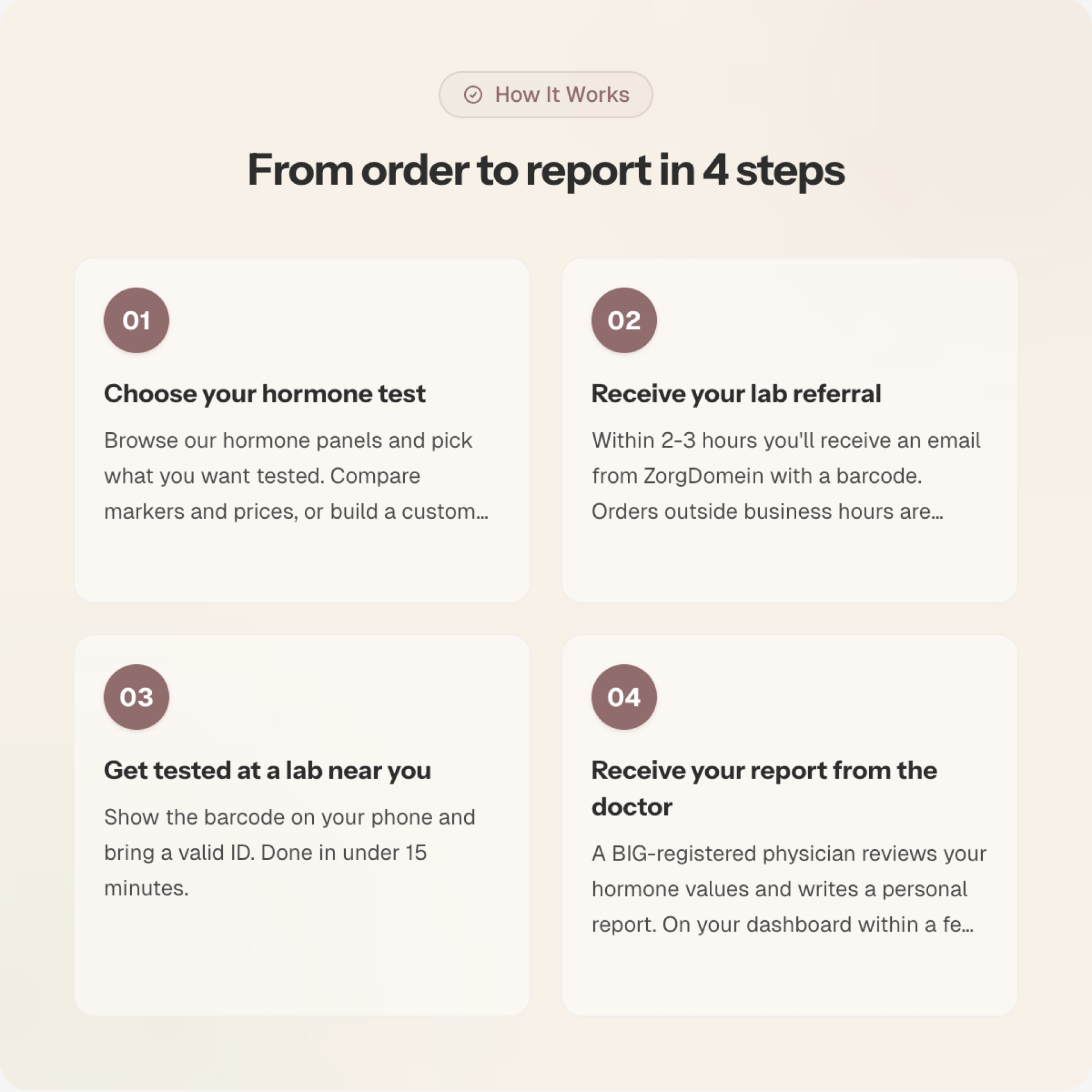
No, you do not need your GP. We arrange the referral through ZorgDomein within one business day; an order after 17:00 or at the weekend counts from the next business day. The ZorgDomein email has a barcode for the draw site. At a few draw sites you choose a time on your order page, or we schedule it for you.
No, a test you request yourself is not part of the basic Dutch insurance. You pay it yourself, and your deductible (eigen risico) stays untouched.
Count on one business day, a day longer for an order after 17:00 or at the weekend: by then the referral email has arrived, and you cannot go before it does. Some draw sites then take walk-ins and the rest work by appointment. Each location says which.
Your barcode from the ZorgDomein email and a valid ID. Showing the barcode on your phone is fine. Without a BSN you get no barcode; print the referral form from the link in the email instead.
Yes, unless your own doctor said otherwise. Some markers ask for extra preparation, such as no alcohol for 24 hours or no heavy training for 48 hours. You see this on the test and in the instructions after you order.
You show your barcode and your ID at the draw site, and then your blood is taken. Allow about a quarter of an hour.
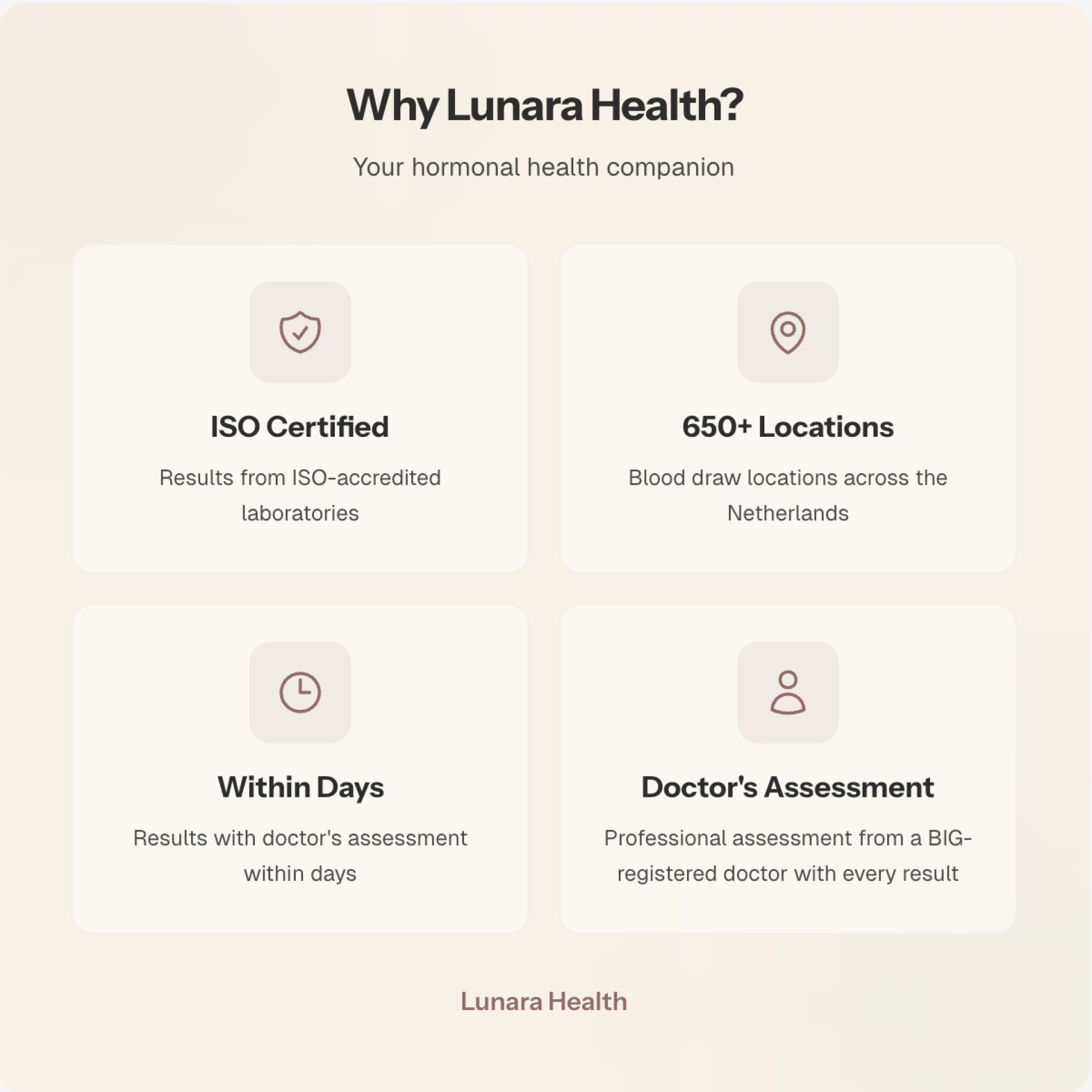
Yes, a BIG-registered doctor assesses every result and explains your values in your account. If you want treatment, discuss the result with your GP.
In one of the independent, certified laboratories across the Netherlands that Lunarahealth works with. They also run the draw sites, which Lunarahealth does not own. Reference values can differ a little between labs.
No, your test bypasses your GP and does not end up in your medical record. Data goes to a healthcare provider only with your written consent, and it is never sold. Anonymous is not possible: a valid result needs your name, date of birth and ID.
What We Test
| No. | Biomarker | Unit |
|---|---|---|
| 01 | Cortisol | nmol/l |
| Your results are usually in your Lunarahealth account within 2 working days of the blood draw. The laboratory states a longer turnaround for Cortisol. | ||
Preparation
-
Pause biotin
RequiredDo you take a supplement with biotin (vitamin B8, common in hair, skin and nail supplements)? Stop it 72 hours before the draw. Biotin interferes with the measurement of these values.
-
Have the draw in the morning
RequiredThese values vary over the day and peak in the morning. Have your blood drawn before 10:00, ideally between 07:00 and 09:00.
- Water is always fine. Drink as usual beforehand, it makes the draw easier.
- Take your usual medication, unless your own doctor told you otherwise.
Extend this panel
Same draw, no second appointment.
You Might Also Like
PCOS Screening
Screening covering key markers associated with PCOS.
Hormones Women
A hormone test for women measures FSH, LH, estradiol, progesterone and prolactin. Together these five values make a hormonal imbalance visible.
Menopause Check
FSH and estradiol when early menopause is suspected, plus TSH and free T4 for your thyroid.