
Confirm ovulation with progesterone in the luteal phase
Day 21 progesterone test that may indicate ovulation, a commonly recommended test.
Add to your order
No referral needed
Added to your order
Click the button to view your cart
Included Markers
1 markersProgesterone
Wondering whether you actually ovulate? That is a very reasonable question, especially if your cycle is irregular or if you are trying to conceive. A progesterone test can give you more clarity.
Progesterone is the hormone that rises after ovulation. By measuring it at the right point in your cycle, you get a tangible reference point about what is happening in your body, so you no longer have to guess.
Why this test?
When it comes to your fertility and cycle, it helps to have something concrete to go on. After ovulation, the corpus luteum in your ovary produces progesterone, which is why this hormone rises in the second half of your cycle.
By measuring progesterone around day 21 of a roughly 28-day cycle, a test can give an impression of whether ovulation has likely taken place. It is a commonly used way to understand your cycle a little better.
Who is this test for?
This test can be useful if you want to know more about your ovulation. Think of women with an irregular cycle, women who are trying to conceive, or those who are simply curious whether they ovulate.
If you already track your cycle with, for example, temperature readings or ovulation strips, measuring progesterone in your blood can be an extra piece of the puzzle. It says something about the phase after ovulation.
What is tested?
This test measures a single hormone in your blood:
- Progesterone: produced after ovulation by the corpus luteum in your ovary. A raised value in the second half of your cycle can fit with ovulation having occurred.
Because progesterone fluctuates strongly across your cycle, timing matters. The value is most meaningful when you have blood drawn around day 21 of a 28-day cycle.
What can this test tell you?
Your progesterone value can give an impression of whether ovulation likely happened in that cycle. A clearly raised value in the luteal phase (the second half of your cycle) often fits with ovulation.
A lower value can sometimes suggest that ovulation may not have taken place in that particular cycle, or that the sample was taken at a slightly different moment. It is one snapshot, which is most informative alongside your cycle and your wider situation. The test cannot establish with absolute certainty that ovulation occurred.
How is the sample collected?
This test requires a small blood draw at a certified sample point. In the Netherlands you can choose from 650+ locations.
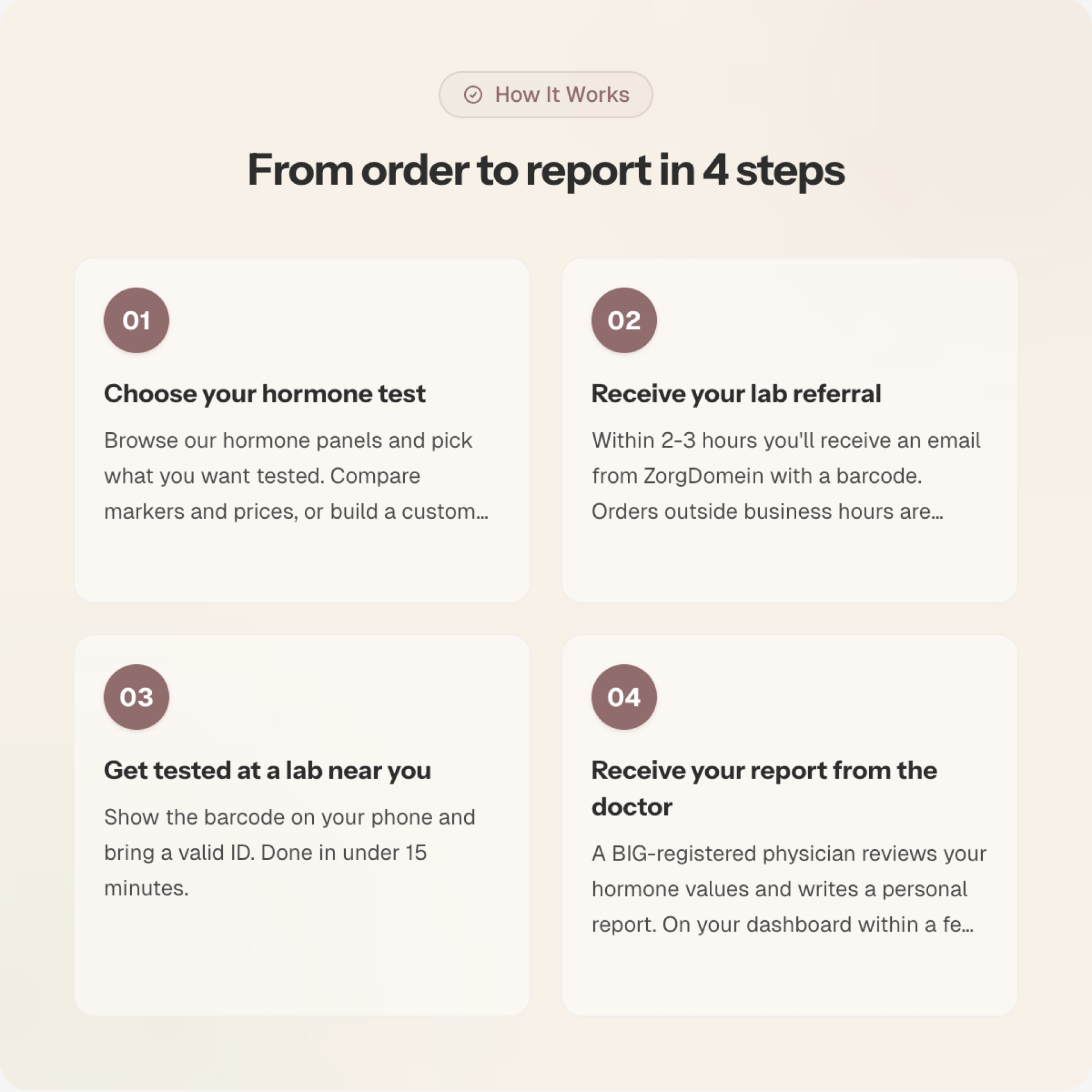
After ordering we arrange your referral through ZorgDomein, usually within one business day; you pick a location near you and have your blood drawn on the right cycle day, walking in or by appointment depending on the location. The draw itself usually takes only a few minutes, and you do not need a referral from your GP.
When is this test useful?
A progesterone test can be valuable at different moments, for example:
- when you want to know whether you ovulate, especially with an irregular cycle
- when you are trying to conceive and want to understand your cycle better
- as a complement to an ovulation test, alongside other signals you already track
- when you want more insight into the second half of your cycle
Timing is precise: the measurement is usually done about seven days before your expected period. In a 28-day cycle that works out to day 21, while a longer or shorter cycle shifts this day.
What do the results mean?
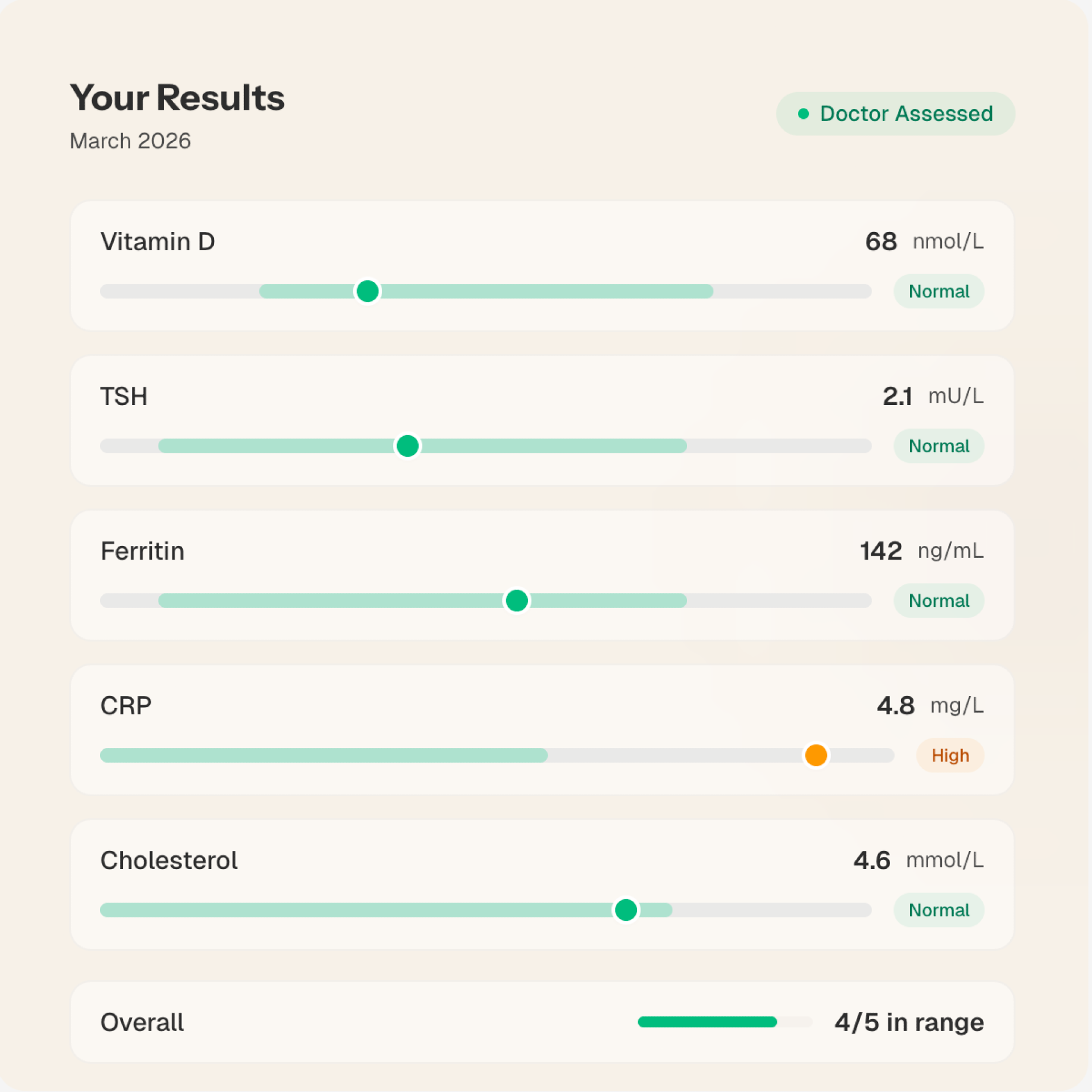
Your result shows your progesterone value together with a reference range and a short explanation. What counts as usual depends on the phase of your cycle and varies by laboratory.
A value above a certain threshold in the luteal phase can fit with ovulation, while a lower value can mean different things. The doctor helps you place your value in the right context.
What happens after the results?
Your results are usually in your Lunarahealth account within 2 working days of the blood draw, often the next day. Some markers take longer. Each value is shown clearly with a reference range and an explanation, so you understand what you see.
Every blood test result includes a professional assessment from a BIG-registered doctor. For treatment decisions, discuss your results with your GP.
Frequently Asked Questions
Progesterone is usually measured about seven days before your expected period. In a 28-day cycle that is around day 21. With a different cycle length, this moment shifts accordingly.
A raised progesterone value in the second half of your cycle can fit with ovulation. It gives a strong indication, but cannot establish with absolute certainty that ovulation occurred.
For measuring progesterone you usually do not need to fast. The right cycle day matters more than whether you have eaten.
With an irregular cycle it can be harder to choose the right moment to test. Sometimes blood is drawn at several points. The doctor can help place your value in context.
You pay €69,-. The blood draw is already included, so nothing is added.
No, you do not need your GP. We arrange the referral through ZorgDomein within one business day; an order after 17:00 or at the weekend counts from the next business day. The ZorgDomein email has a barcode for the draw site. At a few draw sites you choose a time on your order page, or we schedule it for you.
No, a test you request yourself is not part of the basic Dutch insurance. You pay it yourself, and your deductible (eigen risico) stays untouched.
Count on one business day, a day longer for an order after 17:00 or at the weekend: by then the referral email has arrived, and you cannot go before it does. Some draw sites then take walk-ins and the rest work by appointment. Each location says which.
Your barcode from the ZorgDomein email and a valid ID. Showing the barcode on your phone is fine. Without a BSN you get no barcode; print the referral form from the link in the email instead.
Yes, unless your own doctor said otherwise. Some markers ask for extra preparation, such as no alcohol for 24 hours or no heavy training for 48 hours. You see this on the test and in the instructions after you order.
You show your barcode and your ID at the draw site, and then your blood is taken. Allow about a quarter of an hour.
Yes, a BIG-registered doctor assesses every result and explains your values in your account. If you want treatment, discuss the result with your GP.
In one of the independent, certified laboratories across the Netherlands that Lunarahealth works with. They also run the draw sites, which Lunarahealth does not own. Reference values can differ a little between labs.
No, your test bypasses your GP and does not end up in your medical record. Data goes to a healthcare provider only with your written consent, and it is never sold. Anonymous is not possible: a valid result needs your name, date of birth and ID.
What We Test
| No. | Biomarker | Unit |
|---|---|---|
| 01 | Progesterone | nmol/l |
| Your results are usually in your Lunarahealth account within 2 working days of the blood draw. | ||
Preparation
-
Do you have a cycle? Pick the right day
RequiredIf you have a menstrual cycle, have the draw 7 days before your next expected period; if that cycle is irregular, repeat weekly until your period starts. Without a cycle, any day works.
- Water is always fine. Drink as usual beforehand, it makes the draw easier.
- Take your usual medication, unless your own doctor told you otherwise.
Extend this panel
Same draw, no second appointment.
You Might Also Like
PCOS Screening
Screening covering key markers associated with PCOS.
Fertility Assessment
Ovarian reserve panel with AMH, FSH, LH, and Estradiol.
Pregnancy Blood Test
An hCG blood test measures the pregnancy hormone in your blood. The result is an exact value in IU/L, measurable from 8 to 10 days after conception.