PCOS test: hormones, androgens and insulin in view
Screening covering key markers associated with PCOS.
Add to your order
No referral needed
Added to your order
Click the button to view your cart
Included Markers
6 markersAMH (Anti-Müllerian Hormone), Insulin (Fasting), Glucose (Fasting), Free Testosterone, Total Testosterone, HOMA-IR
Do you recognise irregular cycles, changes in your skin or hair growth, or questions around your fertility? PCOS may be on your mind. A PCOS blood test can give you a factual starting point that makes these questions a little more concrete.
PCOS (polycystic ovary syndrome) is often linked to hormonal and metabolic markers in your blood. This test looks at a number of those values, such as your androgens, AMH and your insulin sensitivity, so you gain more insight into what is going on in your body.
Why this test?
PCOS is a common hormonal pattern in women, and it shows up a little differently for everyone. Blood values can help make part of that story visible.
This test looks at markers that are sometimes associated with PCOS: male hormones (androgens) such as testosterone, the hormone AMH, and the way your body handles sugar and insulin. Together they may offer insight, without any single value determining anything on its own.
Who is this test for?
This test can be useful if you notice that your cycle is irregular, if you deal with acne or extra hair growth, or if you have questions about your fertility. It can also be valuable if you simply want to know how your hormones are doing.
Wondering which blood values relate to PCOS? This panel brings together a number of hormonal and metabolic markers that are often involved, so you can have them measured in one go.
What is tested?
This PCOS screening measures six markers in your blood:
- Total Testosterone: the total amount of testosterone in your blood, an androgen that can sometimes be raised with PCOS.
- Free Testosterone: the portion of your testosterone that is not bound to protein and can be biologically active.
- AMH (Anti-Müllerian Hormone): made by the growing follicles in your ovaries and sometimes higher than average with PCOS.
- Glucose (Fasting): your blood sugar in a fasting state, which together with insulin can say something about your metabolism.
- Insulin (Fasting): the hormone that helps regulate your blood sugar, measured in a fasting state.
- HOMA-IR: a value calculated from your glucose and insulin that can give an impression of your insulin sensitivity.
What can this test tell you?
Your values can give an impression of how your hormones and metabolism are doing. Raised androgens such as testosterone are sometimes seen with PCOS, and AMH can be higher than average.
The fasting glucose, insulin and HOMA-IR values together may offer a view of your insulin sensitivity, which is often part of the PCOS picture. On their own, these values do not tell the whole story, so they are best read together and in context.
How is the sample collected?
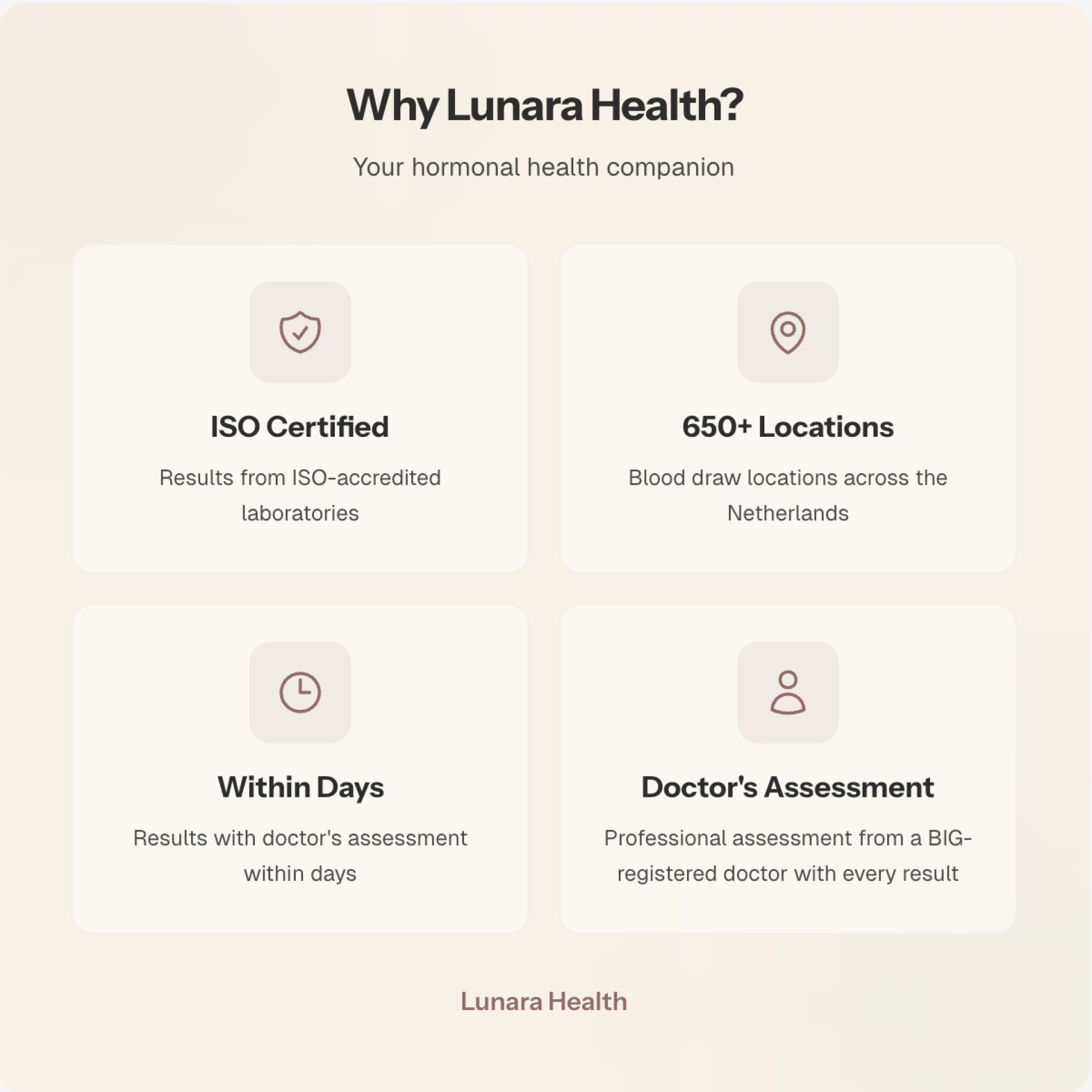
This test needs a short blood draw at a certified lab. In the Netherlands you can choose from 650+ sample points.
You can do this PCOS test without a referral: after ordering, you pick a location near you and schedule a time that suits you. You do not need a referral from your GP.
When is this test useful?
This test can be valuable at different moments, for example:
- with an irregular or absent cycle
- if you recognise symptoms that are sometimes linked to PCOS, such as acne or extra hair growth
- if you have questions about your fertility or wish to conceive
- if you want more insight into how your body handles insulin and sugar
Because glucose and insulin respond to what you eat, this test is best taken while fasting.
What do the results mean?
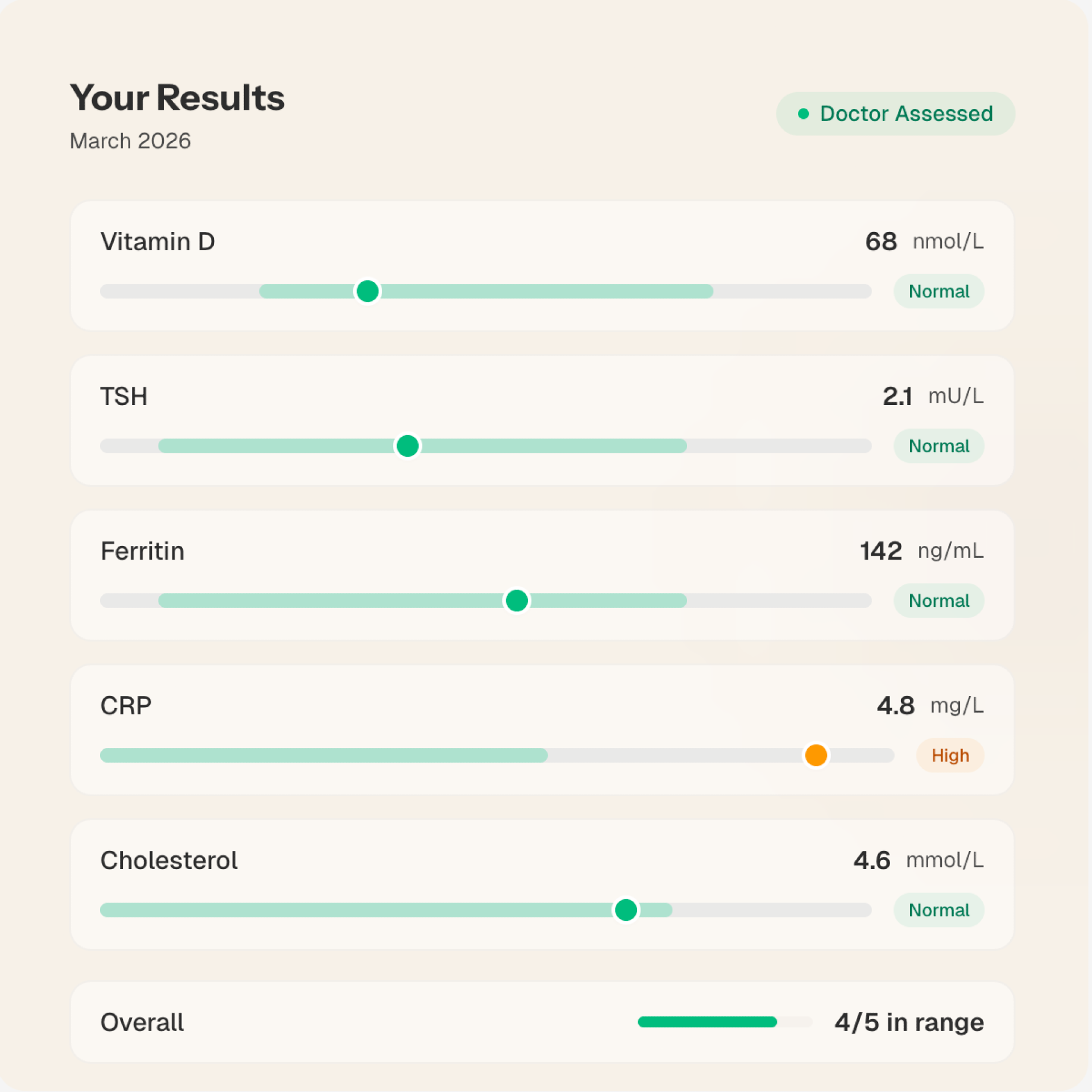
Your result shows each marker with your value, a reference range and a short explanation. What counts as usual can vary from one laboratory to another.
Raised androgens or a higher HOMA-IR score can, for instance, fit the pattern that is sometimes seen with PCOS, but a single value says little on its own. The BIG-registered doctor helps you place your values in the right context.
What happens after the results?
Your results are usually in your Lunarahealth account within 2 working days of the blood draw, often the next day. Some markers take longer. Each value is shown clearly with a reference range and an explanation, so you understand what you see.
Every blood test result includes a professional assessment from a BIG-registered doctor. For treatment decisions, discuss your results with your GP.
Frequently Asked Questions
PCOS is often looked at through androgens such as testosterone, through AMH, and through markers of insulin sensitivity like fasting glucose, insulin and the HOMA-IR score. This test brings those values together.
Yes. You order the test online and choose a sample point near you. You do not need a referral from your GP.
For a reliable measurement of your glucose and insulin, it is best to have your blood drawn while fasting, roughly eight to twelve hours after your last meal.
No. This blood test can give insight into markers that are sometimes linked to PCOS, but it does not make a diagnosis. Your GP can assess your values in context and decide whether further steps are needed.
You pay €159,-. The blood draw is already included, so nothing is added.
No, a test you request yourself is not part of the basic Dutch insurance. You pay it yourself, and your deductible (eigen risico) stays untouched.
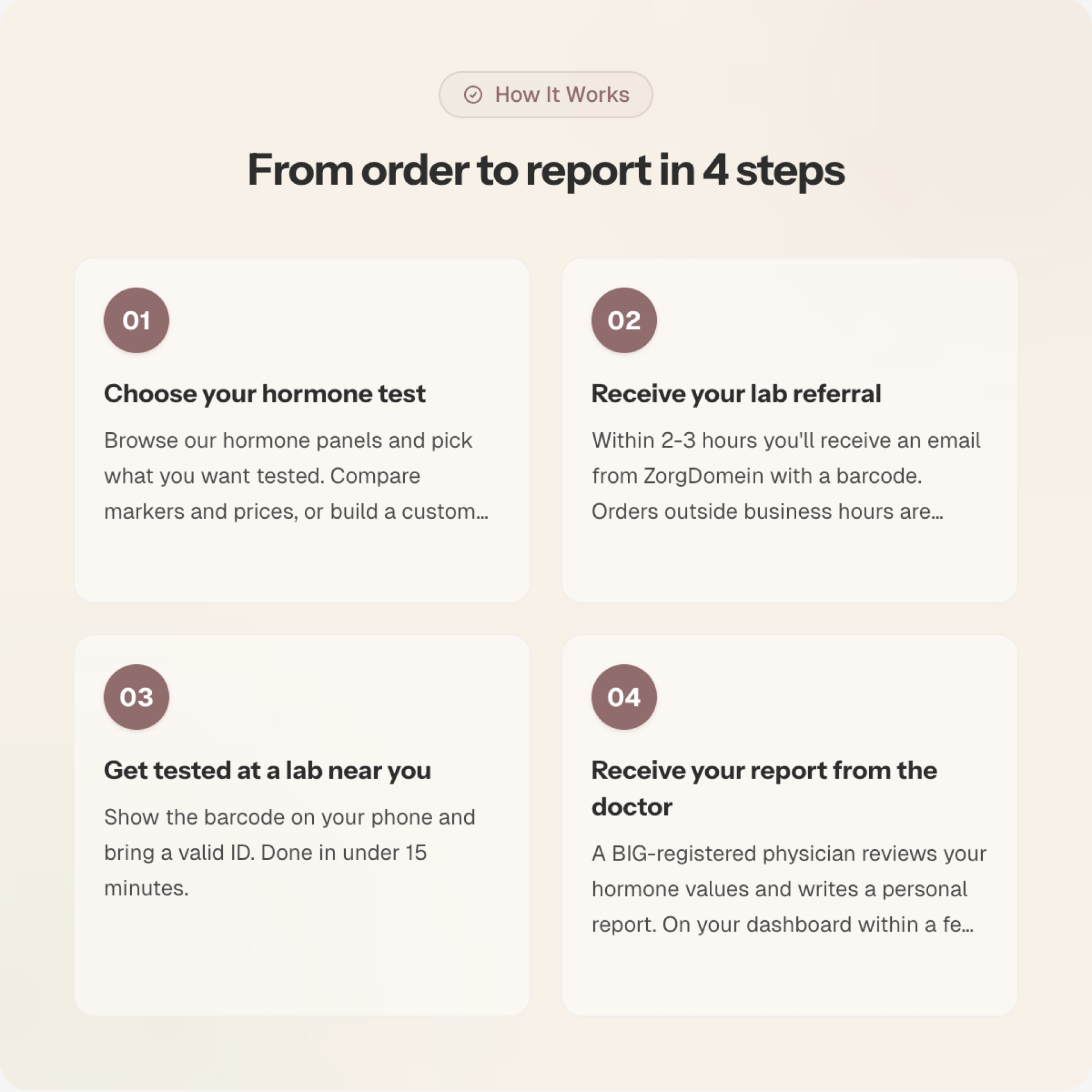
Count on one business day, a day longer for an order after 17:00 or at the weekend: by then the referral email has arrived, and you cannot go before it does. Some draw sites then take walk-ins and the rest work by appointment. Each location says which.
Your barcode from the ZorgDomein email and a valid ID. Showing the barcode on your phone is fine. Without a BSN you get no barcode; print the referral form from the link in the email instead.
Yes, unless your own doctor said otherwise. Some markers ask for extra preparation, such as no alcohol for 24 hours or no heavy training for 48 hours. You see this on the test and in the instructions after you order.
You show your barcode and your ID at the draw site, and then your blood is taken. Allow about a quarter of an hour.
Yes, a BIG-registered doctor assesses every result and explains your values in your account. If you want treatment, discuss the result with your GP.
In one of the independent, certified laboratories across the Netherlands that Lunarahealth works with. They also run the draw sites, which Lunarahealth does not own. Reference values can differ a little between labs.
No, your test bypasses your GP and does not end up in your medical record. Data goes to a healthcare provider only with your written consent, and it is never sold. Anonymous is not possible: a valid result needs your name, date of birth and ID.
What We Test
| No. | Biomarker | Unit |
|---|---|---|
| 01 | AMH (Anti-Müllerian Hormone) | ug/l |
| 02 | Insulin (Fasting) | pmol/L |
| 03 | Glucose (Fasting) | mmol/l |
| 04 | Free Testosterone | pmol/L |
| 05 | Total Testosterone | nmol/l |
| 06 | HOMA-IR | Index |
| Your results are usually in your Lunarahealth account within 2 working days of the blood draw. The laboratory states a longer turnaround for AMH (Anti-Müllerian Hormone), Free Testosterone and Insulin (Fasting). | ||
Preparation
-
Pause biotin
RequiredDo you take a supplement with biotin (vitamin B8, common in hair, skin and nail supplements)? Stop it 72 hours before the draw. Biotin interferes with the measurement of these values.
-
Come fasting
RequiredFrom 22:00 the evening before, eat and drink nothing except water. That is at least 8 hours. Skip coffee, tea, chewing gum and smoking that morning. Plan the draw before 10:00.
-
Have the draw in the morning
RequiredThese values vary over the day and peak in the morning. Have your blood drawn before 10:00, ideally between 07:00 and 09:00.
-
Your cycle does not matter here
Good to knowThis value barely changes, including through a menstrual cycle. Any day works.
- Water is always fine. Drink as usual beforehand, it makes the draw easier.
- Take your usual medication, unless your own doctor told you otherwise.
Extend this panel
Same draw, no second appointment.
You Might Also Like
Ovulation Confirmation
Day 21 progesterone test that may indicate ovulation, a commonly recommended test.
Fertility Assessment
Ovarian reserve panel with AMH, FSH, LH, and Estradiol.
Pregnancy Blood Test
An hCG blood test measures the pregnancy hormone in your blood. The result is an exact value in IU/L, measurable from 8 to 10 days after conception.