Thyroid test for an underactive or overactive thyroid
A thyroid test measures TSH, free thyroxine and free T3. It shows whether your thyroid runs slow or fast.
Add to your order
No referral needed
Added to your order
Click the button to view your cart
Included Markers
3 markersTSH (Thyroid Stimulating Hormone), Free T4 (Thyroxine), Free T3 (Triiodothyronine)
A thyroid test measures how hard your thyroid is working. It reads TSH, free thyroxine and free T3 in your blood. You order it yourself online, without going through a GP.
What a thyroid test measures
Our thyroid sits at the front of the neck, just below the voice box. It makes two hormones: T4 and T3. These set your energy use, your heart rate and your body heat.
The working of the thyroid is driven from your brain. Your pituitary gland makes TSH. That is a stimulating hormone: it puts the thyroid to work.
This test reads three values. TSH shows how hard your pituitary is pulling on the thyroid. Free thyroxine, or free T4 for short, is the store hormone floating loose in your blood. Free T3 is the most active form.
A TSH value on its own does not tell the whole story. That is why we read the two hormones next to it.
An underactive and an overactive thyroid
Your thyroid can make too little hormone, or too much. Both cause symptoms, but very different ones.
With a slow working thyroid, output sits too low. Your energy use drops. Doctors call this hypothyroidism.
Common signs are tiredness, feeling cold, dry skin and weight gain. Low mood, hair loss and a slow gut also occur.
With a fast working thyroid the opposite happens. Everything speeds up. Think of a racing heart, sweating, unrest, poor sleep and weight loss. Doctors call this hyperthyroidism.
The blood picture differs clearly between the two. A slow thyroid tends to give a high TSH with a low free T4. A fast thyroid shows a low TSH instead.
Hashimoto and Graves: when your immune system hits the thyroid
Most thyroid problems in the Netherlands are not caused by diet or stress. They start with the immune system itself.
Hashimoto's disease is the best known. Here the body's own immune cells slowly damage the thyroid.
Hormone output falls over years. That is how a slow thyroid begins. Anti-TPO antibodies are often raised with it.
Graves' disease works the other way round. There, antibodies drive the thyroid into overwork. The result is a fast thyroid.
Both are far more common in women than in men. They also show up more often after birth and around menopause. This test does not read those antibodies itself.
Thyroid, menopause and pregnancy
In women, thyroid signs are often put down to something else. Tiredness, weight gain and mood swings also fit menopause. The two overlap a great deal.
That is exactly why a test helps here. You find out whether the thyroid plays a part or not.
Pregnancy is a different case. Your need for thyroid hormone rises in that period. The thyroid can also go off balance for a while after birth.
Are you pregnant or newly a mother? Then talk any off-range result through with your midwife or GP.
Who this test is for
Do you know signs that could belong to the thyroid? Then this is a good first step. Think of long-running tiredness, weight change you cannot place, or mood swings.
Many women have these values read to gain insight into signs that have lasted months. The thyroid is also worth a look when you hope to get pregnant. It plays a part in fertility and in pregnancy.
Do you need more than these three values? If Hashimoto or Graves is in play, the antibodies belong in the picture too.
How the blood draw works
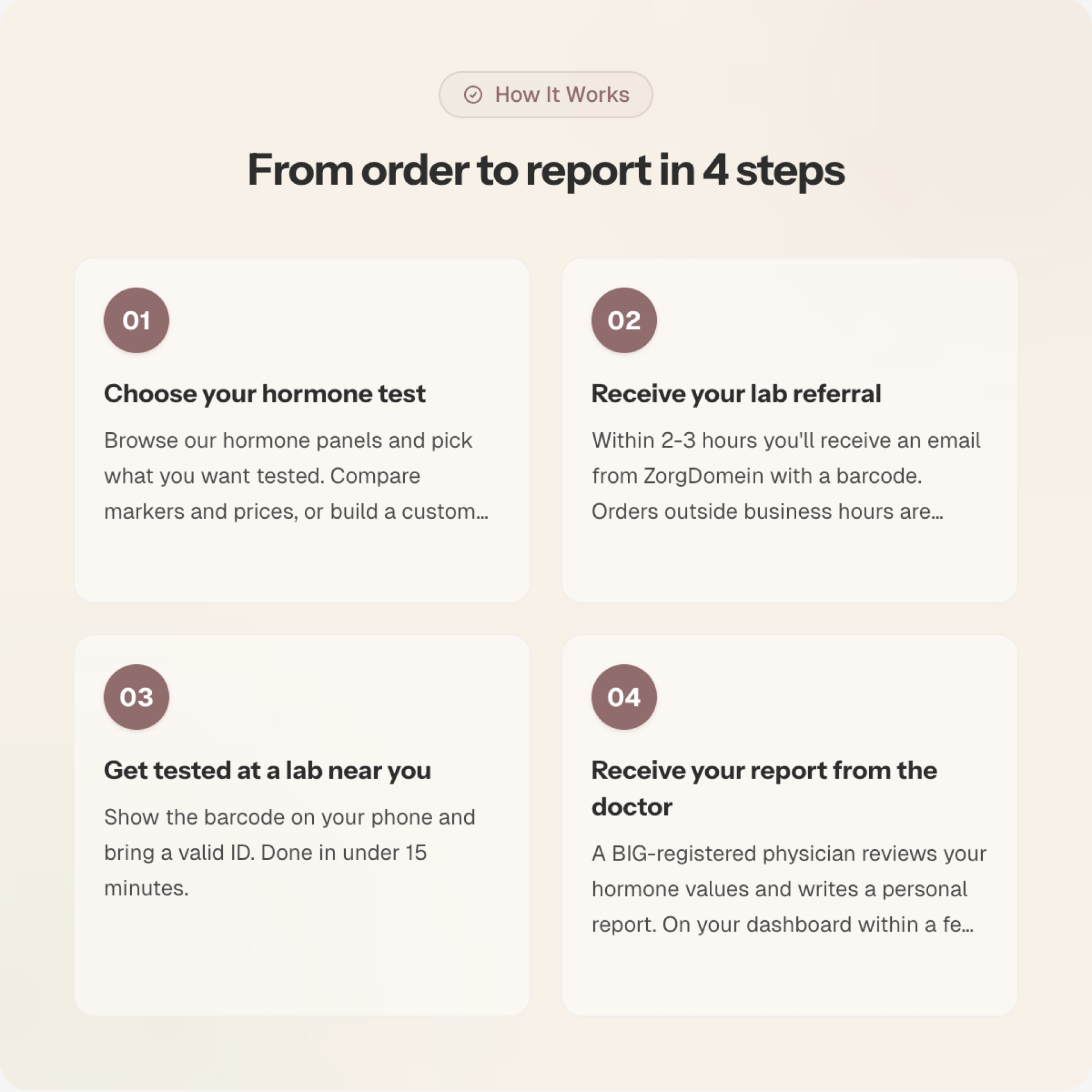
This test needs blood from a vein. You give your sample at a partner site near you. Those sites are run by independent, certified labs.
You usually do not need to fast. Many people give blood in the morning. Your values shift a little through the day, so this keeps results in step.
Do you take supplements with biotin? Those can throw the test off. Talk to the lab first.
When your result is ready
Turnaround differs per test. For TSH we plan on roughly two days. For free T4 and free T3 we plan on roughly four days.
Your full result is ready once the last test is in. This is our planning guide, not a firm promise. Labs differ from one another in turnaround.
Every result comes with a review by a BIG-registered doctor.
What your result means
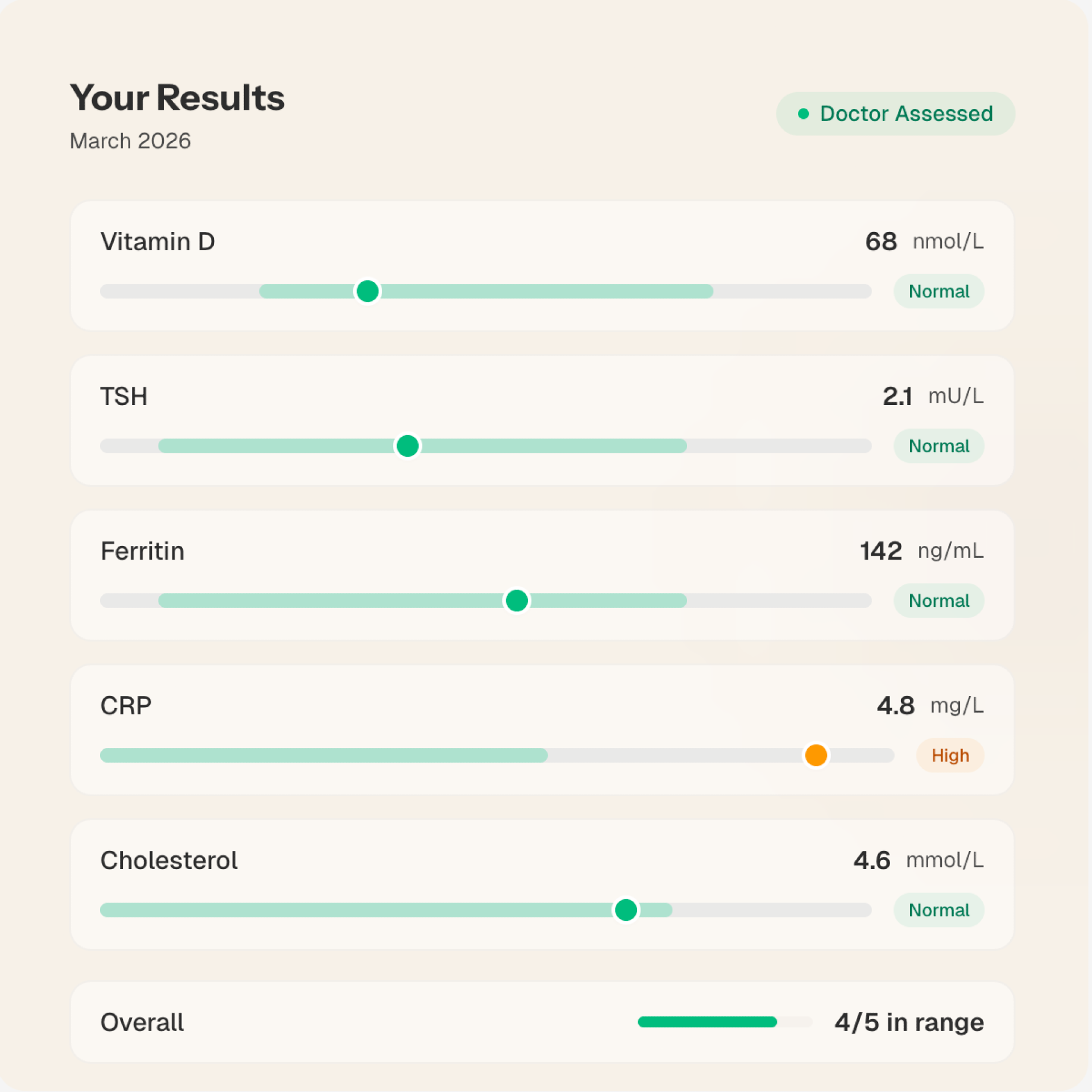
You get each value back with the lab reference range next to it. Those ranges differ per lab. So always read the range printed on your own result.
Does a value sit just outside that range? That is not a diagnosis in itself. A single test stays a snapshot.
The doctor says whether more tests are needed. Sometimes that is just a repeat after a few weeks. Sometimes it is the antibodies, to rule Hashimoto or Graves in or out.
Always talk through treatment choices with your own GP.
Values that sit right on the edge
Not every off-range value is clear cut. One well known picture is a mildly raised TSH with a normal free T4. Doctors call that subclinical.
A result like that rarely calls for treatment on its own. It does call for a repeat. TSH shifts from day to day, and even across the year.
So one test says little about a borderline case. A second test a few weeks later says far more. Put a result like that to your GP before you draw conclusions.
Frequently asked questions
Yes. You order this test online and give blood at a site near you. The sample goes to a certified lab. A doctor then reviews your result.
Through a blood test. TSH shows how hard your pituitary drives the thyroid. Free T4 and free T3 show how much hormone is there to use. Together those three give a full picture.
A slow thyroid often brings tiredness, feeling cold, weight gain, hair loss and low mood. A fast one brings a racing heart, sweating, unrest and weight loss. The signs are often put down to stress or menopause.
Yes, it can. Thyroid hormone helps set how fast food moves through your gut. A fast thyroid speeds that up, which can cause loose stools or diarrhoea. A slow thyroid often does the opposite and binds you up.
No. You order this test without a referral from your GP. You choose your own collection point and a moment that suits you.
It depends on the markers; each test shows whether fasting is needed. If it is, eat nothing after 22:00 the evening before and drink only water, for at least 8 hours. Skip coffee and tea that morning and have blood taken before 10:00.
You pay €99,-. The blood draw is already included, so nothing is added.
No, a test you request yourself is not part of the basic Dutch insurance. You pay it yourself, and your deductible (eigen risico) stays untouched.
Count on one business day, a day longer for an order after 17:00 or at the weekend: by then the referral email has arrived, and you cannot go before it does. Some draw sites then take walk-ins and the rest work by appointment. Each location says which.
Your barcode from the ZorgDomein email and a valid ID. Showing the barcode on your phone is fine. Without a BSN you get no barcode; print the referral form from the link in the email instead.
Yes, unless your own doctor said otherwise. Some markers ask for extra preparation, such as no alcohol for 24 hours or no heavy training for 48 hours. You see this on the test and in the instructions after you order.
You show your barcode and your ID at the draw site, and then your blood is taken. Allow about a quarter of an hour.
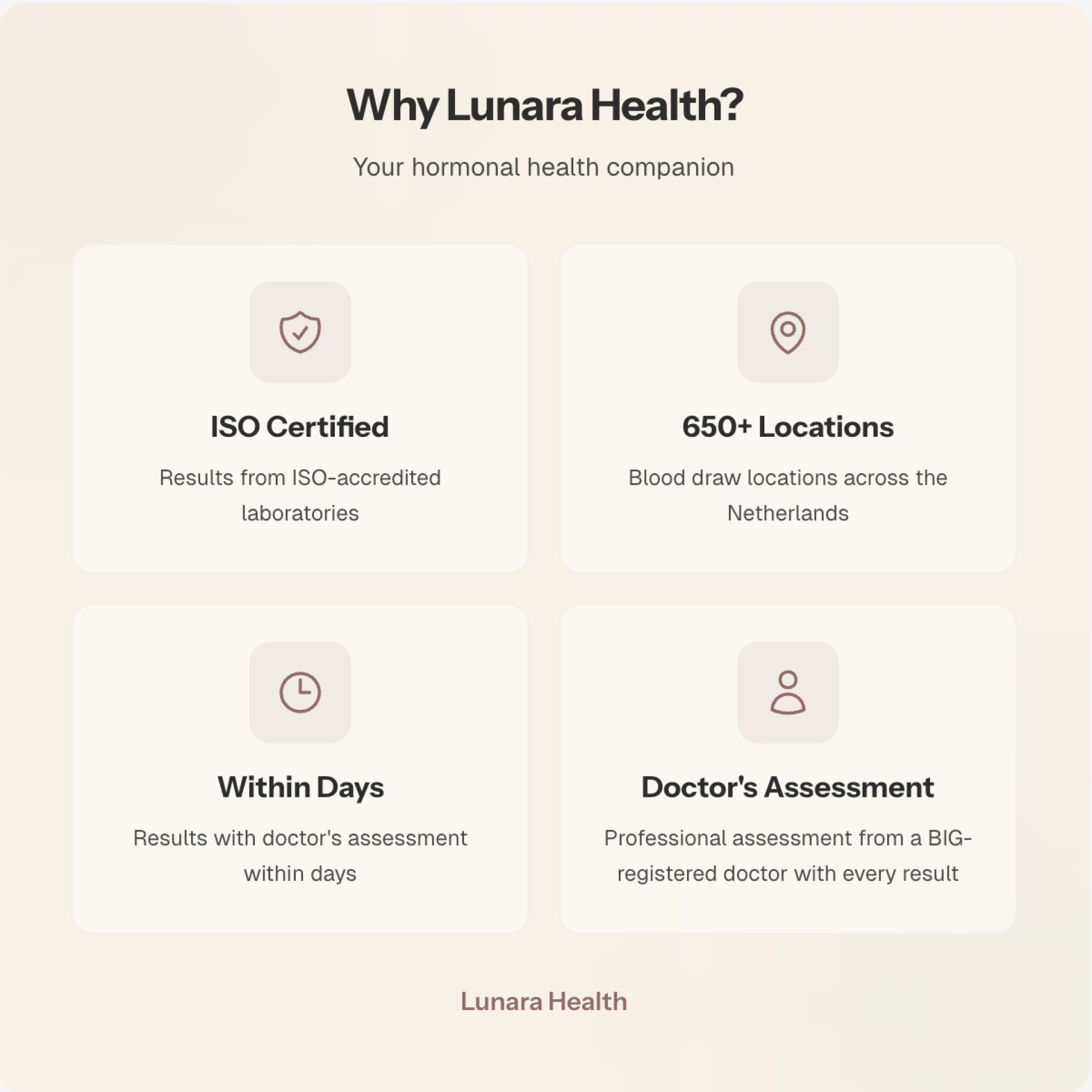
Yes, a BIG-registered doctor assesses every result and explains your values in your account. If you want treatment, discuss the result with your GP.
In one of the independent, certified laboratories across the Netherlands that Lunarahealth works with. They also run the draw sites, which Lunarahealth does not own. Reference values can differ a little between labs.
No, your test bypasses your GP and does not end up in your medical record. Data goes to a healthcare provider only with your written consent, and it is never sold. Anonymous is not possible: a valid result needs your name, date of birth and ID.
What We Test
| No. | Biomarker | Unit |
|---|---|---|
| 01 | TSH (Thyroid Stimulating Hormone) | mu/l |
| 02 | Free T4 (Thyroxine) | pmol/l |
| 03 | Free T3 (Triiodothyronine) | pmol/l |
| Your results are usually in your Lunarahealth account within 2 working days of the blood draw. The laboratory states a longer turnaround for Free T3 (Triiodothyronine) and Free T4 (Thyroxine). | ||
Preparation
-
Pause biotin
RequiredDo you take a supplement with biotin (vitamin B8, common in hair, skin and nail supplements)? Stop it 72 hours before the draw. Biotin interferes with the measurement of these values.
-
Timing worth knowing
Good to knowIf you repeat this test, pick the same time of day each time so the results compare.
-
On levothyroxine? Worth knowing
Good to knowTell the staff at the draw when you took your tablet; for most values the timing makes no difference.
- Water is always fine. Drink as usual beforehand, it makes the draw easier.
- Take your usual medication, unless your own doctor told you otherwise.
Extend this panel
Same draw, no second appointment.
You Might Also Like
Thyroid Complete
Full thyroid panel with antibodies to detect autoimmune thyroid disease.
Prenatal Essentials
Prenatal screening commonly included during pregnancy.
Graves Disease
TSH, Free T4, Free T3, and TSH Receptor Antibodies to help assess Graves' disease.