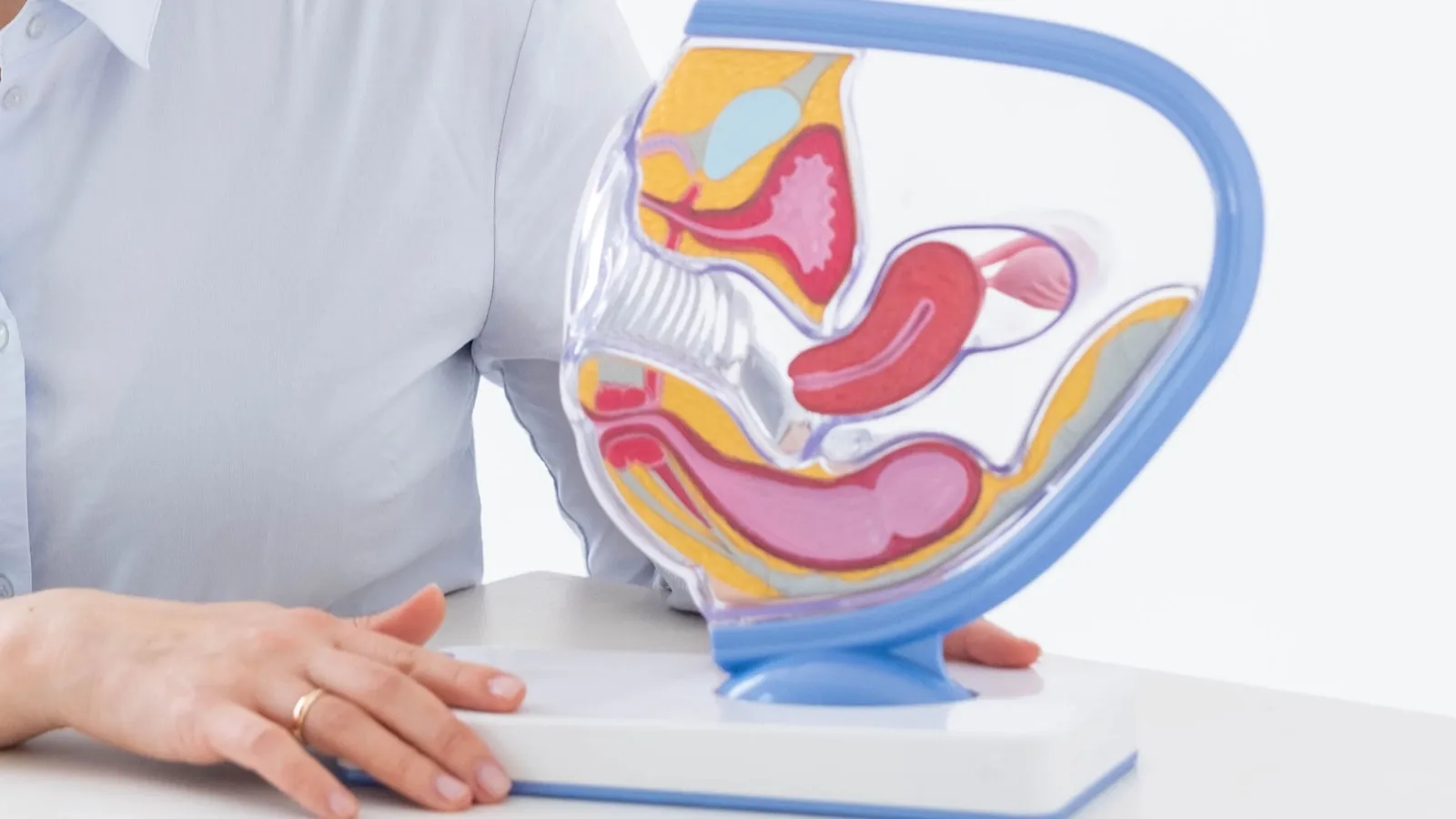
IVF stands for in-vitro fertilisation, literally fertilisation in glass. Your eggs and sperm meet in the lab, and the embryo that grows from them is placed back into your uterus. One round takes roughly eight weeks, from the first hormone injection to the pregnancy test.
Here is what strikes me about almost everything written on IVF: it is all about the treatment. The stimulation, the retrieval, the transfer. About the blood work that comes before any of it, there is almost nothing.
That seems backwards to me, because the blood work is the part you can actually act on before you are sitting in a waiting room.
Below you will find what IVF is, how the process runs, which blood values the clinic checks first, and why you get screened for rubella and CMV. Almost nobody asks that last question, and the answer explains what the whole infection screen is really for.
What is IVF exactly?
In IVF, the clinic collects several eggs from your ovaries and brings them together with sperm in the lab. Fertilisation happens outside your body, in a dish. If an embryo grows, the doctor places it back into your uterus. IVF replaces fertilisation, not pregnancy.
The difference from a normal cycle is one of numbers. Usually one egg matures per month. In IVF you take hormones so several follicles grow at once, which raises the odds that a usable embryo is among them.
The technique is older than most people think. The first IVF baby was born in 1978. More than forty years on, it is routine, not an experiment.
How does an IVF cycle work, step by step?
An IVF round has six steps and takes about eight weeks. You start with preparation and hormone stimulation. Then comes the retrieval, when the mature eggs are drawn out. Fertilisation happens in the lab, an embryo goes back a few days later, and about two weeks after that you take a pregnancy test.
- Preparation. Often you start on the pill, so your cycle can be timed.
- Hormone stimulation. Ten to fourteen days of daily injections, so several follicles grow.
- Retrieval. A thin needle passes through the vaginal wall and draws out the mature eggs.
- Fertilisation in the lab. Egg and sperm are placed together in a dish (IVF), or a single sperm is injected (ICSI).
- Transfer. Two to five days later, usually one embryo goes back.
- The wait. About two weeks until the test. That is the hardest part, most people tell us.
During stimulation you come in regularly for scans and blood draws. Your estradiol shows how fast your follicles are growing, and that helps decide when the retrieval is scheduled. What that day actually looks like is in our article on the IVF egg retrieval.
Which blood values are tested before IVF?
Before an IVF cycle, the clinic looks at three things: how many eggs you still have in reserve, whether your thyroid and nutrient status are in order, and whether you are immune to a handful of infections. Together that quickly adds up to eighteen to twenty-six blood values.
| Block | Blood values | What the clinic is looking for |
|---|---|---|
| Ovarian reserve and hormones | AMH, FSH, LH, estradiol (E2), progesterone, prolactin | A sense of how many eggs are still available and how your ovaries may respond to stimulation |
| Thyroid and nutrient status | TSH, free T4, anti-TPO, vitamin D, vitamin B12, folate, ferritin | Whether something is in play that relates to pregnancy and can often be followed simply |
| Infection serology | HIV, HBsAg, anti-HBc, anti-HCV, syphilis, chlamydia IgG, rubella IgG, toxoplasmosis IgG, CMV IgG, varicella zoster | Whether you are immune or a carrier, with an eye on risks during pregnancy and safety in the lab |
| Baseline data | Blood group and rhesus factor, D-dimer, complete blood count | Values that are needed in any pregnancy anyway |
This is exactly how our IVF blood test with eighteen values and the complete version with twenty-six are built. Not because we invented something clever, but because fertility clinics work with roughly this set.
Your clinic decides what makes sense in your situation. We provide the values, with an assessment from a doctor alongside them.
Why does the clinic screen you for rubella, CMV and toxoplasmosis?
Because those infections can harm a baby during pregnancy, and because you would rather know beforehand than afterwards. The test looks at whether you have been infected in the past and made antibodies. If you are not immune, you know to be more careful.
Rubella is the clearest example. A rubella infection early in pregnancy can cause birth defects of the heart, eyes and hearing. In a classic British study, more than eighty percent of babies were infected when the mother caught rubella in the first twelve weeks, and every child infected before week eleven had defects (PMID 6126663).
The RIVM keeps immunity high in the Netherlands through the MMR vaccination in the national programme. If you were vaccinated, you see it as a positive rubella IgG.
There is no vaccine for CMV or toxoplasmosis. So it is not about a jab, it is about knowing. With CMV the gap is large: after a first infection during pregnancy roughly 32 percent of babies are infected, against 1.4 percent after a past infection (PMID 17579921).
With toxoplasmosis, timing matters. Transmission rises from around 6 percent near week thirteen to 72 percent near week thirty-six, while it is the early infections that can do the most damage (PMID 10359407). If you are already immune, that worry is largely gone. If you are not, raw meat and the cat litter tray suddenly become a real consideration.
And this is what I find genuinely frustrating about most IVF explainers. The screen is treated as a box on a form. Yet the result can change how you live through a pregnancy.
What does your AMH say about the number of eggs?
AMH is a hormone made by your small follicles. The higher your AMH, the more eggs are typically ready to respond to stimulation. So it mostly predicts the harvest at retrieval, and it predicts far less well whether you will get pregnant. That distinction gets lost in nearly every conversation.
Imagine two women, both 34. One has an AMH of 3.5 ng/ml, the other 0.8. At retrieval, the first will probably yield more eggs. The second can still get pregnant perfectly well, because you only need one that works.
AMH is a measure of quantity, not of quality. Your age says more about egg quality than your AMH does.
A review of 42 studies found that AMH and antral follicle count predict the response to stimulation about equally well (PMID 37370145). AMH is not magic. It is simply easier to draw than a scan is to perform.
If you want your own value in context, we have a separate article on AMH levels by age. You can also measure AMH on its own.
What are the success rates of IVF?
That depends mostly on your age, and on how many attempts you make. In a British study of nearly 157,000 women, a first IVF cycle with your own eggs led to a live birth in 32.3 percent of women under 40. Between 40 and 42, it was 12.3 percent (PMID 26717030).
So there is no single number for the success rate of IVF. Anyone who gives you one is leaving something out.
More importantly, the odds accumulate. After six complete cycles, the cumulative live-birth rate for women under 40 reached 68.4 percent. A second study of nearly 179,000 women found a cumulative rate between 42.3 and 57.1 percent after three complete cycles, depending on how drop-outs are counted (PMID 26783243).
The gap between those two figures is not a detail, and clinics have been known to quote selectively from it. We unpack it in our article on IVF success rates by age and by cycle.
IVF or ICSI: when does the clinic choose which?
ICSI is not a different treatment. It is a different action in the lab. In IVF, egg and sperm are left to do the work in a dish. In ICSI, an embryologist injects a single sperm straight into the egg. The stimulation, retrieval and transfer are identical.
ICSI was designed for situations where sperm quality is poor. Yet it is often used when that is not the case. A 2023 Cochrane review found no demonstrated live-birth advantage for ICSI in couples without a male factor, on low-certainty evidence (PMID 37581383).
That is exactly the kind of nuance that rarely reaches a kitchen table. The full difference is in our article on IVF or ICSI.
What are the downsides of IVF?
IVF is physically and emotionally heavy. You inject yourself for weeks, you come in often for checks, and the outcome stays uncertain. There is also a risk of overstimulating your ovaries, known as OHSS. That is why you are monitored so closely.
We know how often that happens with reasonable precision. In a Danish registry of 186,168 stimulated cycles, roughly 1.2 percent led to a hospital admission for severe OHSS (PMID 33543701).
OHSS is more common in women with a high AMH or with PCOS, precisely because their ovaries respond strongly to stimulation. Clinics now adjust the dose accordingly. So do not read your AMH as a score. Read it as information that can make your stimulation safer.
Honestly, too: the process asks a lot of a relationship and of your calendar. That deserves saying, because it rarely appears in the leaflet.
What does IVF cost and what is reimbursed?
In the Netherlands, part of IVF treatment is covered by the basic health insurance, and you also contribute through your own risk excess. Exactly how many attempts are covered and what falls outside depends on your policy and on the year. Your own insurer is the only reliable source on that.
What almost nobody adds: the number of funded attempts matters so much precisely because the odds build up across attempts. That makes it a medically relevant boundary, not an accounting footnote. We work it through in the article on IVF costs and reimbursement.
When does IUI come first?
IUI stands for intrauterine insemination. Washed sperm is placed directly into your uterus, around the time you ovulate. There is no retrieval and nothing is fertilised in a lab. It only shortens the sperm's journey.
That is why IUI only works if your tubes are open and you actually ovulate. If those two conditions are not met, IUI will not help, however often you try. Our article on IUI treatment explains where that ladder comes from.
What can you already test while you wait?
Waiting lists for a Dutch fertility clinic can run to months. In that time you can measure the values the clinic will ask for anyway: your hormone status, your thyroid, your vitamin D and your ferritin. Then those months are not dead time.
I will say plainly that this replaces nothing. The clinic runs its own workup and sets its own policy. But walking in with results is a different conversation from walking in with an empty folder.
The thyroid is the most underrated block here. A meta-analysis of 4,876 women found that thyroid autoimmunity is associated with a lower chance of live birth and a higher chance of miscarriage in IVF (PMID 27323769). The authors themselves warn that association is not causation, and treatment with thyroid hormone has not shown a live-birth benefit in trials. It is still a value you can simply have measured, alongside TSH.
Practically: the IVF blood test covers the hormone block and the infection serology. The complete version adds thyroid and nutrient status. If you are not sure you are that far along, the fertility assessment with AMH, FSH, LH and estradiol is a gentler start.
Then call your GP or your clinic and lay the results side by side. They weigh what it means for you. NHG and Thuisarts take as a starting point that subfertility applies after a year of unprotected intercourse without pregnancy, and that conversation usually begins at your GP.
References
- Smith ADAC, Tilling K, Nelson SM, Lawlor DA. Live-birth rate associated with repeat in vitro fertilization treatment cycles. JAMA. 2015;314(24):2654-2662. PMID 26717030.
- McLernon DJ, Maheshwari A, Lee AJ, Bhattacharya S. Cumulative live birth rates after one or more complete cycles of IVF: a population-based study of linked cycle data from 178,898 women. Hum Reprod. 2016;31(3):572-581. PMID 26783243.
- Liu Y, Pan Z, Wu Y, Song J, Chen J. Comparison of anti-Müllerian hormone and antral follicle count in the prediction of ovarian response: a systematic review and meta-analysis. J Ovarian Res. 2023. PMID 37370145.
- Cutting E, Horta F, Dang V, van Rumste MME, Mol BWJ. Intracytoplasmic sperm injection versus conventional in vitro fertilisation in couples with males presenting with normal total sperm count and motility. Cochrane Database Syst Rev. 2023;8(8):CD001301. PMID 37581383.
- Tomás C, Colmorn L, Rasmussen S, Lidegaard Ø, Pinborg A, Nyboe Andersen A. Annual incidence of severe ovarian hyperstimulation syndrome. Dan Med J. 2021. PMID 33543701.
- Busnelli A, Paffoni A, Fedele L, Somigliana E. The impact of thyroid autoimmunity on IVF/ICSI outcome: a systematic review and meta-analysis. Hum Reprod Update. 2016;22(6):775-790. PMID 27323769.
- Miller E, Cradock-Watson JE, Pollock TM. Consequences of confirmed maternal rubella at successive stages of pregnancy. Lancet. 1982;2(8302):781-784. PMID 6126663.
- Kenneson A, Cannon MJ. Review and meta-analysis of the epidemiology of congenital cytomegalovirus infection. Rev Med Virol. 2007;17(4):253-276. PMID 17579921.
- Dunn D, Wallon M, Peyron F, Petersen E, Peckham C, Gilbert R. Mother-to-child transmission of toxoplasmosis: risk estimates for clinical counselling. Lancet. 1999;353(9167):1829-1833. PMID 10359407.
- RIVM. Information on rubella and the Dutch national immunisation programme. Available via rivm.nl.
- NHG and Thuisarts. Information on subfertility and fertility testing. Available via thuisarts.nl.
Every blood test result at Lunara includes a professional assessment by a BIG-registered doctor. For treatment decisions, discuss your results with your GP.
See Lunarahealth more often in Google
Add us as a preferred source. Google will then show our articles more often in your search results and in AI overviews. You can turn this off again at any time.
That did not work. Please try again.
Author
Lunarahealth
Dr. Naimi, BIG-registered physician, oversees the medical standards behind our content and assessments. Read our medical policy


