SHBG is a protein that holds your testosterone and makes it unusable for your tissue. Only the loose fraction is active, and in women that is roughly 1 to 2 percent of the total. So your total testosterone can look perfectly normal while your symptoms fit either too much or too little androgen.
For me this is the most underrated value on a female hormone profile. Not because SHBG itself causes symptoms, but because it decides how every other number should be read.
Below is what the value does, why the pill changes it so strongly, and how two numbers give you something usable.
What does SHBG actually do?
SHBG stands for sex hormone binding globulin and is made in your liver. It binds testosterone tightly and oestradiol more loosely, holding them in the bloodstream.
When your SHBG rises, more hormone is locked up and less remains for your tissue. When SHBG falls, more comes free.
Your total testosterone can stay identical throughout. That is exactly where things go wrong if you look at that one number alone. A review of SHBG as a biomarker describes this dual role in detail (PMID 26522459).
What raises and what lowers your SHBG?
SHBG is sensitive to your liver, your thyroid and your insulin. That makes the value useful as context, because an abnormal SHBG often points to something other than the hormones themselves. Ask your own laboratory for its reference ranges, because they differ by method.
| Direction | What causes it | What free testosterone then does |
|---|---|---|
| SHBG up | Combined pill containing oestrogen | Clearly lower |
| SHBG up | Overactive thyroid | Lower |
| SHBG up | Pregnancy | Lower |
| SHBG up | Liver disease, marked weight loss | Lower |
| SHBG down | Insulin resistance and excess weight | Higher |
| SHBG down | Underactive thyroid | Higher |
| SHBG down | PCOS | Higher |
The right-hand column is the point. SHBG and free testosterone nearly always move in opposite directions, so a story pointing one way without the other rarely holds.
Why does the pill triple your SHBG?
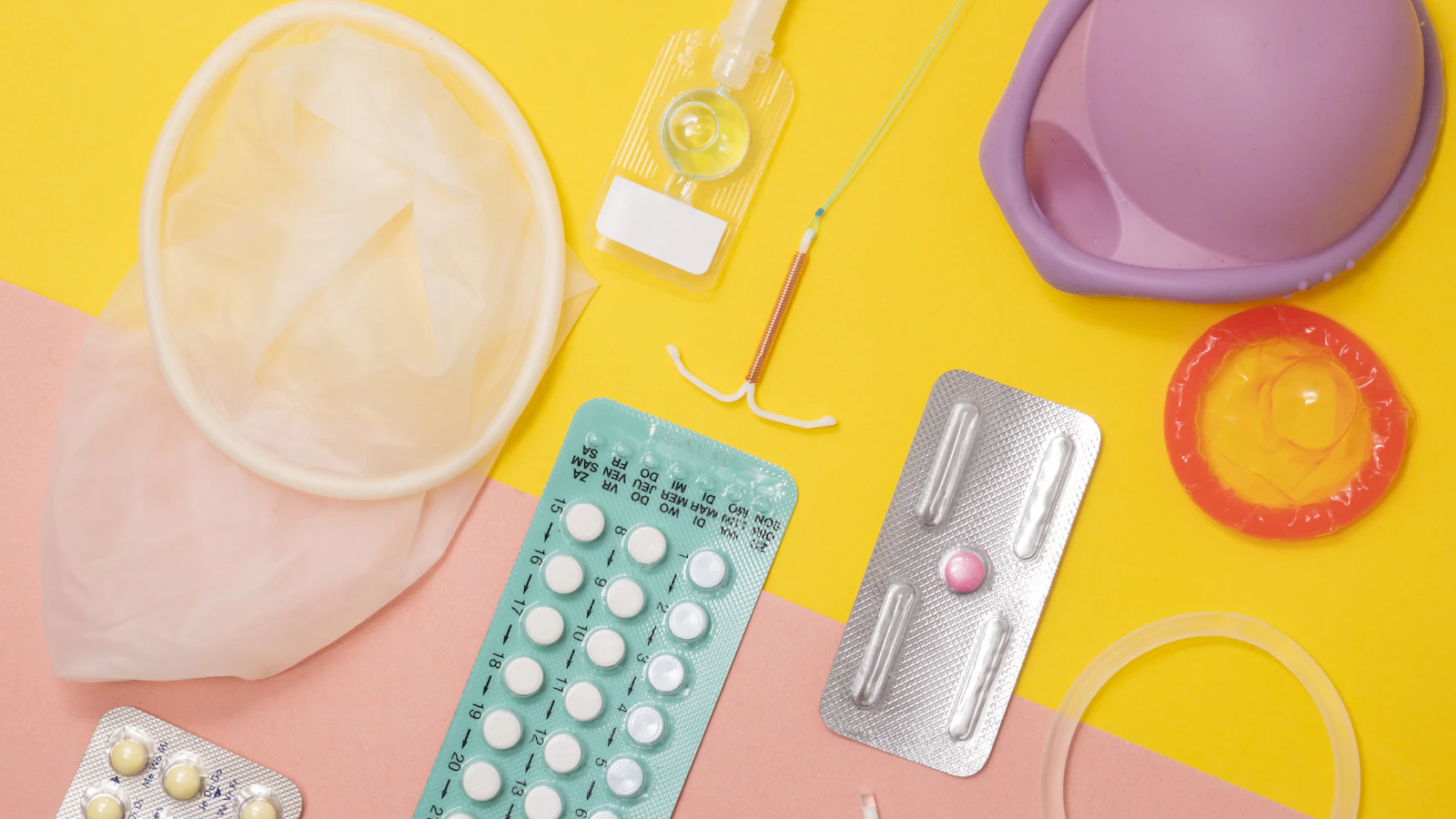
The oestrogen in the combined pill prompts your liver to make more SHBG. That effect is large and well documented. A meta-analysis of 42 studies found the combined pill more than triples SHBG and lowers free testosterone by about 61 percent (PMID 24082040).
That is not a marginal side effect, that is a different hormonal landscape.
In practice it means an androgen profile is barely interpretable while you take the pill. A normal or low free testosterone then proves nothing, because the pill pushes it down regardless. The same study found SHBG does not immediately return to baseline after stopping.
If you want your androgens assessed, the usual route is to do it off the pill and let your GP think along about timing. What else changes on stopping is in coming off the pill and the pill and side effects.
Why does SHBG matter so much in PCOS?
In PCOS, SHBG is often low, and insulin is largely responsible. Higher insulin levels suppress SHBG production in your liver, leaving more free testosterone at the same total.
That produces the picture many women recognise: a total testosterone the GP calls normal, while acne, hair growth and a long cycle tell a different story.
The 2023 international guideline therefore uses a calculated free androgen value rather than the total alone (PMID 37580861). The insulin side is in PCOS and insulin resistance.
How do you work out the free androgen index?
The free androgen index, or FAI, is the simplest way to read your total testosterone and your SHBG together. You divide total testosterone by SHBG and multiply by one hundred. Both values must be in nmol/l, otherwise the result is wrong.
Take two women who both have a total testosterone of 2.0 nmol/l. One uses the combined pill and has an SHBG of 90 nmol/l, giving an FAI of 2.2. The other has insulin resistance and an SHBG of 20 nmol/l, giving an FAI of 10. Same total, an androgen exposure differing by a factor of four.
In adult women an FAI below roughly 5 is generally regarded as normal, though that cut-off differs by laboratory and method. Use your own lab cut-off and always let your GP weigh the result.
The FAI is an estimate, not a measurement. A classic evaluation of the calculation methods showed the derived value becomes less reliable when SHBG is abnormal, exactly the situation in which you want to use it (PMID 10523012). So treat the outcome as direction, not verdict.
What does a low SHBG mean?
A low SHBG means relatively more free testosterone is available. In women that often accompanies insulin resistance, weight around the abdomen, PCOS or an underactive thyroid.
Symptoms that can fit include acne along the jawline, more hair growth on face, abdomen or chest, and thinning hair at the crown. That combination is worked out in hyperandrogenism.
A low SHBG is not a diagnosis by itself. It is a signal that the rest of the profile needs reading differently. If the androgen comes from your adrenal rather than your ovary, the picture shifts again, see DHEA and DHEA-S.
What does a high SHBG mean?
A high SHBG leaves less free testosterone. In women that mainly comes from oestrogen-containing contraception, an overactive thyroid or pregnancy.
Symptoms sometimes reported are lower sex drive, less energy and a flatter mood. These are not specific, so they prove nothing on their own.
With a markedly raised SHBG and no clear explanation, your GP usually also looks at your thyroid and your liver, see thyroid values explained.
When is SHBG requested?
SHBG is rarely requested alone. It usually comes alongside testosterone when there are signs of androgen excess, while working out PCOS, or when a total testosterone does not match the symptoms.
If you menstruate regularly, blood is often drawn on day 2 to 5 so the whole set is comparable. Fasting is not needed for SHBG.
The explanation of the value itself is on SHBG and on free testosterone. Which hormones together give a usable picture is in hormone testing in women, and hormones for women includes these values.
Discuss an abnormal result with your GP, and bring which contraception you use and since when. Without that information an SHBG cannot be weighed.
References
- Zimmerman Y, Eijkemans MJC, Coelingh Bennink HJT, Blankenstein MA, Fauser BCJM. The effect of combined oral contraception on testosterone levels in healthy women: a systematic review and meta-analysis. Hum Reprod Update. 2014;20(1):76-105. PMID 24082040.
- Thaler MA, Seifert-Klauss V, Luppa PB. The biomarker sex hormone-binding globulin: from established applications to emerging trends in clinical medicine. Best Pract Res Clin Endocrinol Metab. 2015;29(5):749-760. PMID 26522459.
- Vermeulen A, Verdonck L, Kaufman JM. A critical evaluation of simple methods for the estimation of free testosterone in serum. J Clin Endocrinol Metab. 1999;84(10):3666-3672. PMID 10523012.
- Teede HJ, Tay CT, Laven JJE, et al. Recommendations from the 2023 international evidence-based guideline for the assessment and management of polycystic ovary syndrome. Eur J Endocrinol. 2023;189(2):G43-G64. PMID 37580861.
- Thuisarts. I have an abnormal blood test result. Available via thuisarts.nl.
Every blood test result at Lunara includes a professional assessment by a BIG-registered doctor. For treatment decisions, discuss your results with your GP.
See Lunarahealth more often in Google
Add us as a preferred source. Google will then show our articles more often in your search results and in AI overviews. You can turn this off again at any time.
That did not work. Please try again.
Author
Lunarahealth
Dr. Naimi, BIG-registered physician, oversees the medical standards behind our content and assessments. Read our medical policy