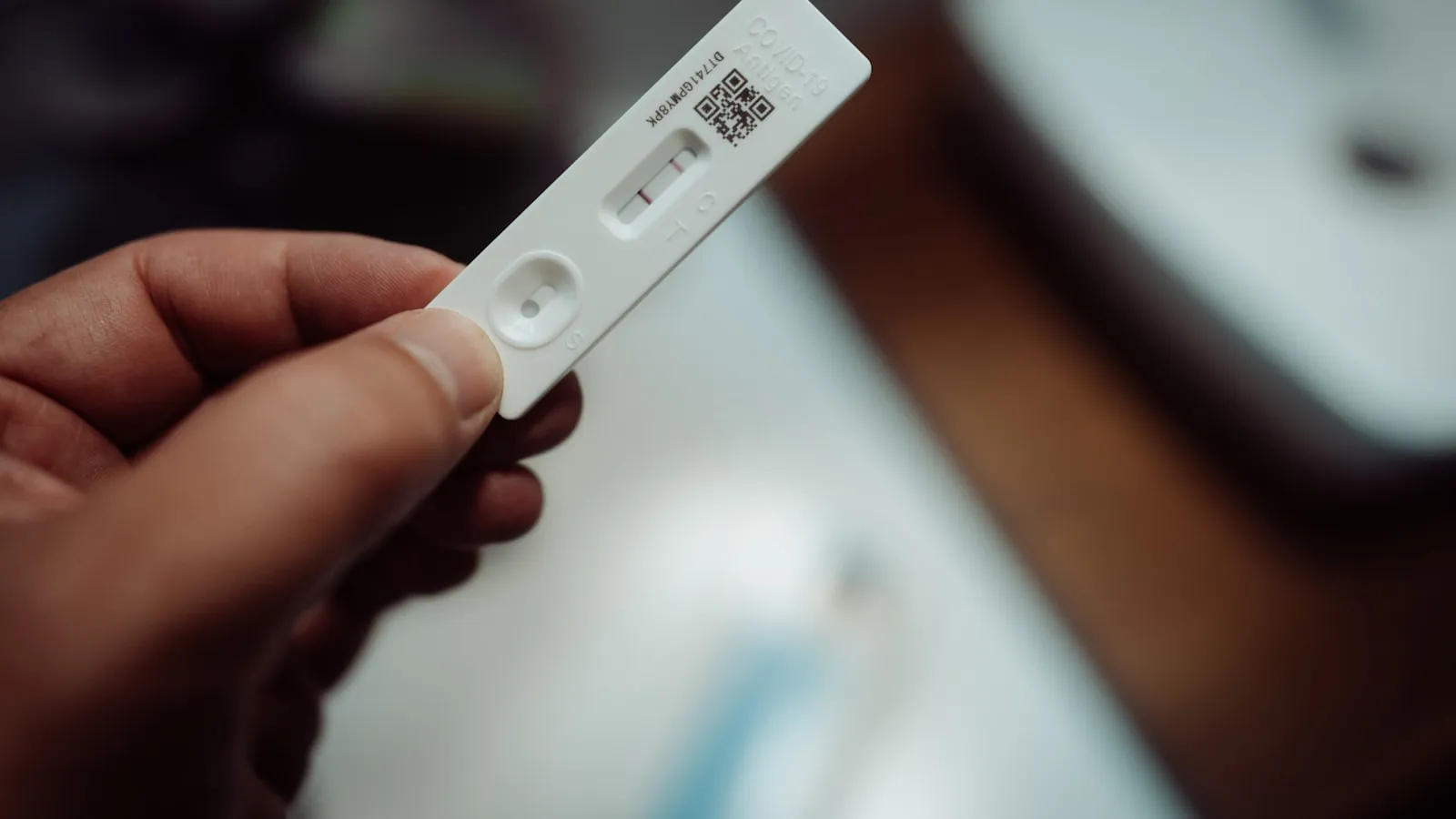
A pregnancy test always measures the same hormone: hCG. The difference between blood and urine is not in what is measured, but in how and how precisely. A urine test from the chemist gives a yes or no, while a pregnancy test by blood gives an exact hCG value in numbers. For most women, a good urine test is more than enough.
At Lunara we regularly get the question of whether a blood test is better than a test from the chemist. The honest answer: usually not, but in a few specific situations a blood test does add something.
Below I explain exactly what the difference is, which test is earlier and more reliable, and when a blood test can really be worth doing.
What is the difference between a blood and urine test?
Both tests detect the same pregnancy hormone: human chorionic gonadotropin, hCG for short. A urine test is qualitative and only shows whether hCG is present, so yes or no. A blood test is quantitative and measures the exact hCG concentration in numbers. That distinction is the key difference between the two.
After implantation, hCG is produced by the early placental tissue. It appears first in your blood and only later, at a lower concentration, in your urine. As a result, hCG is usually detectable slightly earlier and more accurately in blood than in urine.
You do a urine test yourself at home, while a blood test is done through a draw at a location.
In practice this means a urine test gives you a quick and reliable answer to the question am I pregnant, while a blood test also gives a number a doctor can use. You can read more about the hormone itself on our page about the hCG blood value.
Which test is more reliable and earlier?
A blood test is slightly more sensitive and can sometimes pick up hCG a few days earlier than a urine test. Even so, modern urine tests are accurate enough to be reliable from the day your period is due. For most women, that small time difference does not outweigh the convenience of testing at home.
The table below sets the two tests side by side.
| Feature | Blood test (quantitative) | Urine test (qualitative) |
|---|---|---|
| Reliable from | About 8 to 11 days after ovulation | Usually from the first day of a missed period |
| Sensitivity | Higher, detects low hCG values | Slightly lower, but ample around a missed period |
| Type of result | Exact number in IU/L | Yes or no (line or plus sign) |
| Effect of drinking a lot | Virtually no effect | Diluted morning urine can make an early result less clear |
| How fast the result | Usually within a few working days | Within a few minutes |
| Where | Draw at a location | At home |
The table shows that neither test wins on every point. A urine test is faster and easier, a blood test is more precise and gives a number.
A useful rule of thumb: if you test around or after your period is due, a urine test is almost always enough.
When is a blood test really worth doing?
For most women, a good urine test from the chemist is enough to know whether they are pregnant. A blood test mainly adds value if you want very early certainty, if you have just been through a fertility treatment, or if a doctor needs an exact hCG value to monitor or assess something.
A hCG blood test can be useful in these situations:
- You have been through an IVF or IUI pathway and the clinic wants to track the hCG value precisely
- Your urine test gives an unclear or changing result and you want clarity
- A doctor wants to assess the rise in hCG over a few days, for example with doubts about the location of the pregnancy
- You have had a miscarriage or ectopic pregnancy before and your care provider wants to monitor you more closely
If you want to know how quickly hCG should rise and what a healthy doubling means, read our article on the hCG doubling time.
If a quantitative measurement fits your situation, you can request a Pregnancy Blood Test with us without a referral. You book a slot at a draw location near you, receive your result digitally and get a professional assessment with it. If you are unsure whether a blood test adds anything in your case, discuss it first with your midwife or GP.
Important: a single hCG value says little on its own. Only in combination with your story, the trend over a few days and possibly an ultrasound does a complete picture emerge. That is why the result always belongs with your midwife or GP.
Qualitative versus quantitative hCG blood test
A qualitative test only shows whether hCG is present, just like a urine test. A quantitative blood test gives the exact hCG concentration in numbers, expressed in IU/L. That number makes it possible to compare a value with an earlier measurement and so assess the trend over time.
At Lunara we measure the quantitative version, because the number gives the most context. A single value mainly tells you whether hCG is there and in what order of magnitude.
The real information often lies in the trend: a second measurement after about two days shows whether the value is rising as expected.
A rising hCG value usually fits a developing pregnancy, but the spread between women is wide. Two healthy pregnancies can have quite different hCG values at the same point. That is why you never interpret a number in isolation, and always together with a care provider. For what the hCG value in early pregnancy actually means, see our in-depth guide to hCG in early pregnancy.
Frequently asked questions
Is a blood test more reliable than a urine test from the chemist?
A blood test is slightly more sensitive and can sometimes pick up hCG a few days earlier. For most women, though, a modern urine test around a missed period is plenty reliable. A blood test mainly adds something if you need an exact number or want very early certainty.
How early can a blood test detect a pregnancy?
A hCG blood test can often detect a pregnancy around 8 to 11 days after ovulation, so sometimes just before your period is due. Testing too early can still be negative while you are in fact pregnant. If in doubt, discuss with your midwife or GP when testing makes the most sense.
Do I need to fast for a hCG blood test?
No, you do not need to fast for a hCG blood test and you may simply drink. Unlike an early urine test, drinking a lot has hardly any effect on the hCG value in your blood. So you can have the draw at any time of day.
Sources
- Thuisarts.nl. I want to know whether I am pregnant. Dutch College of General Practitioners, 2023. Available via thuisarts.nl.
- NHG Guideline Miscarriage (M03). Dutch College of General Practitioners, 2020. Available via nhg.org.
- Allesovertesten.nl, knowledge platform of the NVKC (Dutch Society for Clinical Chemistry). Pregnancy test and hCG, 2023. Available via allesovertesten.nl.
Every blood test result through Lunara includes a professional assessment by a BIG-registered doctor. Always discuss a pregnancy with your midwife or GP.
Author