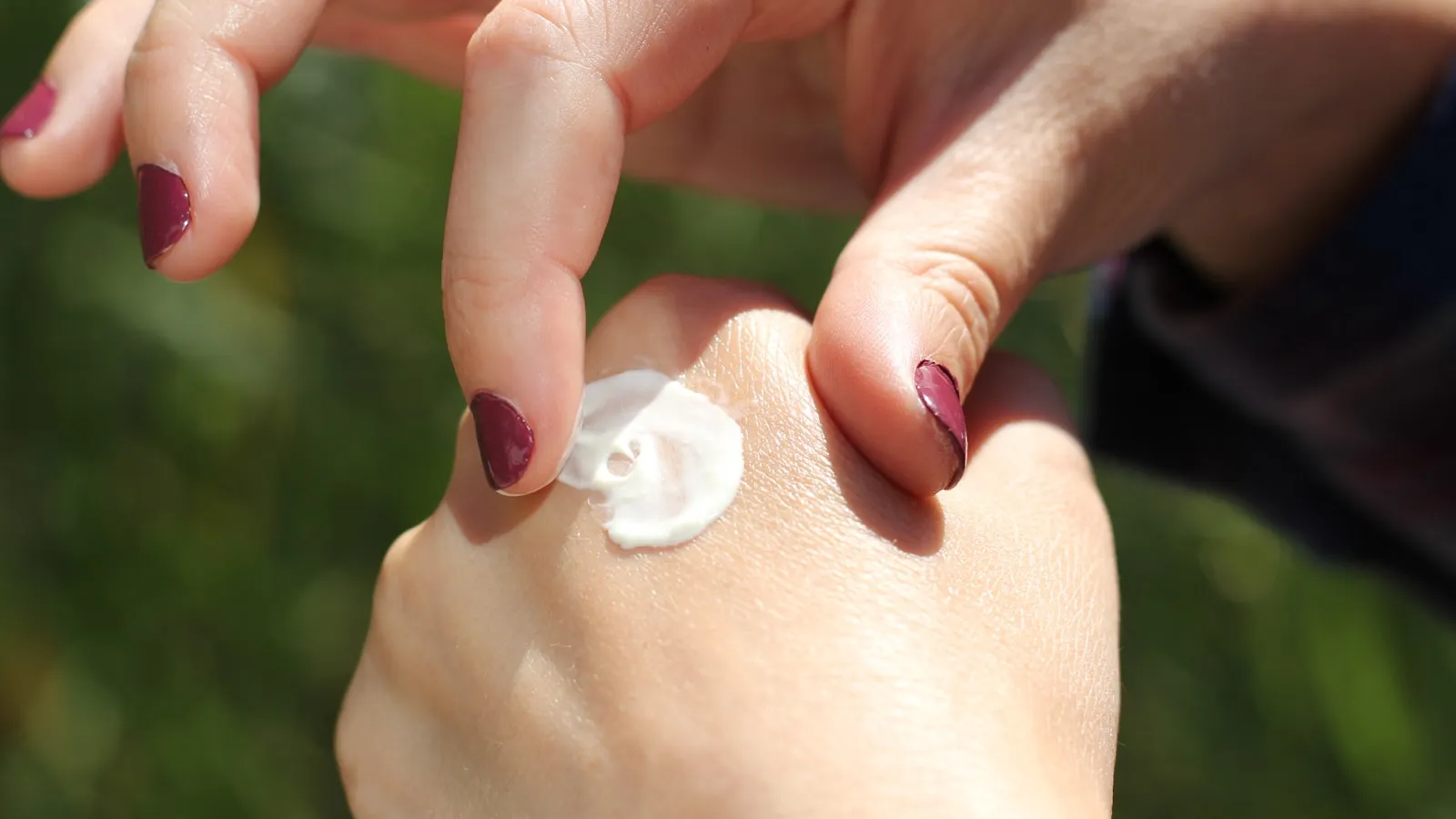
Itch in menopause is not a fringe symptom. Among 50 women attending a menopause clinic, 78% reported itch and 76% dry skin, and all 50 had at least one skin complaint (PMID 40172065). In a broader review of the research, itch was present in 46% of postmenopausal women (PMID 41331233).
Seen that way, you are the rule rather than the exception.
And still this is the topic that makes me most uneasy. Itch without a rash is also exactly the symptom where "it must be the menopause" can push something else out of view.
Why does your skin start itching in menopause?
Because your skin gets thinner and drier, and dry skin itches. Your skin cells, connective tissue cells and oil glands carry oestrogen receptors. As oestrogen falls, your skin makes less collagen and fewer barrier lipids. Moisture evaporates faster and the skin is irritated more easily.
The good thing about this research is that it separates menopause from plain ageing.
In a study of 32 women, collagen loss tracked the number of years since menopause (r = 0.76) more closely than it tracked calendar age (r = 0.59) (PMID 10656502). Older work found the same pattern (PMID 3978054). So it is not only time, it is that specific transition.
Take two women of 54. One is three years postmenopausal with skin that feels tight all over in winter. The other still has irregular periods and notices little. Same age, different number of years since a last period.
How much collagen do you really lose after menopause?
Roughly 1 to 2% a year. That is the figure that was actually measured, in a study where skin collagen, skin thickness and bone density all fell at that rate (PMID 3120067). Online you usually read something else, namely 30% in the first five years, and that number does not hold up.
I followed that trail, because it sits on dozens of pages.
It surfaces in a 2013 review article, where it appears as "is thought to" (PMID 24194966). Neither of the two sources that article points to contains the figure. And it does not add up: 2% a year over five years comes to about 10%, not 30%.
That does not make the story less true. Your skin genuinely changes, measurably. Just not three times as fast as the internet says.
That same oestrogen decline shows up in places you would not connect to it. In your eyes, which I work through in dry eyes in menopause, and in your joint capsule in frozen shoulder in menopause.
Why is it worse in the evening and at night?
Partly your skin and partly the rest of your night. Your skin temperature rises in the evening and you lose more moisture through it, which lowers the itch threshold. Something else joins in during this phase that rarely gets a mention: hot flushes and night sweats put your skin to extra work.
And if you are lying awake anyway, nothing distracts you from your skin.
Some women describe something other than itch, namely the feeling of something crawling over their skin. That is called formication and it is a recognised phenomenon in menopause. How common it is I do not know: the percentages circulating about it sit unsourced on consumer sites, so I would rather not quote them.
Poor sleep makes all of this heavier. That side is in poor sleep in menopause.
When is itch not a menopause symptom?
When there is nothing to see on your skin and the itch persists. Whole-body itch without a rash is a different kind of complaint from a dry shin in February. In persistent adult itch, a condition elsewhere in the body turns out to be involved in 10 to 50% of cases (PMID 26240837).
That is exactly why a doctor looks past the skin here.
Dutch guidance on chronic itch describes which values usually come into view: a full blood count with differential, inflammation markers, ferritin, liver enzymes, kidney function, TSH and a fasting glucose. That is not a list to tick off yourself, it is what your GP weighs.
| What it might be | What is looked at in blood | What is known about it |
|---|---|---|
| Iron deficiency | Ferritin, haemoglobin, transferrin saturation | Among 200 people with long-standing itch, 29% had a ferritin under 15 (PMID 35283535). An association, not a proven cause. |
| Cholestasis and liver conditions | Alkaline phosphatase, gamma-GT, bilirubin, liver enzymes | Of 2,194 people with primary biliary cholangitis, 73.5% had experienced itch and 34.5% persistently (PMID 30557739). This condition mostly affects women around this age. |
| Reduced kidney function | Creatinine and eGFR, urea | Itch occurs in 20 to 50% of people with chronic kidney disease (PMID 26240837). |
| Overactive thyroid | TSH, free T4 | Itch in 4 to 11% of people with an overactive thyroid. With an underactive thyroid, itch is rare (PMID 26240837). |
| Raised blood sugar | Fasting glucose, HbA1c | Named in Dutch guidance as one of the trails to consider. |
Look at the second row. Primary biliary cholangitis is a liver condition in which more than nine in ten patients are women, peaking in exactly the years you attribute itch to your hormones. Itch is often its first sign, and it is the reason rash-free itch does not automatically belong in the menopause folder.
What a low ferritin means, and why you need not be anaemic for it, is in iron deficiency without anaemia. The thyroid and menopause distinction is in slow thyroid and menopause. An iron status panel looks at the iron side, a liver function panel at the liver side.
Incidentally, Dutch public GP guidance on itch names dry skin, allergy and eczema, but not menopause. The pages that do cover menopause never name that liver side. So both halves stay invisible to the person who needs both.
What do you take to your GP?
Whether there is anything to see on your skin, and where exactly. Whether the itch is all over or in fixed places. Since when it has been going on, and whether it is worse at night. And whether you noticed anything else: dark urine, pale stool, more tiredness than you know from yourself.
That last list sounds innocent and is the most informative.
Go sooner for whole-body itch lasting weeks without any visible skin change, for yellowing of your skin or the whites of your eyes, for unintended weight loss, or for night sweats that do not fit hot flushes.
For the wider picture of this phase, navigating perimenopause is the starting point.
References
- Brincat M, Kabalan S, Studd JW, Moniz CF, de Trafford J, Montgomery J. A study of the decrease of skin collagen content, skin thickness, and bone mass in the postmenopausal woman. Obstet Gynecol. 1987;70(6):840-845. PMID 3120067.
- Affinito P, Palomba S, Sorrentino C, et al. Effects of postmenopausal hypoestrogenism on skin collagen. Maturitas. 1999;33(3):239-247. PMID 10656502.
- Brincat M, Moniz CJ, Studd JW, et al. Long-term effects of the menopause and sex hormones on skin thickness. Br J Obstet Gynaecol. 1985;92(3):256-259. PMID 3978054.
- Thornton MJ. Estrogens and aging skin. Dermatoendocrinol. 2013;5(2):264-270. PMID 24194966.
- Roster K, Fleshner L, Karatas TB, et al. Menopause and common dermatoses: a systematic review. Am J Clin Dermatol. 2026;27(1):67-84. PMID 41331233.
- Salih H, Schaedel Z, Hum O, DeGiovanni C. Results of a patient survey exploring skin symptoms in a menopause clinic. Post Reprod Health. 2025;31(3):159-161. PMID 40172065.
- Tarikci N, Kocaturk E, Gungor S, et al. Pruritus in systemic diseases: a review of etiological factors and new treatment modalities. ScientificWorldJournal. 2015;2015:803752. PMID 26240837.
- Hegade VS, Mells GF, Fisher H, et al. Pruritus is common and undertreated in patients with primary biliary cholangitis in the United Kingdom. Clin Gastroenterol Hepatol. 2019;17(7):1379-1387. PMID 30557739.
- Saini S, Jain AK, Agarwal S, Yadav D. Iron deficiency and pruritus: a cross-sectional analysis to assess its association and relationship. Indian J Dermatol. 2021;66(6):705. PMID 35283535.
- Richtlijnendatabase. Chronic itch, diagnosis. Available via richtlijnendatabase.nl.
- Thuisarts. I have itch. Available via thuisarts.nl.
Every blood test result at Lunara includes a professional assessment by a BIG-registered doctor. For treatment decisions, discuss your results with your GP.
Author