

Kidney function test with creatinine, eGFR and urea
Creatinine, eGFR, and BUN: key kidney markers.
Add to your order
No referral needed
Added to your order
Click the button to view your cart
Included Markers
3 markersUrea (BUN), Creatinine, eGFR (Estimated Glomerular Filtration Rate)
Your kidneys quietly do their job every day: they filter waste from your blood, keep your fluid balance in check and help regulate your blood pressure. You rarely notice them at work, which is exactly why it can help to take a look under the hood at some point. A kidney function blood test can help you do that.
With a few markers in your blood, you get an impression of how well your kidneys are working right now. That gives you something concrete to hold on to instead of guessing, and you do not have to wait for symptoms first.
Why this test?
Your kidneys are small, hard-working filters that keep going around the clock. They remove waste products, regulate your salts and fluids, and play a role in your blood pressure. Because this often happens unnoticed, a kidney function test can give you a bit more insight into how your body is doing.
This test looks at a number of markers that can say something about the filtering function of your kidneys. Together they offer a picture you can calmly discuss with your GP.
Who is this test for?
This test can be interesting if you are curious about your kidney function, or if you are dealing with high blood pressure, diabetes in the family, or medication that can put extra load on your kidneys.
It can also fit if you simply want to have your kidneys checked without a specific reason. You decide for yourself when a measurement feels meaningful to you, without any pressure.
What is tested?
This kidney function blood test measures three markers in your blood:
- Creatinine: a waste product from your muscles that your kidneys normally filter out of your blood. Its level can say something about how well that filtering is going.
- eGFR (Estimated Glomerular Filtration Rate): a calculated estimate of how quickly your kidneys filter your blood, based partly on your creatinine, age and sex.
- Urea (BUN): a waste product formed when proteins are broken down and excreted through your kidneys.
Together these values give an impression of the filtering function of your kidneys.
What can this test tell you?
The results can give an impression of how well your kidneys filter your blood. Your eGFR estimates the filtration speed, while creatinine and urea show how much waste is circulating in your blood at that moment.
Your kidney function blood test in context
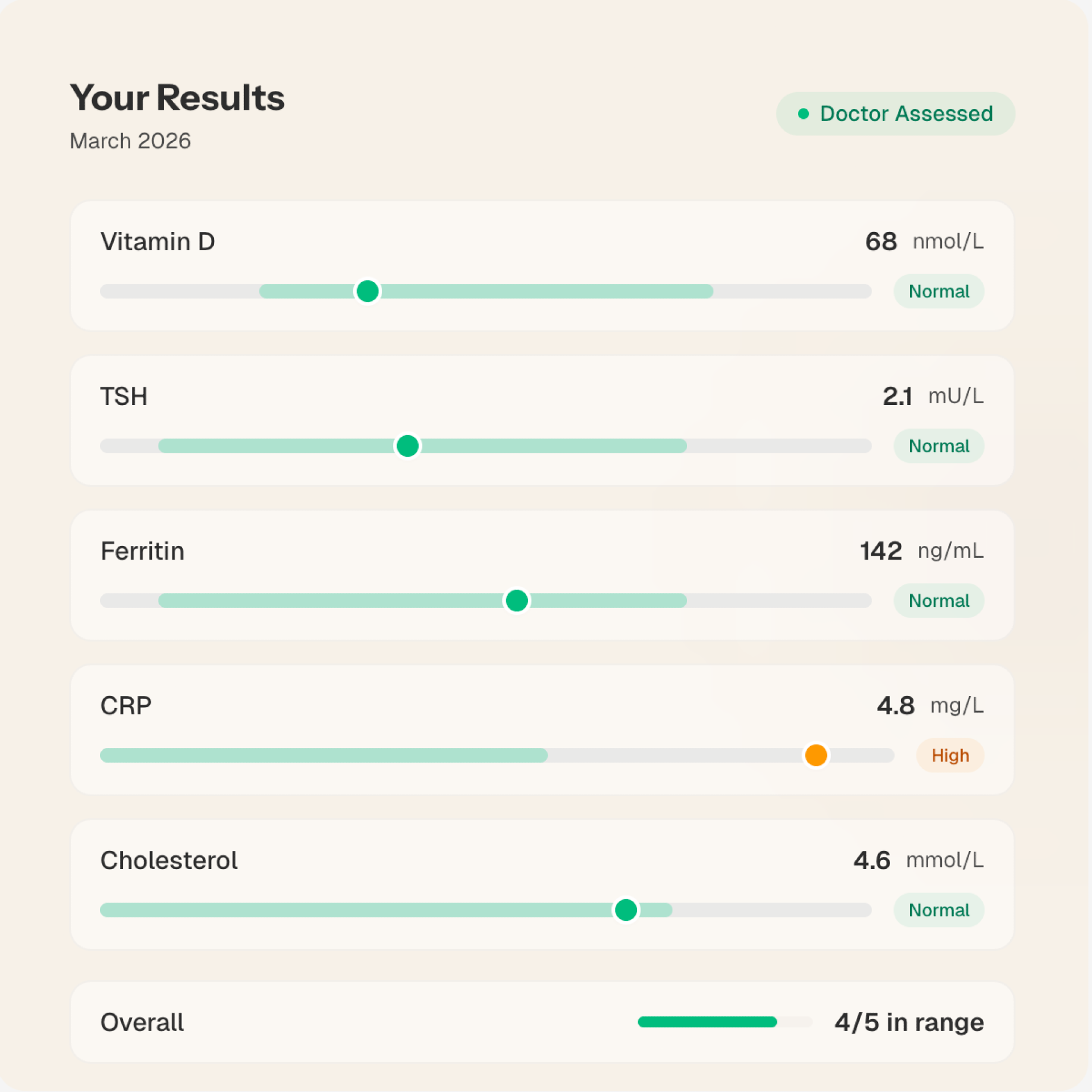
Good to know: these values are snapshots and can fluctuate due to things like your fluid intake, your diet or intense exercise. On their own they do not provide a diagnosis, but they can be a starting point for a conversation with your GP.
How is the sample collected?
This test requires a small blood draw at a certified lab. In the Netherlands you can choose from 650+ sample points, so there is almost always a location near you.
After ordering, you pick a location and a moment that suits you. The draw itself usually takes just a few minutes, and you do not need a referral from your GP.
When is this test useful?
Measuring your kidney function can be valuable at different moments, for example:
- when you want to have your kidneys checked without a direct reason
- when kidney problems, diabetes or high blood pressure run in your family
- when you use medication that can affect your kidneys
- when you want to map out your general health a bit better
A kidney function blood test then gives you a factual starting point to build on.
What do the results mean?
Your result shows each marker together with a reference range and a short explanation. What counts as usual can vary by laboratory and depends, among other things, on your age, sex and muscle mass.
A value outside the range does not automatically mean something is wrong. Creatinine can be higher after intense exercise or a protein-rich diet, for instance. The doctor helps you place your values in the right context.
What happens after the results?
Your results are usually in your Lunarahealth account within 2 working days of the blood draw, often the next day. Some markers take longer. Each value is shown clearly with a reference range and an explanation, so you understand what you see.
Every blood test result includes a professional assessment from a BIG-registered doctor. For treatment decisions, discuss your results with your GP.
Frequently Asked Questions
For most kidney markers you do not need to fast. It does help to drink enough around the draw and to avoid heavy exercise just beforehand, as those can temporarily influence your values.
Creatinine is a waste product that your kidneys filter from your blood. Your eGFR is a calculated estimate of the filtration speed, based partly on your creatinine value, age and sex.
No, you do not need a referral from your GP. You order the test online and choose a sample point near you.
A kidney function test mainly gives insight into how your kidneys filter your blood. It is one piece of the puzzle that says most in combination with other values and your personal situation, which you can discuss with your GP.
You pay €69,-. The blood draw is already included, so nothing is added.
No, a test you request yourself is not part of the basic Dutch insurance. You pay it yourself, and your deductible (eigen risico) stays untouched.
Count on one business day, a day longer for an order after 17:00 or at the weekend: by then the referral email has arrived, and you cannot go before it does. Some draw sites then take walk-ins and the rest work by appointment. Each location says which.
Your barcode from the ZorgDomein email and a valid ID. Showing the barcode on your phone is fine. Without a BSN you get no barcode; print the referral form from the link in the email instead.
Yes, unless your own doctor said otherwise. Some markers ask for extra preparation, such as no alcohol for 24 hours or no heavy training for 48 hours. You see this on the test and in the instructions after you order.
You show your barcode and your ID at the draw site, and then your blood is taken. Allow about a quarter of an hour.
Yes, a BIG-registered doctor assesses every result and explains your values in your account. If you want treatment, discuss the result with your GP.
In one of the independent, certified laboratories across the Netherlands that Lunarahealth works with. They also run the draw sites, which Lunarahealth does not own. Reference values can differ a little between labs.
No, your test bypasses your GP and does not end up in your medical record. Data goes to a healthcare provider only with your written consent, and it is never sold. Anonymous is not possible: a valid result needs your name, date of birth and ID.
What We Test
| No. | Biomarker | Unit |
|---|---|---|
| 01 | Urea (BUN) | mmol/l |
| 02 | Creatinine | umol/l |
| 03 | eGFR (Estimated Glomerular Filtration Rate) | ml/min/1,73m² |
| Your results are usually in your Lunarahealth account within 2 working days of the blood draw. The laboratory states a longer turnaround for Urea (BUN). | ||
Preparation
-
Better no hard training beforehand
RecommendedHard exercise in the 48 hours before can raise this value temporarily. Plan the draw on a rest day if you can.
- Water is always fine. Drink as usual beforehand, it makes the draw easier.
- Take your usual medication, unless your own doctor told you otherwise.
You Might Also Like
Liver Function
Liver Function Test (LFT).
Extended Health Checkup
Our broadest panel: CBC, thyroid, vitamins, lipids, liver, kidney, and HbA1c.
Basic Health Checkup
Key health markers: CBC, lipids, and Vitamin D.