In perimenopause migraine gets worse for many women, not better. In the American Migraine Prevalence and Prevention Study, covering 3,664 women, 8.0% of premenopausal women had ten or more headache days a month. In perimenopause that figure was 12.2% (PMID 26797693).
That is the phase in which you would least expect something new to arrive.
What strikes me most here: menopause is usually explained as a period of falling hormones. For migraine that is the wrong picture. It is not the fall that counts, but how unpredictable it becomes.
Why does migraine get worse in menopause?
Because your oestrogen does not taper neatly. In perimenopause it swings harder than in the years before. High peaks, deep troughs, and less and less regularity in when they arrive. Every sharp drop is a moment at which an attack can start.
While your cycle was regular, you had roughly one predictable drop a month. Now there can be several, at random moments.
Take two women of 48. In one, migraine comes 3 times a month, on ever changing days. In the other, the cycle is still regular and it stays at 1 attack around the period. The difference is not their age. It is how erratic their hormones already swing.
The underlying explanation is the same as for menstrual migraine: oestrogen withdrawal. A 2023 critical review does point out that the evidence for that explanation is thinner than commonly assumed (PMID 37730536). The pattern is well described; the mechanism less so.
Something else joins in that rarely gets mentioned. Poor sleep, hot flushes and lying awake at night are headache triggers in their own right. In perimenopause those factors stack on top of the hormonal side. What that sleep part looks like is in poor sleep in menopause.
When does it settle down again?
Usually after natural menopause, once the swings have burnt out. While your cycles still vary, you stay in the turbulent phase. As soon as your oestrogen is low and above all stable, the trigger that drove the attacks disappears. For a proportion of women it then improves markedly.
That is not a promise, and it does not go that way for everyone.
A study of 1,436 women aged 40 to 54 shows the contrast well. Among women with PMS in late perimenopause, migraine occurred in 31%. Among women with PMS who had been through menopause spontaneously, it was 7% (PMID 12752752).
In that same study, low oestrogen alongside high FSH was associated with less migraine, not more. Exactly what you would expect if the swing is the problem rather than the level.
| Phase | What your oestrogen does | What women often report |
|---|---|---|
| Before menopause | Regular cycle, predictable monthly drop | Attacks sitting tight against the period |
| Perimenopause | Hard, irregular swings | More attacks, less predictable, more heavy months |
| Around the last period | Low values, final irregular peaks | Mixed picture, sometimes the hardest stretch |
| After menopause | Low and stable | Clearly fewer attacks for a proportion of women |
Look at the third row. Many women expect things to improve the moment periods stop, and are caught out when that final year is heavy instead. That fits the picture: the last irregular peaks have not gone yet.
Does hormone therapy help migraine in menopause?
There is no evidence for it. Dutch headache guidance states explicitly that there is no evidence for hormonal treatment in women with more migraine attacks around menopause. That is a strikingly sober line, given how much gets promised about it online.
That does not make hormone therapy pointless. It means migraine is not a good reason for it.
Do you already use hormone therapy, or are you considering it? That is a conversation with your GP or gynaecologist. Your migraine can simply be part of it. Particularly if you have aura: that weighs into decisions around hormone use and is worth naming.
What happens to your values in this phase is in hormone balance in menopause.
Is it menopause, or something else?
That question is harder than it looks, because the symptoms overlap. Fatigue, headache, poor sleep and concentration problems fit menopause, but they also fit an underactive thyroid and iron deficiency. All three become more common around this age.
Blood testing does not establish migraine. No blood value does that.
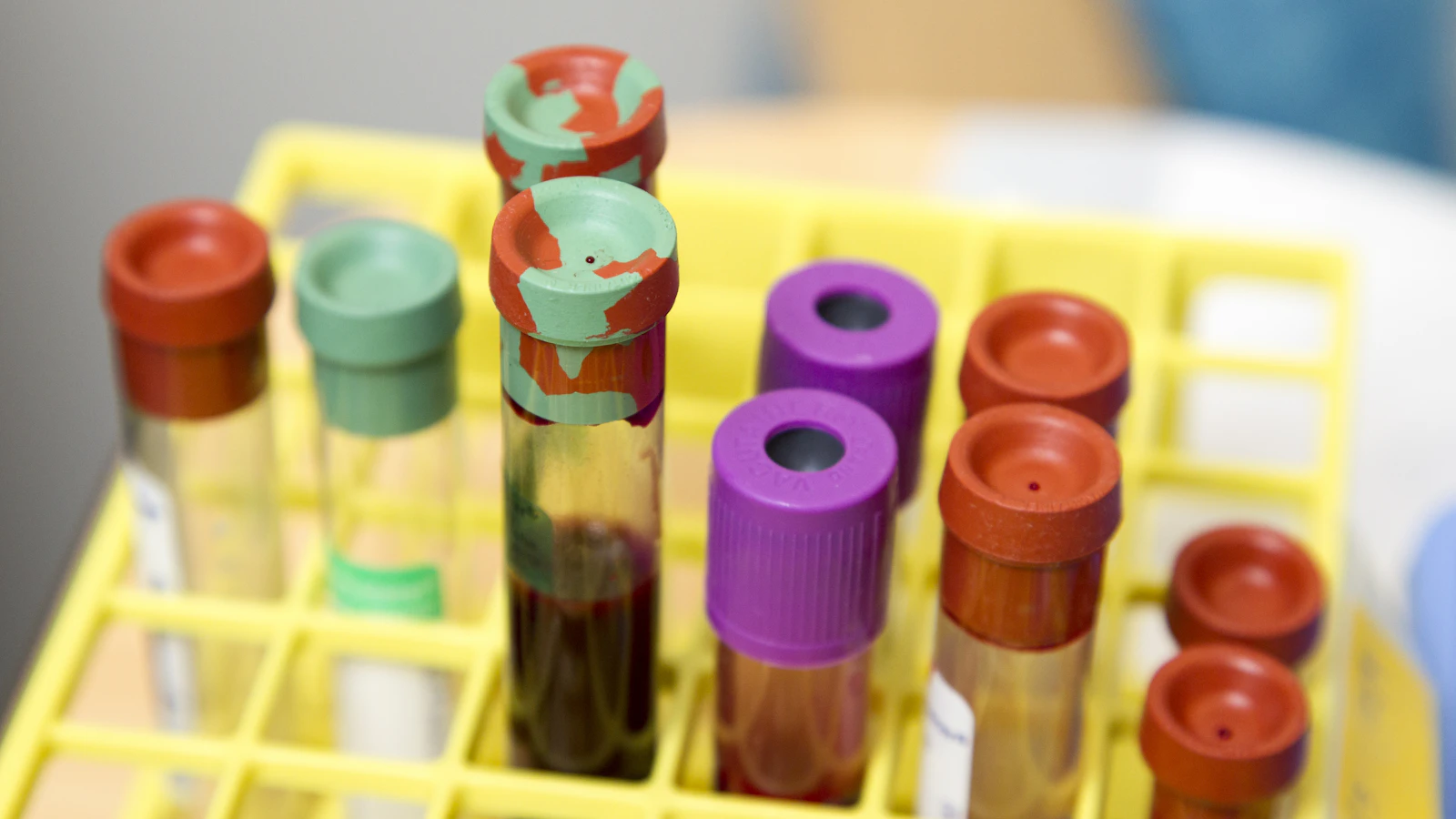
What it can do is open or close those other trails for your GP. A TSH and free T4 for the thyroid side. A ferritin for the iron side. And FSH and oestradiol for the question of where you are in the transition. A menopause panel looks at that hormonal side.
The iron angle matters more when bleeding is heavy in perimenopause, and it often gets skipped. I work that through in headache from iron deficiency.
What do you take to your GP?
The pattern of the last few months. Note the date, the duration, whether nausea came with it and whether you saw shimmering beforehand, per headache day. Note your periods too, even if they have turned irregular. That irregularity is itself information.
Two to three months is enough to see a line.
The full explanation of why your oestrogen does this, and which cycle phases do and do not matter, is in hormonal headache. What menstrual migraine looked like before this is in menstrual migraine. For the wider menopause picture, navigating perimenopause is the starting point.
Contact your GP promptly for a few signals. Headache that reaches full force within seconds. Neurological symptoms that do not resolve. Or a headache pattern that starts for the first time after fifty. That last one is the point to stay alert to in this age group, because it does not automatically belong to the menopause story.
References
- Martin VT, Pavlovic J, Fanning KM, Buse DC, Reed ML, Lipton RB. Perimenopause and menopause are associated with high frequency headache in women with migraine: results of the American Migraine Prevalence and Prevention Study. Headache. 2016;56(2):292-305. PMID 26797693.
- Raffaelli B, Do TP, Chaudhry BA, Ashina M, Amin FM, Ashina H. Menstrual migraine is caused by estrogen withdrawal: revisiting the evidence. J Headache Pain. 2023;24(1):131. PMID 37730536.
- Wang SJ, Fuh JL, Lu SR, Juang KD, Wang PH. Migraine prevalence during menopausal transition. Headache. 2003;43(5):470-478. PMID 12752752.
- Reddy N, Desai MN, Schoenbrunner A, Schneeberger S, Janis JE. The complex relationship between estrogen and migraines: a scoping review. Syst Rev. 2021;10(1):72. PMID 33691790.
- Richtlijnendatabase. Sex hormones and migraine, headache guideline. Available via richtlijnendatabase.nl.
- RIVM and VZinfo. Migraine: figures and context. Available via vzinfo.nl.
- Thuisarts. Migraine. Available via thuisarts.nl.
Every blood test result at Lunara includes a professional assessment by a BIG-registered doctor. For treatment decisions, discuss your results with your GP.
Author