Alcohol appears on almost every list of hot flash triggers, and there are now numbers behind that place. In a large cohort study of premenopausal women, the odds of vasomotor symptoms rose with intake, from an odds ratio of 1.42 below 10 grams per day to 3.52 at 40 grams or more.
Those figures describe association, not cause. But the pattern climbs cleanly, which makes it harder to wave away.
So we call alcohol the first trigger worth testing. Not because it is the biggest, but because it is the easiest to measure.
Why does alcohol cause hot flashes?
Alcohol widens your blood vessels and briefly increases blood flow to your skin, exactly the reaction you feel in a hot flash. Because your thermoneutral zone is narrower during menopause, less needs to happen before your body triggers that response. Hot drinks and a warm room work through the same mechanism.
On top of that, alcohol changes how your body sheds heat. You feel warm briefly, and a cold phase often follows.
There is a second route. Alcohol is broken down in the liver by enzymes also involved in hormone metabolism.
How much that second route weighs is not settled. The honest answer is that the vascular mechanism is the best supported.
What does alcohol do to your sleep during menopause?
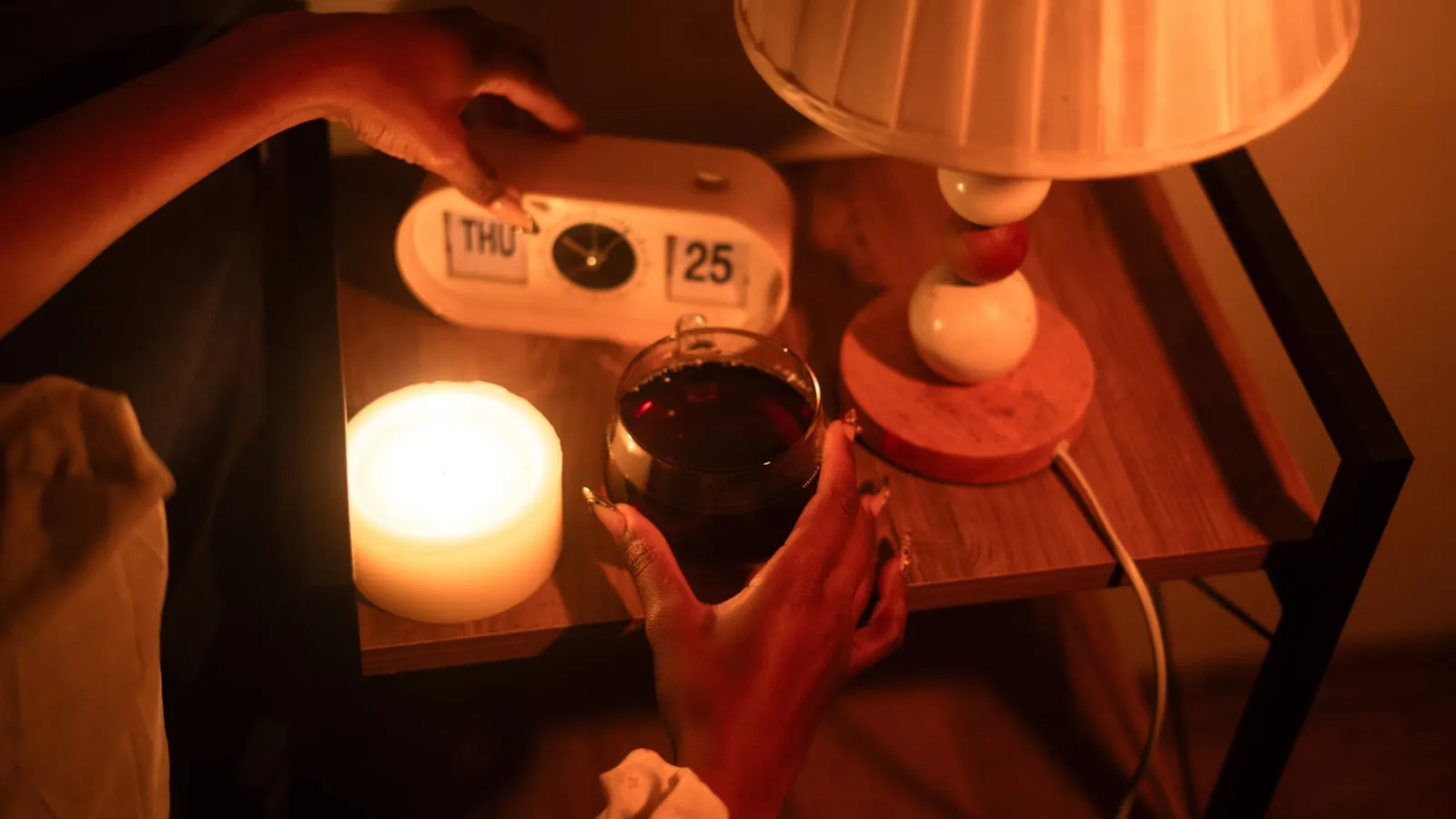
Alcohol helps you fall asleep faster and then disrupts the second half of your night. You sleep more lightly, wake more often, and are more likely to get night sweats in the early morning. In a period when your sleep is already fragmented, that counts double.
This is why a glass of wine as a nightcap backfires. You fall asleep faster and are wide awake at four.
Many women only notice this effect after stopping for a few weeks.
| What you often notice | First half of the night | Second half of the night |
|---|---|---|
| Falling asleep | Happens faster | Not applicable |
| Staying asleep | Usually settled | Waking more, lighter sleep |
| Night sweats | Less noticeable | More frequent and more intense |
| How you wake | Not applicable | Restless, palpitations, thirst |
This table describes what women report and is not medical advice.
What else happens to your sleep in this period is in poor sleep during menopause.
How much is too much?
The Dutch Gezondheidsraad advises drinking no alcohol, or in any case no more than one glass a day. That advice is independent of menopause and applies to everyone. In the vasomotor research, risk was already higher in the lowest intake category.
Ten grams of alcohol is roughly one standard glass. Forty grams is therefore about four glasses a day.
We think it is fairer to present this as a dial than as a ban. Drinking less appears to help, and how much less is a choice you make.
There is another reason to look at it critically. Regular heavy drinking is associated with lower bone density, and after menopause you already lose bone faster.
That is set out further in osteoporosis after menopause.
Does cutting back actually help hot flashes?
For some women it does, and for others there is no noticeable change. Which is exactly why a trial period beats general advice. Two weeks without alcohol, with a simple log of your hot flashes alongside, gives you an answer that applies to you.
Note the number of flashes per day and how often you woke. That is all you need.
What we often see women do is change everything at once: alcohol, coffee, spicy food and sugar. Then you know nothing at the end.
Change one thing.
Take two women aged 50 who both drink four glasses of wine a week. Both get hot flashes daily.
The first stops for two weeks and counts her flashes down from seven to three a day. For the second, nothing changes.
Same intake, different result.
For the first, alcohol is clearly a trigger. For the second, the explanation lies elsewhere, which is just as useful to know. That is why I rate a trial period above any trigger list.
If you measure no difference, alcohol is probably not your dominant trigger, and you can put your attention elsewhere. The overview of the other triggers is in our article on hot flashes.
When should you discuss this with your GP?
Raise it if cutting back is not working, if you drink in order to sleep, or if symptoms persist after you have already cut down substantially. If you take medication the conversation is also worthwhile, because alcohol interacts with many drugs.
Keep your notes to hand.
If hot flashes persist despite cutting back, you and your GP can look at the other explanations, or at menopause hormone therapy. To include your thyroid and iron values, those sit in the menopause check.
References
- Kwon R, Chang Y, Kim Y, et al. Alcohol consumption patterns and risk of early-onset vasomotor symptoms in premenopausal women. Nutrients, 2022. PMID 35684078.
- Gezondheidsraad, Dutch dietary guidelines, advice on alcohol.
- RIVM, figures and information on alcohol use.
- Thuisarts.nl, drinking less alcohol.
Lunara Health provides blood testing and explanation, not diagnosis. Your results are reviewed by a BIG-registered doctor. Always involve your GP if you have symptoms, and do not use this article to treat yourself.
شاهد Lunarahealth أكثر في Google
أضِفنا كمصدر مُفضّل. سيعرض Google حينها مقالاتنا بشكل أكثر تكرارًا في نتائج بحثك وفي ملخّصات الذكاء الاصطناعي. يمكنك إيقاف ذلك في أي وقت.
لم تنجح العملية. حاول مرة أخرى.
الكاتب
Lunarahealth
Dr. Naimi، طبيب مسجل في سجل BIG الهولندي، يشرف على المعايير الطبية لمحتوانا وتقييماتنا. اقرأ سياستنا الطبية