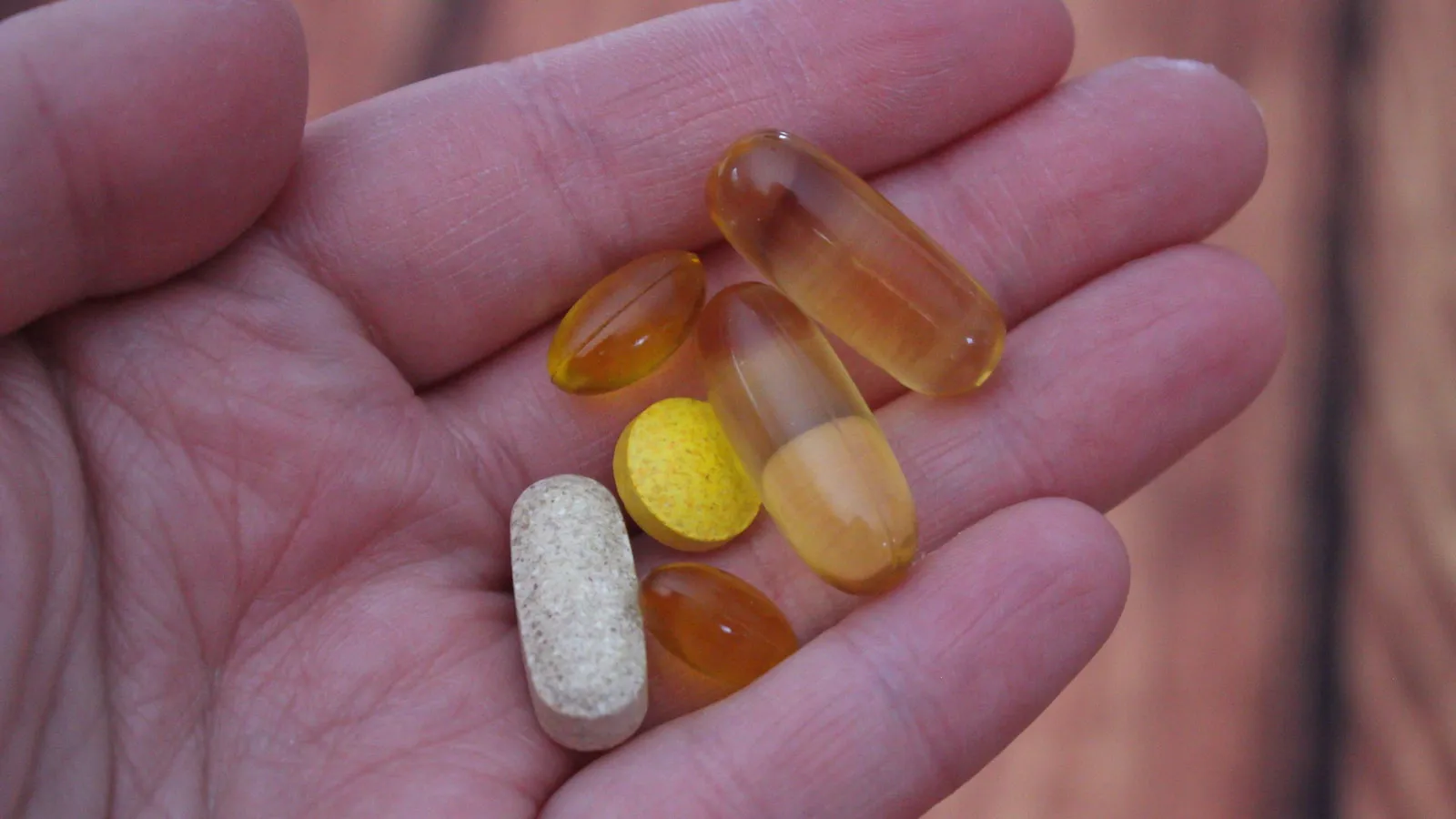
Magnesium in menopause is widely recommended, and the evidence behind it is considerably thinner than the shelves suggest. The one intervention study in exactly this group counted 20 postmenopausal women, gave 1,830 mg of magnesium citrate a day for 30 days, and measured shifts in bone turnover markers (PMID 19488681).
Twenty women, thirty days. A large part of this story rests on that.
I think you should know that before buying a tub. Not because magnesium is nonsense, because it is not, but because the difference between "important mineral" and "helps your symptoms" is systematically smoothed over here.
What does magnesium do in your body?
It is involved in hundreds of processes, among them muscle function, nerve signalling and building your bones. Roughly half of your magnesium sits in your skeleton. That bone share is why it comes up around menopause, because bone breakdown speeds up precisely then.
It sits mostly in your bones, not in your blood.
Reviews of magnesium and bone health describe a plausible role in bone building and bone density, with the caveat that large clinical studies in humans are missing (PMID 33959846). In gynaecological practice magnesium is named for a range of complaints, again more on the basis of mechanism than of outcomes (PMID 28392498).
What falling oestrogen does to your bones, and what part that plays after menopause, is in osteoporosis after menopause.
Does magnesium help menopause symptoms?
For hot flushes there is no good evidence, and that is precisely what it is most often sold for. The study that exists in this group did not look at hot flushes, sleep or mood, but at bone breakdown in blood and urine.
There is a difference between measured and felt.
The figures from that study are worth printing, precisely because nobody else names them. In the women given magnesium, parathyroid hormone fell significantly, osteocalcin rose, a marker of bone formation (p less than 0.001), and deoxypyridinoline in urine fell, a marker of bone breakdown (p less than 0.001). The researchers concluded magnesium suppressed bone turnover (PMID 19488681).
That is a real signal, and it is also a small, short study with neither bone density nor fractures as an outcome. A recent randomised study in postmenopausal osteoporosis looked at pain and found magnesium supplementation changed none of the endpoints significantly (PMID 41566091).
Reviews of vitamins and minerals used by postmenopausal women reach the same sober conclusion: widely used, little hard evidence per complaint (PMID 20580500). What is and is not established more broadly for supplements around your hormones is in supplements for hormone balance.
Can you have your magnesium measured?
You can measure it, and the result says less than you hope. About 1% of your magnesium sits in your blood. Your body holds that value tightly by drawing on your bones and cells, even when your stores fall.
A normal result does not rule out a shortfall.
That is an uncomfortable sentence for a company selling blood tests, and it is true. Serum magnesium is a good test in specific medical situations, for instance with certain medication or gut problems, and a poor measure of the question "am I getting enough magnesium". For that question, what you eat is more informative than what you draw.
| Question | Does blood testing say anything? | What does say something |
|---|---|---|
| Am I getting enough magnesium? | Barely | Your eating pattern over weeks |
| Are my symptoms caused by magnesium? | No | Ruling out other causes |
| Is there a medical reason for a shortfall? | Yes, in specific situations | Serum magnesium, via your doctor |
| How are my thyroid or iron doing? | Yes | TSH, free T4, ferritin |
| Where am I in menopause? | Partly | FSH and oestradiol, variable |
Look at the second row. Complaints attributed to magnesium, such as muscle cramps, poor sleep and fatigue, often have other and better demonstrable explanations at this stage of life. A menopause check looks at your hormones, a women's hormone panel at the wider picture.
How much magnesium do you need?
For adult women the recommended amount sits around 300 mg a day, and most people get most of that from food. Dutch nutrition guidance names wholegrain products, nuts, pulses, green vegetables and dairy as the main sources.
That is not an exciting list, and it is the list.
A shortfall from diet alone is unusual in the Netherlands. It occurs more often with persistent diarrhoea, with certain medicines such as acid reducers or diuretics, and with heavy alcohol use. Those are also exactly the situations in which measuring does make sense.
Take two women of 51 with night-time calf cramps. One eats varied, takes no medication and recently started magnesium without noticing a difference. The other has used an acid reducer for years. Only in the second is there a reason to look at it with the GP.
What do you take to your GP?
Three things. Which complaint exactly you hope magnesium will fix. Which medicines you take, acid reducers and diuretics first. And what you have already tried, in dose and for how long.
Bring the tub, or photograph it.
That sounds trivial and it saves a guessing game: doses differ sharply between brands, and the form it comes in differs too. If you take more than a mid-range dose, say so, because too much magnesium mainly causes gut symptoms.
What else there is to gain from food in this phase is in nutrition during menopause. For the wider picture of this phase, navigating perimenopause is the starting point.
References
- Aydin H, Deyneli O, Yavuz D, et al. Short-term oral magnesium supplementation suppresses bone turnover in postmenopausal osteoporotic women. Biol Trace Elem Res. 2010;133(2):136-143. PMID 19488681.
- Pickering ME, et al. Quantitative sensory testing of pain in osteoporosis: a pilot randomized clinical trial with magnesium supplementation. Aging Clin Exp Res. 2026. PMID 41566091.
- Rondanelli M, Faliva MA, Tartara A, et al. An update on magnesium and bone health. Biometals. 2021;34(4):715-736. PMID 33959846.
- Parazzini F, Di Martino M, Pellegrino P. Magnesium in the gynecological practice: a literature review. Magnes Res. 2017;30(1):1-7. PMID 28392498.
- Dennehy C, Tsourounis C. A review of select vitamins and minerals used by postmenopausal women. Maturitas. 2010;66(4):370-380. PMID 20580500.
- Voedingscentrum (Netherlands Nutrition Centre). Magnesium. Available via voedingscentrum.nl.
- Gezondheidsraad (Dutch Health Council). Dietary reference values for vitamins and minerals. Available via gezondheidsraad.nl.
- RIVM. Dutch National Food Consumption Survey, mineral intake. Available via rivm.nl.
Every blood test result at Lunara includes a professional assessment by a BIG-registered doctor. For treatment decisions, discuss your results with your GP.
Widuj Lunarahealth częściej w Google
Dodaj nas jako preferowane źródło. Google będzie wtedy częściej pokazywać nasze artykuły w Twoich wynikach wyszukiwania i w przeglądach AI. Możesz to w każdej chwili wyłączyć.
Nie udało się. Spróbuj ponownie.
Autor
Lunarahealth
Dr. Naimi, lekarz wpisany do holenderskiego rejestru BIG, nadzoruje standardy medyczne naszych treści i ocen. Przeczytaj naszą politykę medyczną
Powiązane badania
Powiązane artykuły

Spotting in the perimenopause: normal or get it checked?

Menopause or pregnant? How to tell the difference