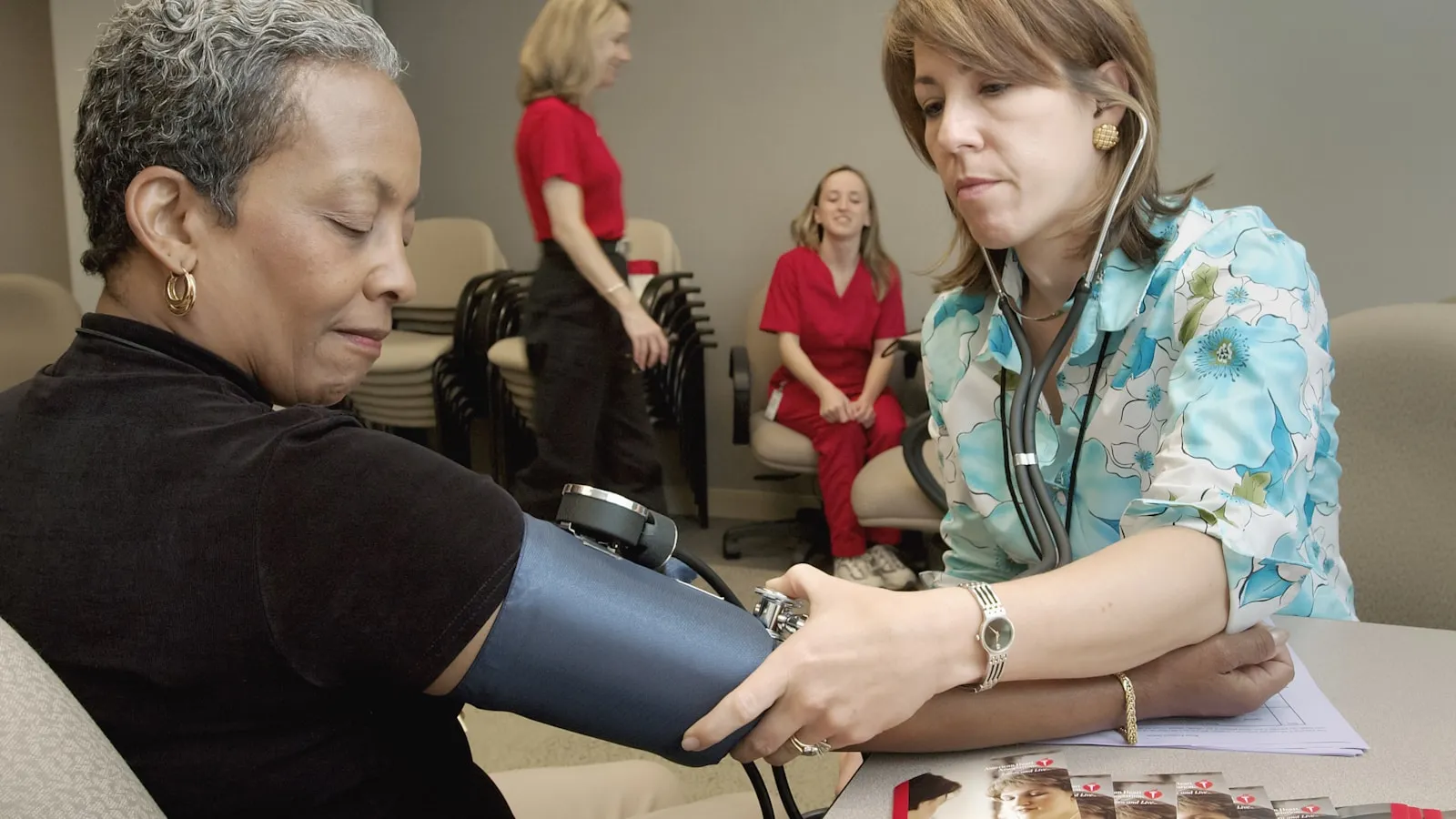
Your blood pressure in menopause often rises, and whether your hormones cause that is less clear than is suggested everywhere. In a population study of 908 women aged 45 to 54, blood pressure did not differ between women before and after menopause once age and BMI were accounted for (PMID 18806621).
The researchers attributed the rise to weight, not to the ovaries stopping.
That is an uncomfortable finding, and I think it is worth printing for exactly that reason. There is a second large study showing something different, and how you read the two together is the whole story.
Does menopause raise your blood pressure?
Partly, and less directly than most pages claim. There is no doubt that high blood pressure is more common in women after menopause than before it. The question is whether that comes from oestrogen falling away, or from everything else happening in those same years.
Age and weight move alongside your hormones.
That is precisely what the Czech population study tried to separate. After adjusting for age and BMI, nothing was left of the difference between women before and after menopause, including in the number of women with high blood pressure (PMID 18806621). The strongest association was with BMI.
Going by that study alone, menopause is mainly the moment other risk factors become visible. That is a different story from the usual one, and it is no reason to ignore your blood pressure. It only moves where the attention goes.
Why does other research find an effect?
Because it looks at a smaller, more sharply defined moment. Where the Czech study compared before and after menopause, a Korean study of 2,037 women aged 44 to 56 split the transition itself into stages. There the difference did stand out.
Not menopause as a whole, but the second half of it.
The figures are concrete. The largest difference in blood pressure sat between the early and the late transition, and it held after adjusting for the usual factors (systolic beta 2.753, p less than 0.01; diastolic beta 1.746, p equals 0.02). The share of women with high blood pressure went from 1.4% in early transition to 6.1% in late transition (PMID 26296869).
That is more than a fourfold rise within a few years, in the same group of women.
That is how you read the two together. Menopause is probably not a switch that turns your blood pressure up, but the late transition is the period in which it tips for a share of women. Reviews therefore describe menopause as a risk window rather than a cause (PMID 34889118).
A third track runs separately from blood pressure: your arteries stiffen in this phase, and that process appears to accelerate around menopause (PMID 38101308). Stiff arteries and a higher systolic pressure go together.
What else changes in the same years?
Almost your whole cardiovascular profile, which is why blood pressure rarely stands alone here. In the years around menopause, cholesterol values, abdominal fat and blood sugar regulation often shift at the same time. The Dutch Heart Foundation describes this period as a tipping point in women's risk.
They move as a group, not separately.
| What shifts | What you notice | Where it shows up |
|---|---|---|
| Systolic pressure | Usually nothing | Blood pressure cuff, not in blood |
| LDL cholesterol | Nothing | Lipid profile |
| Triglycerides | Nothing | Lipid profile, measured fasting |
| Fat shifting to the abdomen | Clothes fit differently | Waist measurement |
| Blood sugar regulation | Sometimes tiredness after eating | Glucose and HbA1c |
| Arterial stiffness | Nothing | Not in standard testing |
Look at the second column. You notice almost nothing on this list, which is exactly why this is the phase in which things get measured rather than waited on. What happens to your cholesterol is in cholesterol values table for women, and the wider risk picture in heart disease in women.
Which blood values belong here?
Blood pressure itself is not in your blood. It is measured with a cuff, and that remains the only thing that answers the question. What blood testing adds is the rest of the profile moving in the same years.
The cuff and the tubes answer different questions.
That usually means your lipids, your glucose and your kidney function. A lipid panel looks at total cholesterol, LDL, HDL and triglycerides. A complete metabolic panel adds glucose and kidney values among others, which weigh in when blood pressure is high.
What your GP does with this, and which values fit you, is up to your GP. None of these results tells you whether you are in menopause, and none replaces a blood pressure reading.
What can you do with this?
The main thing is knowing where you stand, because you notice nothing here. High blood pressure generally produces no symptoms, and that is exactly why it is often found late. Dutch heart and patient guidance both point this out.
There is no symptom to wait for.
Take two women of 53 with the same complaints: hot flushes, poor sleep, some weight gained. One has her blood pressure taken at the GP because she is there anyway. The other does not, because she otherwise feels fine. Only the first knows anything. For the second, nothing changes until another reason for a reading comes along.
Weight gain in this phase has its own role here, given the BMI finding above. What does and does not help with that is in weight gain in menopause. Alcohol plays a part too, and that side is in alcohol and menopause.
What do you take to your GP?
Three things. Whether high blood pressure, heart attack or stroke runs in your close family, and at what age. Whether you had pre-eclampsia or high blood pressure in a pregnancy. And roughly where you are in menopause, based on your cycle over the past year.
That second question is nearly always forgotten.
High blood pressure or pre-eclampsia during a pregnancy still counts in your risk profile years later, and many women do not know that. It is worth mentioning even if it was twenty years ago. For the wider picture of this phase, navigating perimenopause is the starting point.
References
- Cifkova R, Pitha J, Lejskova M, et al. Blood pressure around the menopause: a population study. J Hypertens. 2008;26(10):1976-1982. PMID 18806621.
- Son MK, Lim NK, Lim JY, et al. Difference in blood pressure between early and late menopausal transition was significant in healthy Korean women. BMC Womens Health. 2015;15:64. PMID 26296869.
- Okeahialam BN. Arterial hypertension in women: menopause as a risk window. Post Reprod Health. 2022;28(1):37-42. PMID 34889118.
- O'Neill SM, Ni Chroinin D, Barrett E. Menopause and accelerated aortic stiffness. Maturitas. 2024;180:107886. PMID 38101308.
- Dutch Heart Foundation (Hartstichting). Menopause and the heart. Available via hartstichting.nl.
- Dutch College of General Practitioners (NHG) guideline on cardiovascular risk management. Available via richtlijnen.nhg.org.
- Thuisarts. I have high blood pressure. Available via thuisarts.nl.
- RIVM. Statistics on high blood pressure in the Netherlands. Available via rivm.nl.
Every blood test result at Lunara includes a professional assessment by a BIG-registered doctor. For treatment decisions, discuss your results with your GP.
شاهد Lunarahealth أكثر في Google
أضِفنا كمصدر مُفضّل. سيعرض Google حينها مقالاتنا بشكل أكثر تكرارًا في نتائج بحثك وفي ملخّصات الذكاء الاصطناعي. يمكنك إيقاف ذلك في أي وقت.
لم تنجح العملية. حاول مرة أخرى.
الكاتب
Lunarahealth
Dr. Naimi، طبيب مسجل في سجل BIG الهولندي، يشرف على المعايير الطبية لمحتوانا وتقييماتنا. اقرأ سياستنا الطبية