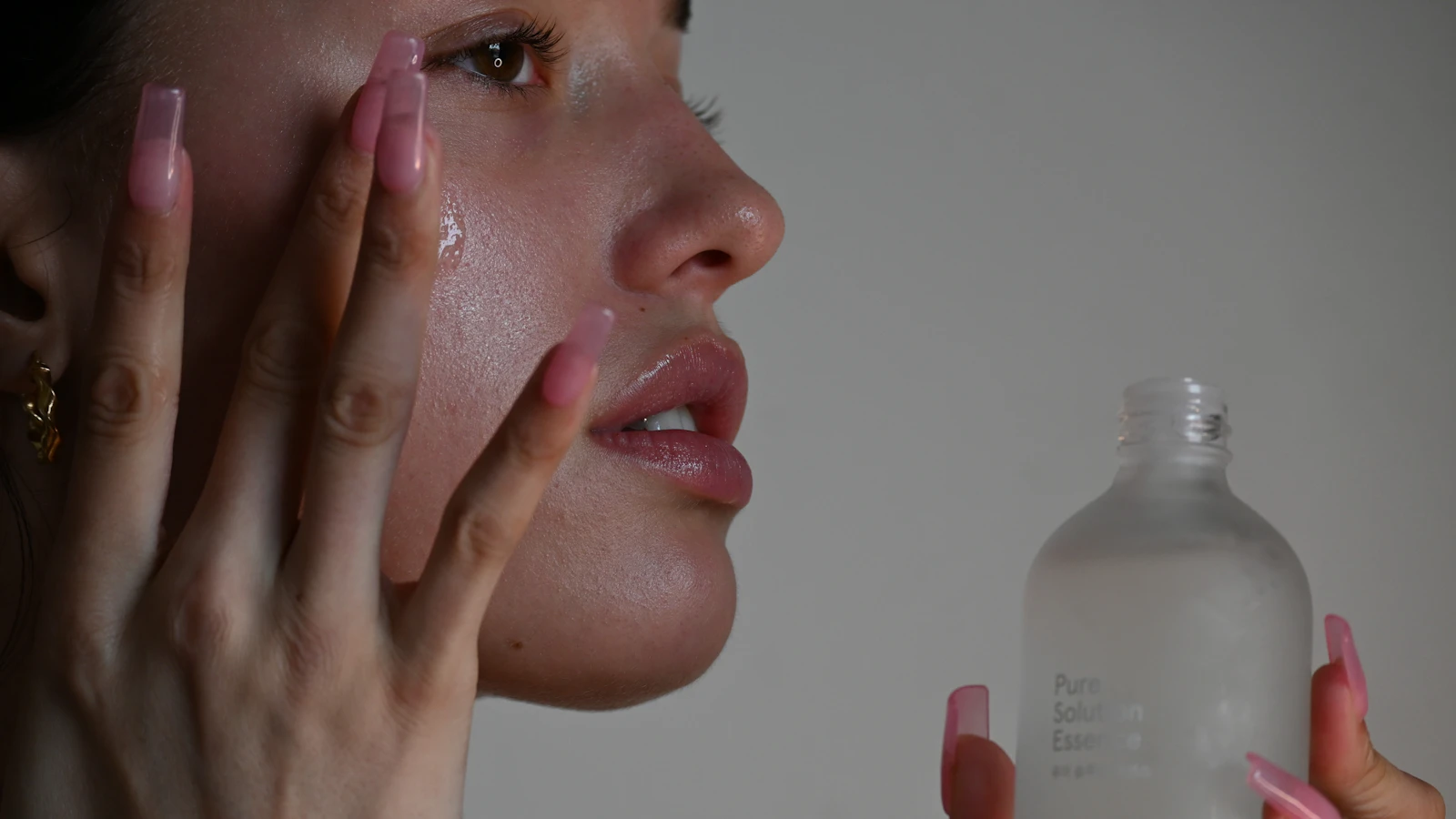
You are well past your teens, yet every month the same deep spot returns along your jawline, somewhere in the week before your period. Pharmacy creams do nothing. That pattern, flaring with your cycle and mostly on the lower jaw, chin and neck, often points to a hormonal cause. Three values usually give the most insight here: total testosterone, SHBG and DHEA-S.
My take: with hormonal acne, a product on your skin is rarely the whole answer. If the cause comes from within, you can keep applying creams without ever changing the source. Below you will read how to recognise hormonal acne, which hormones play a role, what each value shows and when a test makes sense.
How do you recognise hormonal acne?
Hormonal acne stands out by its location and timing: often deep, tender spots along the lower jaw, chin and neck that appear around your period. Unlike classic teenage acne, this form often responds poorly to ordinary acne products. According to the Dutch GP guideline on acne (NHG), this pattern in adult women is recognisable enough to look at specifically.
- Spots mainly along the jawline, chin and neck
- Flaring around your period or in the second half of your cycle
- Deep, tender bumps rather than surface blackheads
- Acne that returns despite a good, consistent skincare routine
Does the acne come with excess hair growth or an irregular cycle? Then it may be worth looking further, because that combination can point to too many androgens.
Which hormones play a role in acne?
With hormonal acne the focus is mainly on androgens, the so-called male hormones that are also present in your body. A higher testosterone, or a low SHBG that leaves more testosterone freely available, can make the sebaceous glands more active. DHEA-S shows whether your adrenal glands contribute to those androgens.
| What you notice | Value that gives insight | What that value shows |
|---|---|---|
| Jawline acne, oily skin | Total testosterone | The overall level of androgens in your blood |
| Symptoms while total testosterone looks normal | SHBG | A low SHBG leaves more testosterone freely available |
| Acne together with fatigue or stress | DHEA-S | A share of the androgens coming from the adrenal glands |
| Acne plus irregular cycle and hair growth | The three above together | A pattern that can point towards PCOS |
No single value on its own proves that your acne is hormonal. It is about the pattern, together with your symptoms and the location of the acne. This table is a tool to prepare a conversation with a doctor, not a diagnosis.
Hormonal acne and PCOS
Jawline acne is one of the best-known signs of too many androgens, and that often fits PCOS. When the acne comes with an irregular cycle and excess hair growth, that can point to the PCOS picture. With PCOS you often see a raised testosterone with a low SHBG.
Recognise several of these signs? Then read our PCOS pillar on symptoms, causes and diagnosis, or the pillar on irregular periods and which hormones to test. Mainly bothered by thinning hair? Then read which hormones to test for hair loss.
When is testing worthwhile?
A hormone test is mainly worthwhile when your acne moves with your cycle and comes with other complaints such as hair growth, hair loss or an erratic period. With mild acne and no other signs, the cause more often lies in the skin itself, and Thuisarts.nl points to an ordinary skincare routine as the first step.
- Stubborn jawline acne that does not respond to ordinary products
- Acne together with excess hair growth or hair loss
- An irregular cycle alongside your skin complaints
The Women's Hormones panel measures testosterone and SHBG, among others, in one draw, so you see the pattern rather than one isolated number.
What can you do yourself?
Alongside a good skincare routine, attention to your whole lifestyle can help, although the effect differs per person. A steadier blood sugar, enough sleep and stress management seem to make a difference for some women. As for the skin, patience matters, because you often only see an effect after weeks.
- A mild, consistent skincare routine without too many different products
- Attention to stress and enough sleep
- Food that keeps your blood sugar steadier
If complaints persist or are severe, discuss them with your GP or a dermatologist. An abnormal blood value is always something to discuss with a doctor, who can place it in context.
Frequently asked questions
Does hormonal acne mean I have PCOS?
Not automatically. Acne can be a sign of too many androgens, but only in combination with an irregular cycle or excess hair growth does it point towards PCOS. A doctor assesses the whole picture.
Which hormone causes acne in women?
Androgens, especially testosterone, often play a role. A low SHBG leaves more testosterone freely available, and DHEA-S shows a contribution from the adrenal glands. It is about the pattern, not one value.
When in my cycle should I have my hormones drawn?
For androgens such as testosterone, SHBG and DHEA-S the timing is less strict than for cycle hormones. If you have no fixed cycle, blood can be drawn at any time. Discuss with the doctor what suits your situation.
Sources
- NHG guideline on acne, Dutch College of General Practitioners. Available via richtlijnen.nhg.org.
- Thuisarts.nl, I have acne, Dutch College of General Practitioners. Available via thuisarts.nl.
Every blood test result via Lunara receives a professional review by a BIG-registered doctor. For treatment decisions, discuss your results with your GP.
Widuj Lunarahealth częściej w Google
Dodaj nas jako preferowane źródło. Google będzie wtedy częściej pokazywać nasze artykuły w Twoich wynikach wyszukiwania i w przeglądach AI. Możesz to w każdej chwili wyłączyć.
Nie udało się. Spróbuj ponownie.
Autor
Lunarahealth
Dr. Naimi, lekarz wpisany do holenderskiego rejestru BIG, nadzoruje standardy medyczne naszych treści i ocen. Przeczytaj naszą politykę medyczną
Powiązane badania
Powiązane artykuły

Luteal phase: what happens and how to measure it

Kyleena experiences: side effects and how it differs from Mirena