In conversations I often notice that women are unsure about what birth control actually does to their hormones. One hears that the pill sends your hormones out of control, another that a blood test while on the pill means nothing. Both pictures are only half true, and that makes choosing hard.
This is the overview article in our series on contraception and hormones. Below you will read how hormonal birth control works, which types there are, what the pill does to your own hormones and when a hormone test can be useful. For the details per topic, see the separate articles in this series.
Important to say upfront: Lunara does not prescribe contraception and does not treat complaints. What we can do is map your hormones when you stop the pill or when you have complaints you want to look into.
How does hormonal birth control work?
Hormonal birth control releases artificial versions of your sex hormones, usually an oestrogen and a progestogen or a progestogen alone. These hormones suppress ovulation, thicken the mucus in your cervix and change the lining of your womb. This makes the chance of pregnancy much smaller.
Your own cycle normally runs on an interplay of hormones from your brain and your ovaries. Your pituitary drives FSH and LH, which in turn regulate ovulation and the production of oestradiol and progesterone. Hormonal birth control acts right within that system.
With the combined pill your body perceives the artificial hormones as sufficient, so your brain makes less FSH and LH. Without that signal no egg matures and ovulation does not happen. According to the NHG guideline on contraception, suppressing ovulation is the main mechanism of the combined pill.
Methods with only a progestogen, such as the mini pill or the hormonal IUD, often work somewhat differently. They rely more on thickening the cervical mucus and keeping the lining thin. In some women ovulation is suppressed as well, in others it is not.
Each method has its own way of preventing pregnancy. One pauses your whole cycle, the other works mostly in one place. That difference also determines how strongly your hormone values change, something that comes back later in this article.
Which types of contraception are there?
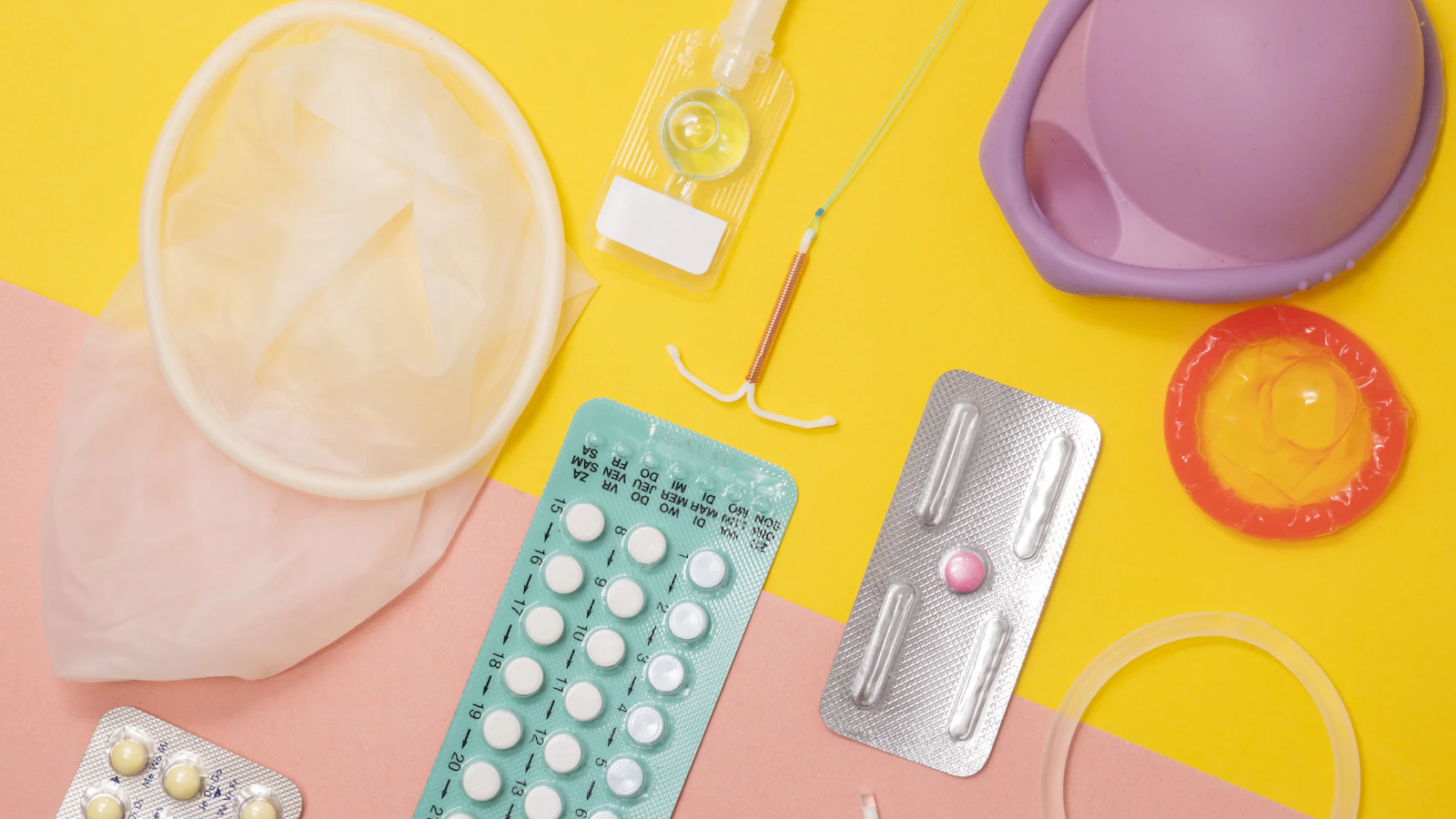
There are roughly two groups: methods with hormones and methods without hormones. Within the hormonal group, it differs which hormones are involved and how strongly they act on your whole body. The copper IUD is the best known hormone-free method.
The table below lists the most used forms, with the main hormone and the effect on your cycle and hormones. It is an educational overview and not advice on what suits you best. That choice you make together with your GP or another healthcare provider.
| Type of contraception | Hormone | Effect on your cycle and hormones |
|---|---|---|
| Combined pill | Oestrogen and progestogen | Suppresses ovulation by lowering FSH and LH; the monthly bleed is a withdrawal bleed, not a real period |
| Mini pill | Progestogen only | Mainly thickens the cervical mucus; suppresses ovulation in some women, not in others |
| Hormonal IUD | Progestogen (levonorgestrel) | Works mostly locally in the womb; the systemic hormone change is limited and ovulation often stays intact |
| Injection or implant | Progestogen only | Suppresses ovulation via a slow-release depot; can change the bleeding pattern considerably |
| Copper IUD | No hormone | Works without hormones via copper ions; your own cycle and hormone values stay unchanged |
What stands out is that not every method affects your hormones equally. The combined pill and the injection largely pause your own cycle. The hormonal IUD does this much less, and the copper IUD not at all.
Want more on a specific method? Read about Zoely, ellaOne (morning-after pill), Implanon (contraceptive implant) and the Evra contraceptive patch.
What does the pill do to your natural hormones?
The combined pill replaces your own hormone signal with a fixed dose of artificial oestrogen and progestogen. As a result your body suppresses the production of FSH and LH, the hormones that normally drive your ovulation. Your own oestradiol and progesterone therefore stay low.
That is exactly what the pill is meant to do, and it is not harmful. Your natural cycle is on pause, as it were, as long as you use the pill. The bleed in the pill-free week is a withdrawal bleed and not a real period.
The pill also affects your SHBG, a protein that binds sex hormones in your blood. The oestrogen in the combined pill makes your liver produce more SHBG. As a result there is less free, active testosterone available, which in some women is linked to calmer skin.
The hormonal IUD works differently here. It releases its progestogen mostly locally in the womb, so the amount that reaches your blood stays limited. Your ovulation and your natural hormone values therefore often stay largely intact.
Want to know exactly what the pill does to your hormones and which side effects can come with it? Then read our article on the pill and side effects and the article on the hormonal IUD and your hormones.
What are possible side effects of hormonal birth control?
Hormonal birth control can cause side effects, although this differs strongly per person and per method. Frequently mentioned complaints are tender breasts, headaches, changes in your bleeding pattern and shifts in your mood or libido. In many women these complaints disappear after the first months.
It is good to know that a side effect is something other than harm. According to the Farmacotherapeutisch Kompas, mild side effects occur regularly, while serious complications are rare. Each method has its own profile, and what one woman tolerates well suits another less.
Some women notice that their interest in sex changes while on the pill. This can be related to the hormonal effects, for example through the higher SHBG and the lower free testosterone. In our article on the pill and libido we go into this in more depth.
Mood is also a topic that occupies many women. Whether contraception affects your mood differs per person, and the research gives no clear-cut answer. We discuss the nuances in our article on the pill and mood.
Something else that plays a part is that a side effect does not always come from the contraception. Complaints like tiredness, headaches or a shifting mood can have other causes too. A blood test can help rule out some of those other causes, although it never gives the whole answer on its own.
Do you recognise complaints that do not go away or that affect your life considerably? Then discuss that with your GP.
Does contraception change your hormone values in a blood test?
Yes, and this is one of the most important things to know. As long as you use the combined pill, it suppresses your own FSH, LH, oestradiol and progesterone. A blood test while on the pill therefore mainly measures the effect of the pill and not your natural hormone values.
This means that a hormone panel says little about your own cycle as long as you are on the pill. If you want to know how your hormones function without contraception, it makes more sense to test after stopping. That way you get a picture that fits your own body.
With the hormonal IUD this is different. Because it works mostly locally and ovulation often stays intact, your natural hormone values may be closer to their usual level. Even so, the timing within your cycle remains important for a good interpretation.
In short: the result of a hormone test depends on which contraception you use and when you draw blood. This is exactly why it helps to know what you are measuring and why.
When is a hormone test useful around contraception?
A hormone test is mainly useful once you have stopped the pill and want to see how your cycle recovers. After stopping, FSH and LH come back into action and your body resumes its own production of oestradiol and progesterone. How fast this happens differs per woman.
A test can also give peace of mind with complaints. Think of a cycle that has not returned after months, or symptoms you want to look into. A blood value is then a starting point for a conversation, not a diagnosis in itself.
The best moment to draw blood depends on your cycle. For a number of hormones the early phase, around day three to five, is usual, while progesterone in the second half of the cycle says something about your ovulation. In our article on hormone testing in women we explain the timing.
Have you just stopped or are you considering it? Then also read what you can expect from coming off the pill and hormone recovery. You always discuss an abnormal result with your GP, who looks at your whole situation.
By the way, a test does not only say something when there is a problem. For some women it is actually nice to have a calm reference point, for example before they start trying to conceive. That way you know where your values stand at that moment, without having to draw conclusions from it right away.
Testing your own hormones
At Lunara you can have your hormones tested without a referral, for example after you have stopped the pill or when you want to look into complaints. The Hormones women test looks at values like FSH, LH, oestradiol, progesterone and SHBG. You order online and draw blood at one of the 650+ locations.
Your blood is preferably drawn in the morning, which is helpful because a number of hormones are best assessed then. Every result is reviewed by a BIG-registered doctor, so you do not just get numbers but also context. That way you know what your values mean.
Important: testing yourself does not replace the care of your GP. It is meant as an addition and as a starting point for a conversation. If you are thinking about stopping the pill, wait to test until your cycle is running again, so your result shows your own hormones and not the effect of the pill.
Frequently asked questions
Can you have your hormones tested while on the pill?
You can, but the result says little about your natural cycle. The combined pill suppresses your own FSH, LH, oestradiol and progesterone, so you mainly measure the effect of the pill. For a picture of your own hormones you test better after stopping.
How long after stopping the pill is it best to test?
That differs per woman. Many women wait until their cycle is running again, often a few weeks to months after stopping. That way a hormone test shows your own rhythm instead of a cycle that is still recovering.
Does the hormonal IUD change your hormone values too?
The hormonal IUD works mostly locally in the womb, so the systemic hormone change stays limited. In many women ovulation stays intact and the natural values are closer to their usual level. The timing within your cycle does remain important for interpretation.
Are side effects of the pill the same as harm?
No. A side effect is an unwanted effect that can occur and often disappears again, for example tender breasts or a changed bleeding pattern. According to the Farmacotherapeutisch Kompas mild side effects are not rare, while serious complications are indeed rare. Persistent complaints you discuss with your GP.
Can contraception affect my mood or libido?
In some women yes, in others no, and the research gives no clear-cut picture. Hormonal effects, such as a higher SHBG and less free testosterone, can play a part. If you recognise a clear change, discuss it with your GP.
Does Lunara prescribe contraception?
No. Lunara does not prescribe contraception and does not treat complaints. What we offer is a hormone test with a professional assessment, so you have your values in view for a conversation with your GP.
References
- Dutch College of General Practitioners. NHG guideline Contraception (NHG-standaard Anticonceptie). NHG.
- Thuisarts.nl. I want to choose contraception. Dutch College of General Practitioners.
- Farmacotherapeutisch Kompas. Hormonal contraceptives. Zorginstituut Nederland.
Every blood test result through Lunara includes a professional assessment by a BIG-registered doctor. Blood testing through Lunara does not replace the care of your GP. For treatment decisions, discuss your results with your GP.
Widuj Lunarahealth częściej w Google
Dodaj nas jako preferowane źródło. Google będzie wtedy częściej pokazywać nasze artykuły w Twoich wynikach wyszukiwania i w przeglądach AI. Możesz to w każdej chwili wyłączyć.
Nie udało się. Spróbuj ponownie.
Autor
Lunarahealth
Dr. Naimi, lekarz wpisany do holenderskiego rejestru BIG, nadzoruje standardy medyczne naszych treści i ocen. Przeczytaj naszą politykę medyczną