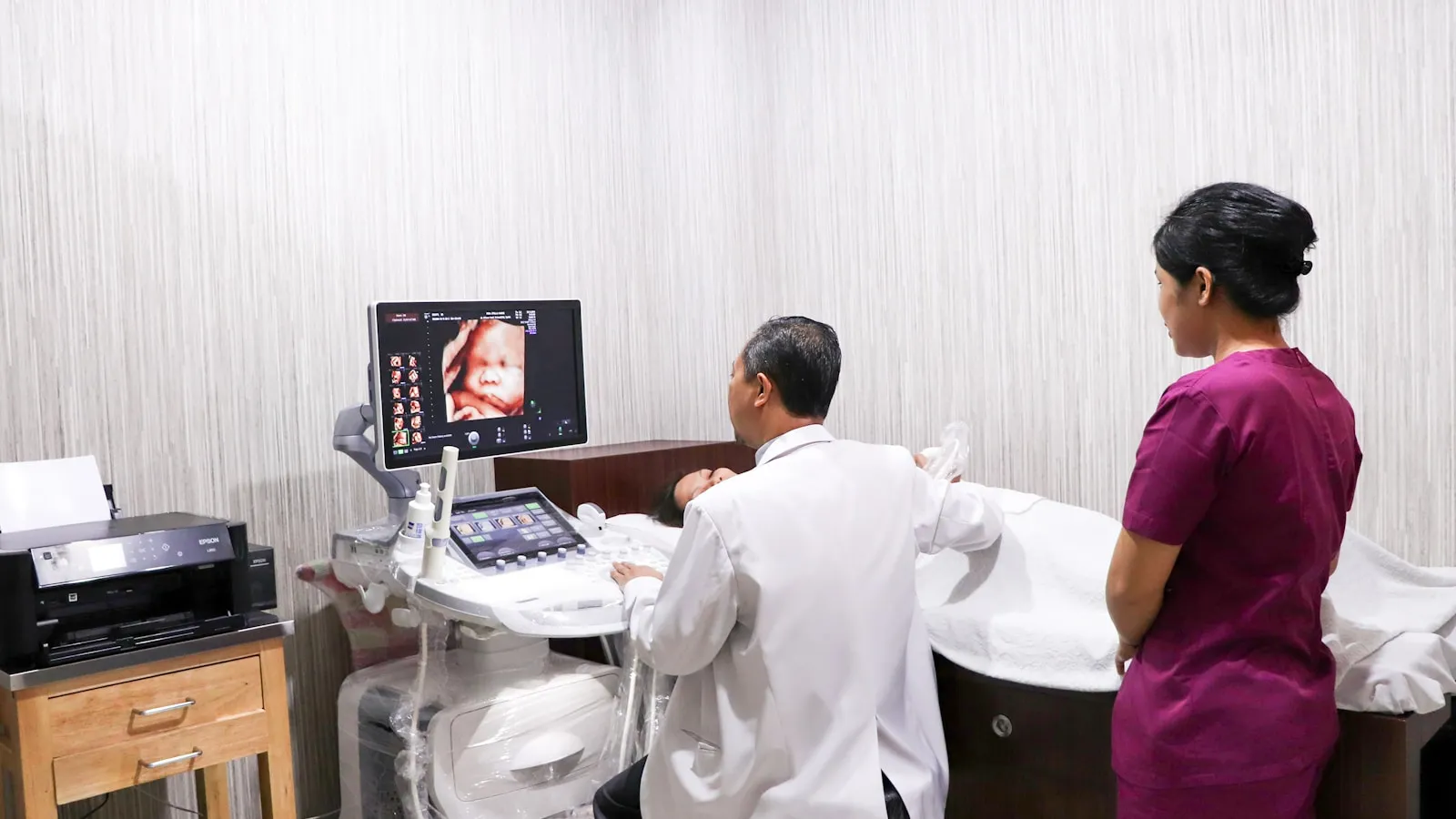
If a heartbeat was seen at six weeks, the risk of miscarriage afterwards is about 9 percent. At eight weeks it is 1.5 percent, and at nine weeks 0.5 percent. Those figures come from an Australian cohort of 696 women without symptoms.
Almost every Dutch page gives you one number: roughly 1 in 10. That is right on average, and it is exactly the wrong number when you are seven weeks along and saw a heartbeat yesterday.
Because that risk changes week by week. Sharply.
What is the miscarriage risk after a heartbeat is seen?
Once cardiac activity has been confirmed, risk falls quickly. In the study by Tong and colleagues, published in Obstetrics and Gynecology, risk across the whole group was 1.6 percent. The difference by week was large: from 9.4 percent at six weeks to 0.5 percent at nine weeks.
| Week of pregnancy at the scan | Miscarriage risk afterwards |
|---|---|
| 6 weeks | 9.4 percent |
| 7 weeks | 4.2 percent |
| 8 weeks | 1.5 percent |
| 9 weeks | 0.5 percent |
| 10 weeks | 0.7 percent |
Two notes on this table. The women in the cohort had no symptoms, so no bleeding and no pain. And cardiac activity had been confirmed in all of them at that visit.
If you are bleeding, these percentages do not describe your situation. What your GP or midwife assesses takes over from there.
Take two women who both saw a heartbeat, one at 6 weeks and one at 9. Both got good news at the scan, while their risk afterwards was 9.4 percent against 0.5 percent. The same reassurance meant something quite different for each of them.
What the numbers do explain is why the eight-week scan so often feels like a turning point. Statistically, it is one.
How does risk change with your age?
Age is the strongest known factor. A Norwegian register study in the BMJ followed 421,201 pregnancies and found the lowest risk in women aged 25 to 29, around 10 percent. From about 30 the curve rises, and from 45 the risk sits near 53 percent.
The reason is largely genetic. As eggs age, the chance of a chromosomal error during division goes up.
This is not a matter of fitness or lifestyle. It is biology you have little influence over.
How those errors arise is covered in what causes a miscarriage.
What increases the chance of a miscarriage?
The 2021 Lancet analysis lists older or very young maternal age, older paternal age, a very low or very high body-mass index, smoking, alcohol, night shifts and previous miscarriages. Those factors apply at population level and rarely explain one specific pregnancy.
Smoking and alcohol also appear in Dutch public health guidance from RIVM, separate from pregnancy. That makes them two of the few items on the list you can actually change.
Beyond that, the list is shorter than people hope. It feels powerless, and it also protects you from years of looking back.
What are the odds of a second miscarriage?
Raised, but less dramatically than it is usually presented. The same Norwegian study found an odds ratio of 1.54 after one miscarriage, 2.21 after two and 3.97 after three in a row. Even after three losses, most women go on to have a child.
An odds ratio is not a probability. That distinction gets lost constantly in news coverage and forum threads.
After two or more losses a gynaecologist can discuss investigation. What that involves is in recurrent miscarriage: the tests you can be offered.
What about the second trimester?
Risk there is small. The large majority of losses happen in the first trimester, and after week 12 the risk falls further. Thuisarts, the patient information service of the Dutch College of General Practitioners (NHG), uses 20 weeks as the upper limit for the term miscarriage.
In the Australian cohort, nearly half of the miscarriages were diagnosed in the second trimester. That does not mean they happened then, only that they were detected then.
That distinction matters if you come across those figures somewhere.
What to do with these numbers
Use them to place your own situation, not to predict an outcome. A figure of 4.2 percent at seven weeks describes a group, not your pregnancy.
I still think this is the most honest form of reassurance available. Not "it will probably be fine", but a number with a source under it.
If you have symptoms, call your midwife or GP rather than doing more arithmetic. The symptoms that matter are in early miscarriage: symptoms and how it feels, and the full overview is in miscarriage: symptoms, causes and tests.
Every blood test result includes a professional assessment from a BIG-registered doctor. For treatment decisions, discuss your results with your GP.
References
- Tong S, et al. Miscarriage risk for asymptomatic women after a normal first-trimester prenatal visit. Obstetrics and Gynecology. 2008. PMID 18310375
- Magnus MC, et al. Role of maternal age and pregnancy history in risk of miscarriage: prospective register based study. BMJ. 2019. PMID 30894356
- Quenby S, et al. Miscarriage matters: the epidemiological, physical, psychological, and economic costs of early pregnancy loss. Lancet. 2021. PMID 33915094
- Thuisarts.nl, patient information on miscarriage. Dutch College of General Practitioners (NHG)
- RIVM, public health information on smoking and alcohol around pregnancy
Autor