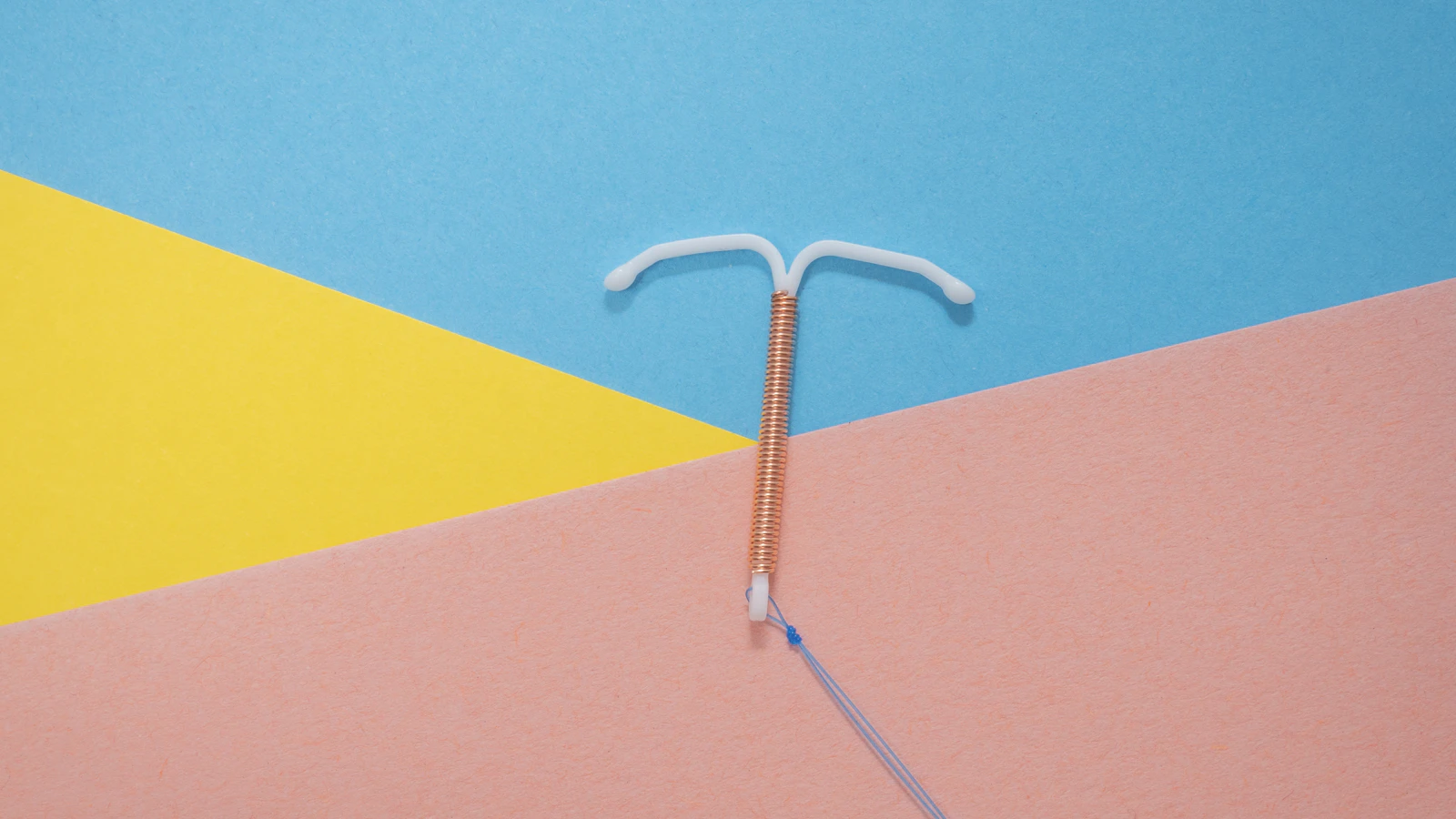
A Mirena IUD in menopause does something no other contraceptive does: it can serve at the same time as the progestogen half of hormone therapy. In a pooling of six studies with 518 participants, the hormonal IUD protected the lining of the womb as well as progestogen tablets, and better than one of the tablet schedules used (PMID 21720280).
That is why gynaecologists often leave it in place during this phase.
And there is a flip side that appears almost nowhere: it removes your bleeding pattern, and with it the one reference point you have for tracking where you are in menopause. I think you should know that beforehand.
Your IUD makes your cycle unreadable, so you cannot read menopause from it. The menopause check works from your symptoms instead.
Why do doctors leave the Mirena in during menopause?
Because oestrogen on its own makes the lining of your womb grow, and something has to hold that back. Anyone with a womb who uses oestrogen for menopause symptoms therefore needs a progestogen. That can be a tablet, and it can be the hormonal IUD you may already have.
Two jobs, one device.
The hormonal IUD releases levonorgestrel directly into your womb, where the work needs doing. Little of it reaches your bloodstream as a result. That is precisely the argument made in the clinical literature for this use (PMID 25553775).
The figures are reassuring and modest at the same time. In those six studies of 518 women, the number with a lining that kept growing was comparable between the IUD and progestogen tablets, with one exception: one of the tablet schedules showed it more often than the IUD. The number of women who stopped did not differ (PMID 21720280).
A separate review of how well the hormonal IUD protects the lining pointed the same way, and concluded mainly that more and longer research is needed (PMID 22017273). That is the honest state of things: good enough to use, less firmly underpinned than you would want.
The 52 mg IUD is registered for this purpose, with a shorter term for this job than for contraception. Which term applies to you and when it needs replacing is a question for your GP or gynaecologist, because it depends on what it is doing for you.
What do you notice in these years?
Usually less bleeding, and that is often exactly what you want in perimenopause. Periods can become heavier and less predictable in this phase, and the hormonal IUD makes them lighter for many women or stops them altogether.
The first months are messy though.
Bleeding and spotting were common in the first three to six months in the groups studied (PMID 21720280). That is the window in which most women wonder whether it is working at all. What is normal after that and what is not is in IUD bleeding, what is normal.
An important difference from what you might expect: the IUD does not take away your hot flushes. The levonorgestrel protects your lining, but it does not replace oestrogen. Anyone with hot flushes, night sweats or mood symptoms needs separate oestrogen treatment for that. The types are in menopause hormone therapy.
Mirena, Kyleena or tablets: what is the difference here?
For the menopause question only one can do all three jobs. Kyleena holds less levonorgestrel and is not the same for this use. The copper IUD holds no hormone and so does not protect your lining.
That distinction often goes wrong in conversation.
| Method | Contraception | Protects lining during oestrogen therapy | Effect on bleeding | Helps hot flushes |
|---|---|---|---|---|
| Hormonal IUD 52 mg (Mirena) | Yes | Yes, registered for this | Often much lighter or absent | No |
| Lower-dose hormonal IUD (Kyleena) | Yes | Not registered for this | Lighter, more often still some | No |
| Copper IUD | Yes | No | Often heavier instead | No |
| Progestogen in tablet form | Variable | Yes | Depends on the schedule | No |
| Oestrogen (patch, gel, spray) | No | No, this is the reason something must be added | Variable | Yes |
Look at the third column. That is the column deciding whether you need a tablet alongside, and it is the column missing from nearly every online IUD comparison. A wider comparison is in which IUD is best, and what the hormonal IUD does to your hormones more broadly in the hormonal IUD and your hormones.
How do you know you are in menopause with an IUD?
Harder than without, and that is the real drawback. Menopause is normally established from your cycle: twelve months without a period. If the IUD has already removed your bleeding, that reference point is gone.
You lose your measuring stick.
Take two women of 51. One tracks her cycle and sees the gaps lengthen. The other has had a Mirena since 46 and has not bled for four years. For the first the question can be answered with a calendar. For the second it cannot.
So what then? Your symptoms remain the main clue, and the IUD does not change those. Alongside that your GP may consider blood tests, usually FSH and oestradiol, sometimes repeated. That is not a conclusive answer, because those values swing sharply from week to week in perimenopause. What a result does and does not say is in menopause and blood testing.
A menopause check looks at those hormones, and a women's hormone panel at the wider picture. Neither replaces the conversation in which it is decided whether and when the IUD comes out.
When can the IUD come out?
That depends on what it is there for, and those two answers do not run together. For contraception Dutch GP guidance sets an age limit, because the chance of pregnancy becomes negligible after it. For protecting your lining the product term counts, and that is shorter.
Two jobs, two clocks.
Dutch GP guidance on contraception and public patient guidance both describe when contraception can stop. If you also use the IUD as the progestogen alongside oestrogen, the replacement question belongs with whoever prescribes your hormone therapy. Contraception at this stage of life is a separate topic in the literature precisely because the two purposes run together (PMID 23932427).
One thing stands apart from all of it. Bleeding that returns after twelve months without any, or new bleeding after menopause, always gets checked. That holds with an IUD and without. Why is in bleeding after menopause.
What do you take to your appointment?
Four things. When the IUD was fitted, and which one it is. Whether you still bleed, and if so how often. Which menopause symptoms you have, apart from bleeding. And whether you use oestrogen or are considering it.
That last question shapes the whole conversation.
If you use no oestrogen, the IUD is contraception only and the age rule counts. If you do, it does two jobs and the shorter term counts. For the wider picture of this phase, navigating perimenopause is the starting point.
References
- Somboonporn W, Panna S, Temtanakitpaisan T, et al. Effects of the levonorgestrel-releasing intrauterine system plus estrogen therapy in perimenopausal and postmenopausal women: systematic review and meta-analysis. Menopause. 2011;18(10):1060-1066. PMID 21720280.
- Depypere H, Inki P. The levonorgestrel-releasing intrauterine system for endometrial protection during estrogen replacement therapy: a clinical review. Climacteric. 2015;18(4):470-482. PMID 25553775.
- Wan YL, Holland C. The efficacy of levonorgestrel intrauterine systems for endometrial protection: a systematic review. Climacteric. 2011;14(6):622-632. PMID 22017273.
- Joo JK. Levonorgestrel-releasing intrauterine system use in perimenopausal women. J Menopausal Med. 2021;27(2):49-57. PMID 34463068.
- Baldwin MK, Jensen JT. Contraception during the perimenopause. Maturitas. 2013;76(3):235-242. PMID 23932427.
- Dutch College of General Practitioners (NHG) guideline on contraception (M02). Available via richtlijnen.nhg.org.
- Thuisarts. I want an IUD. Available via thuisarts.nl.
Every blood test result at Lunara includes a professional assessment by a BIG-registered doctor. For treatment decisions, discuss your results with your GP.
شاهد Lunarahealth أكثر في Google
أضِفنا كمصدر مُفضّل. سيعرض Google حينها مقالاتنا بشكل أكثر تكرارًا في نتائج بحثك وفي ملخّصات الذكاء الاصطناعي. يمكنك إيقاف ذلك في أي وقت.
لم تنجح العملية. حاول مرة أخرى.
الكاتب
Lunarahealth
Dr. Naimi، طبيب مسجل في سجل BIG الهولندي، يشرف على المعايير الطبية لمحتوانا وتقييماتنا. اقرأ سياستنا الطبية