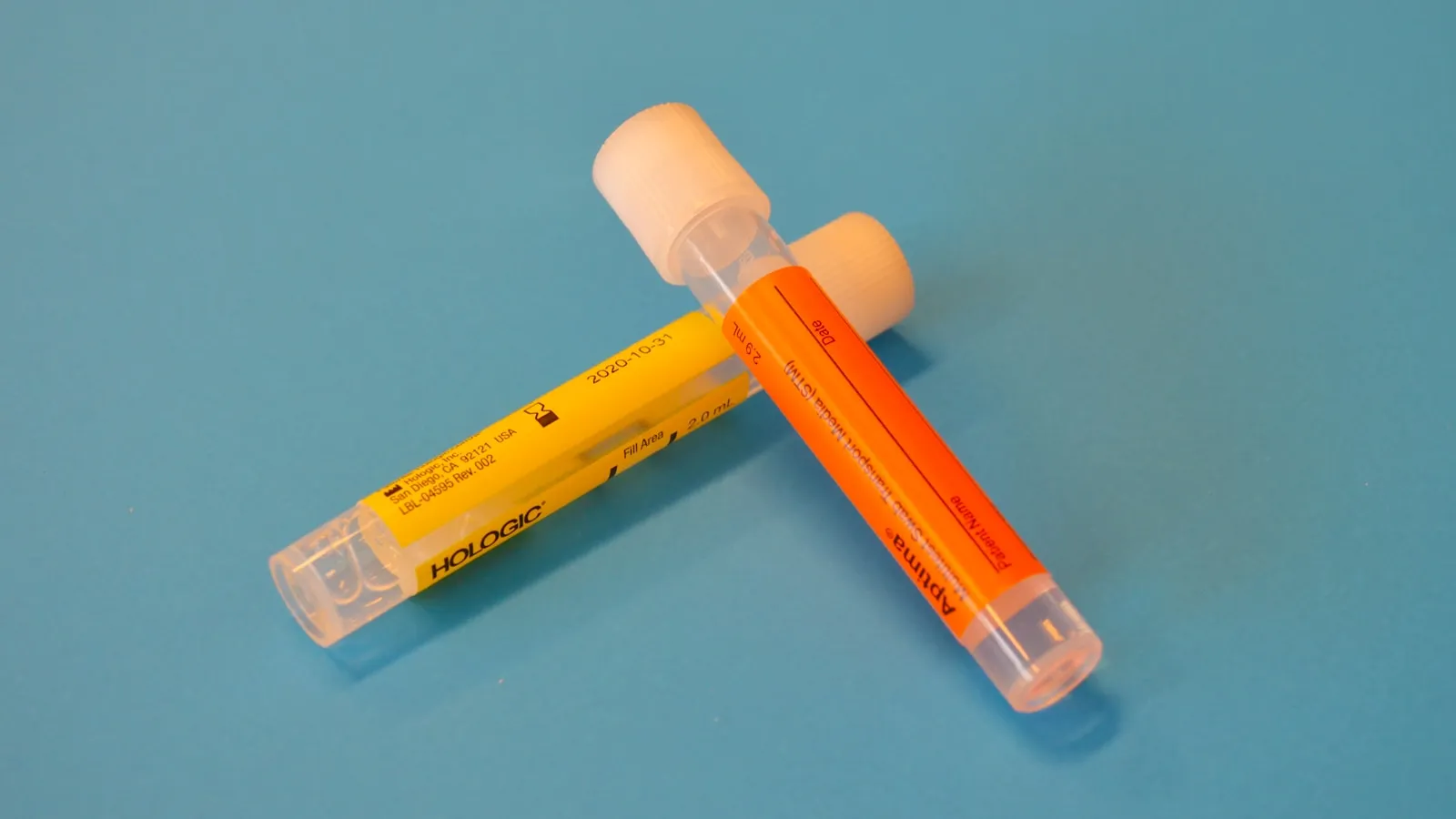
AMH testing is, practically speaking, the simplest hormone test there is: one tube of blood, on any day of your cycle, no fasting required. The value reflects your egg reserve and barely moves with your cycle, which is what makes the logistics so easy.
The substance deserves more attention than the logistics. Whether the result gets you anywhere depends on the question you want it to answer.
So below you'll find both: the practical side of the blood draw and the checklist I'd have you fill in first.
How does an AMH test work?
You order the AMH test online, pick a blood draw location near you and have a single tube of blood taken there. The laboratory measures your AMH level, and a BIG-registered doctor reviews the result before it reaches you. No referral is needed.
The result is usually ready within a few working days, review included.
At Lunara the AMH test costs 89 euros. A fertility work-up through your GP is a different and broader route; our test doesn't replace it, but it can make that conversation more concrete.
When in your cycle can you test AMH?
On any day. AMH comes from the small follicles in your ovaries and therefore barely fluctuates across your cycle. No planning around your period, no fasting.
That's the big practical difference with FSH, the other well-known reserve gauge: FSH has to be drawn on cycle day 2 to 5 to mean anything.
There is one timing rule, and it's often missed: if you use hormonal contraception, your AMH reads artificially low. Researchers found the value consistently suppressed during pill use, recovering only after stopping; an honest measurement asks for two to three months of patience after your last strip (PMID 32362164).
Checklist: ask yourself these questions before testing
An AMH test is most useful when the result can change a decision. Walk through these five questions first; if question 1 has no concrete answer, not testing is a perfectly good outcome too.
| Question | Why it matters |
|---|---|
| 1. Which decision of mine hangs on this result? | Egg freezing, IVF preparation or PCOS context: then you measure with a purpose |
| 2. Am I on the pill or other hormonal contraception? | Then the value reads artificially low (PMID 32362164) |
| 3. Do I know the unit of the result (µg/l or pmol/l)? | The numbers differ by a factor of 7; confusion is one glance away |
| 4. Do I know what's normal for my age? | Without age context the number can't be interpreted |
| 5. Am I expecting an answer to "can I get pregnant now?" | AMH doesn't answer that question (PMID 29049585) |
Question 5 is the most important of the five. A large American study found that women with low AMH conceived spontaneously just as often as women with normal values (PMID 29049585).
What does the result tell you, and what not?
The result places your egg reserve on the age curve: does your reserve match your age, run ahead of it or lag behind. That is valuable for choices around freezing or an IVF programme. What the result doesn't do: predict your chance of a spontaneous pregnancy, or tell you when menopause will arrive.
Take Nora, 29, weighing up egg freezing. Her result of 3.2 micrograms per litre fits her age neatly and gives her the calm to postpone the choice for another two years. That same number would have added little to an acute wish to conceive.
How to read your own number is in our table of AMH levels by age, and you can enter your result straight into the AMH level check.
AMH testing alongside other values
If you want to look wider than reserve alone, a single value quickly becomes too narrow. The fertility assessment combines AMH with FSH, LH and oestradiol among others, so the doctor reviews reserve and regulation together.
More background on what the hormone itself does is in our overview of AMH and your egg reserve, and on the supply behind it in egg cells and age.
My honest closing advice: don't order this test out of unease, order it to answer a concrete question. And whatever your result turns out to be, take it to your GP; that's where interpretation belongs.
Every blood test result includes a professional assessment from a BIG-registered doctor. For treatment decisions, discuss your results with your GP or your gynaecologist.
References
- Steiner AZ, Pritchard D, Stanczyk FZ, et al. Association Between Biomarkers of Ovarian Reserve and Infertility Among Older Women of Reproductive Age. JAMA, 2017. PMID 29049585.
- Landersoe SK, Forman JL, Birch Petersen K, et al. Ovarian reserve markers and endocrine profile during oral contraception. Gynecol Endocrinol, 2020. PMID 32362164.
- Teede HJ, Tay CT, Laven JJE, et al. Recommendations from the 2023 International Evidence-based Guideline for the Assessment and Management of Polycystic Ovary Syndrome. Hum Reprod, 2023. PMID 37580037.
- NHG-standaard Subfertiliteit. Nederlands Huisartsen Genootschap.
- Thuisarts.nl. Wij willen graag zwanger worden.
الكاتب
Lunarahealth
Dr. Naimi، طبيب مسجل في سجل BIG الهولندي، يشرف على المعايير الطبية لمحتوانا وتقييماتنا. اقرأ سياستنا الطبية